China 10-Year Government Bond Yield at 2.47%
Lowest Since 2002
Asset Flight to Long-Term Bonds Amid Investment Sentiment Weakness
Amid China's sluggish economic recovery and stock market sell-off, investors are flocking to Chinese government bonds, which offer relatively stable returns.
According to a Bloomberg report on the 30th (local time), the yield on China's 10-year government bonds (bond interest rate) fell to 2.47%, the lowest level since 2002. This is attributed to increased demand for safe-haven assets amid expectations that the economy will continue to face downward pressure due to weakened consumer and investment sentiment and a real estate slump.
Ho Wei Chen, an economist at United Overseas Bank, explained, "There is pressure for bond yields to decline due to expectations of interest rate cuts," adding, "Market participants who foresee low economic growth in the long term are driving up demand for long-term bonds."
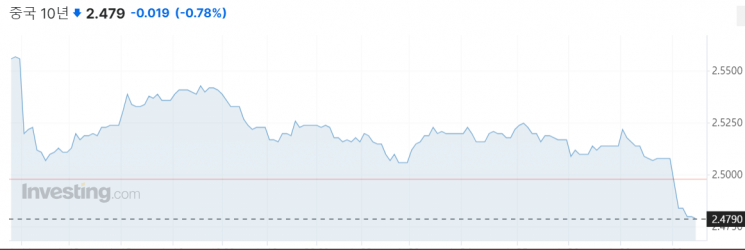
Chinese policymakers are currently being urged to implement aggressive monetary stimulus measures to boost growth. In response, the authorities last week signaled aggressive liquidity supply policies, including lowering the reserve requirement ratio (RRR) for commercial banks. The RRR cut announced at a press conference with Pan Gongsheng, governor of the People's Bank of China (PBOC), was assessed by analysts as exceeding expectations. At the press conference, Governor Pan stated that liquidity amounting to 1 trillion yuan (approximately 187 trillion won) would be supplied starting February 5 this year.
Mingming, chief economist at Citi Securities, said, "Especially after the surprise RRR cut announcement by the PBOC, market expectations for an interest rate cut in February have gained credibility."
Additionally, the Chinese government plans to expand investment options within this month to allow overseas investors to invest in onshore repurchase agreement (repo) bonds. Repo bonds are a popular means for traders to circulate short-term funds using yuan-denominated bonds as collateral, and are expected to contribute to the inflow of foreign capital.
According to data from Chinese research firm Z-Ben Advisors, last month Chinese bond funds raised 13 times more capital than equity funds. The amount of new capital raised by Chinese bond funds in the fourth quarter of last year marked the highest level since mid-2022.
Meanwhile, some view that the PBOC will not provide liquidity support before the Chinese Lunar New Year holiday, Chunje. Traditionally, the PBOC supplies liquidity during the Chunje period to meet increased consumer spending and cash demand during the long holiday, so it is expected that the central bank will not advance monetary policy timing by breaking this practice.
Sung Ki-yong, Asia macro strategist at Soci?t? G?n?rale SA, warned, "Liquidity remains at a healthy level, and there is consensus on further easing policies by the PBOC, such as policy rate cuts," but added, "The scale and speed of the Chinese interest rate cut rally will be very gradual, contrary to market expectations."
© The Asia Business Daily(www.asiae.co.kr). All rights reserved.
![Clutching a Stolen Dior Bag, Saying "I Hate Being Poor but Real"... The Grotesque Con of a "Human Knockoff" [Slate]](https://cwcontent.asiae.co.kr/asiaresize/183/2026021902243444107_1771435474.jpg)
















