Recently, banks have begun suspending and reducing the sales of equity-linked securities (ELS) products, which have recently caused large-scale losses. Following the 2019 overseas interest rate-linked derivative-linked fund (DLF) incident and the Lime Asset Management incident, large-scale loss incidents have reoccurred within just 4 to 5 years, leading to growing calls for a ban on banks selling high-risk financial products such as ELS.
According to the financial sector on the 30th, KB Kookmin Bank decided to completely suspend the sale of ELS products on the same day. A KB Kookmin Bank official stated, "Considering the increasing volatility in the global financial market, we have decided to temporarily suspend the sale of ELS products," adding, "We are continuously monitoring the market and will decide whether to resume sales in the future by comprehensively considering market stability and consumer choice."
Shinhan Bank also held a non-deposit product committee meeting on the same day and decided to suspend all sales of equity-linked trusts (ELT) and equity-linked funds (ELF) products starting February 5. A Shinhan Bank representative said, "We will focus on post-management of customers who suffered losses from the H Index ELT product and support at branch offices," adding, "We will review whether to resume sales after reorganizing consumer protection-related systems and internal controls related to product sales."
In this way, ELS products are rapidly disappearing from bank counters. Hana Bank also decided to temporarily suspend the sale of ELS products the day before, and prior to that, NH Nonghyup Bank had already completely suspended the sale of principal non-guaranteed ELS products in October last year.
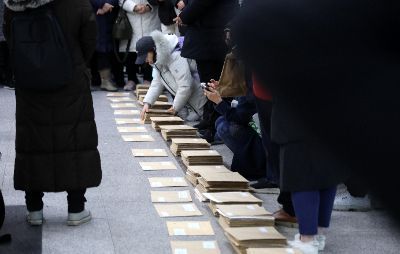 On the 30th, a petition from the Hong Kong Index ELS victims' group to be sent to members of the National Assembly was placed at the National Assembly Communication Office. Photo by Hyunmin Kim kimhyun81@
Woori Bank is currently adjusting by lowering the loss occurrence range (Knock-in Barrier) of ELTs based on the Nikkei index. Woori Bank is still supplying the products, but it is reported that they are also considering suspending sales of related products like other banks depending on the situation. A Woori Bank official said, "We have not yet suspended the sale of ELS products," but added, "It is under review."
In the political and financial authorities as well, there is a mood to consider suspending the sale of high-risk financial products such as ELS by banks. At the end of 2019, after the overseas interest rate-linked derivative-linked fund (DLF) incident, financial authorities banned banks from selling high-risk financial products. High-risk financial products refer to those with derivatives embedded and are difficult for investors to understand, with a maximum possible principal loss ratio exceeding 20%.
However, banks later requested to resume sales on the premise of customer protection, and authorities allowed limited sales of ELTs containing public ELS, leading to the current situation. The sales limits assigned to each bank at that time were ▲KB Kookmin Bank 12.9 trillion KRW ▲Hana Bank 6.2 trillion KRW ▲Shinhan Bank 5.9 trillion KRW ▲Woori Bank 4.2 trillion KRW ▲NH Nonghyup Bank 3.2 trillion KRW ▲SC First Bank 1.7 trillion KRW. This effectively reopened the path for selling high-risk financial products.
At a previous plenary session of the National Assembly's Political Affairs Committee, related criticisms continued. Lee Yong-woo, a member of the Political Affairs Committee from the Democratic Party of Korea, said, "During the 2020 audit, I mentioned that option selling has unlimited risk, so banks should be restricted from selling it to individuals," adding, "This time, banks should suspend (ELS) sales, and at least a legal provision is needed to allow customers to claim damages in cases of incomplete sales."
Gil Seong-ju, chairman of the Hong Kong H Index-linked ELS Victims Association, also held a press conference at the National Assembly Communication Hall in Yeouido, Seoul, on the same day, stating, "Article 1 of the Banking Act stipulates that 'banks must protect depositors and maintain credit order,'" and criticized, "ELS are ultra-high-risk investment products and derivatives, and the act of banks selling such dangerous derivatives, which are only purchased by risk-seeking investors, violates the Banking Act."
The authorities are also showing deep concern. Kim Ju-hyun, chairman of the Financial Services Commission, attending the plenary session of the National Assembly's Political Affairs Committee, said regarding the ban on ELS sales, "Not only ELS but all financial investment products carry risks," and added, "We will comprehensively review and consider the issue." Lee Bok-hyun, governor of the Financial Supervisory Service, also said, "Even for the same high-risk products, we will consider which channels are more appropriate for actual consumer protection depending on the structure."
© The Asia Business Daily(www.asiae.co.kr). All rights reserved.

















