2 Million Developers Worldwide
Collaborate with AI Model Sharing Platform
Partners Include Open Camp
Challenging 'Closed' OpenAI and MS
Strategic Move to Lead Generative AI Ecosystem
Google has partnered with Hugging Face, a leading figure in the open artificial intelligence (AI) camp. Until now, Google had not disclosed its AI models, but it has now joined hands with Hugging Face, which belongs to the opposing camp. This move is interpreted as Google countering Microsoft’s (MS) AI ‘closed ecosystem’?created by embracing OpenAI?with an ‘open ecosystem.’
According to the IT industry on the 31st, Google Cloud recently signed a partnership with Hugging Face. Hugging Face is a platform where more than 2 million developers worldwide share AI models. Through this collaboration, developers can utilize AI-optimized infrastructure such as Google Cloud’s computing service Tensor Processing Unit (TPU) 5th generation model ‘TPU v5e’ and Graphics Processing Units (GPUs). It supports training and providing Hugging Face models on Google Cloud. Thomas Kurian, CEO of Google Cloud, said, "With this partnership, developers will be able to accelerate building next-generation AI services and applications on Hugging Face."
The pairing of large language model (LLM) developers and cloud providers is not new. The same strategy was used by OpenAI and Microsoft (MS), who sparked the generative AI boom. MS provides the computing resources needed for OpenAI to develop AI models via the cloud and obtained exclusive rights to use GPT-4, which underpins ChatGPT. Subsequently, ChatGPT was integrated one by one into MS services such as the search engine Bing, cloud service Azure, PowerPoint, and Excel.
Experts agree that the combination of LLMs and cloud is essential. Since LLMs learn from data to become smarter and handle many user requests based on that, cloud-based computing resources are necessary. Another advantage is that AI services can naturally be brought into cloud products.
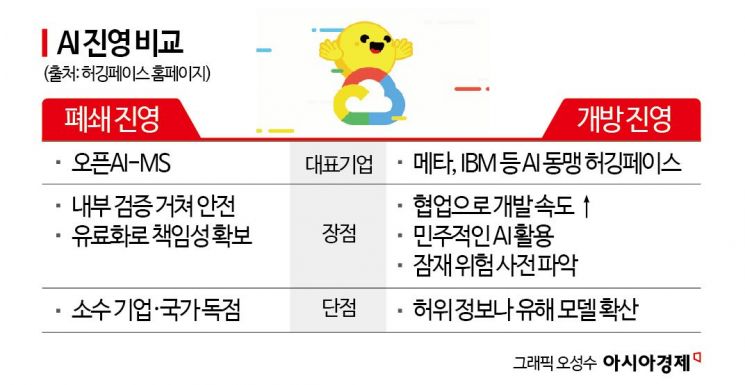
What makes this collaboration special is that Google has embraced the open AI camp as a partner. This is a different strategy from the closed camp of OpenAI-MS. The closed camp pursues profits by keeping development code proprietary and exclusive. They argue that closed models, which follow internal standards and undergo verification, are safer. On the other hand, the open camp publicly shares development code for free, allowing anyone to develop models in their preferred way. They believe this helps identify potential risks in advance and accelerates technological development.
Until now, Google belonged to the closed camp that did not disclose its latest AI models. Although it released some application programming interfaces (APIs) such as its own LLM ‘PaLM 2,’ their use was limited. When Google launched the LLM ‘Gemini’ last month but failed to make a significant impact, it began courting the open camp. This was part of a reorganization to reverse the mood in a market led by OpenAI-MS.
Google is not the only one challenging the closed camp. Last month, 50 AI companies and research institutions, including Meta, IBM, and Intel, launched an AI alliance aiming for open AI models. Apple also released the multimodal LLM ‘Perrot,’ which can understand images and text together, as open source last month. Even Apple, which usually keeps development information strictly confidential, has sided with the open camp.
The competition between the closed and open camps is expected to intensify. It is a race of speed between the rapidly advancing OpenAI and the open alliance trying to catch up. There is also a strategic move to dominate the generative AI ecosystem, which has just opened its doors. OpenAI is already drawing numerous developers into its ecosystem through the ‘GPT Store.’ The open camp also aims to increase the utilization of its models to attract more developers and partners.
An industry insider said, "Just as big tech companies that dominated the smartphone ecosystem early on monopolized the market, the fight in the AI market is about who controls the ecosystem," adding, "If a major model like ChatGPT cannot be developed, companies will either go open or pursue strategies of alliances and mergers."
© The Asia Business Daily(www.asiae.co.kr). All rights reserved.
![Clutching a Stolen Dior Bag, Saying "I Hate Being Poor but Real"... The Grotesque Con of a "Human Knockoff" [Slate]](https://cwcontent.asiae.co.kr/asiaresize/183/2026021902243444107_1771435474.jpg)
















