SK Telecom Researches 6G Candidate Frequency Bands
Industry-Academic Cooperation with Kyungpook National University, Seoul National University, and Yonsei University
Simulator Developed and Exhibited at MWC
SK Telecom has begun experiments on candidate frequency bands to stably provide 6G mobile communication services. It has also developed technology to identify the optimal 6G network structure and plans to showcase its research results at the global IT exhibition MWC 2024. Through this research, SKT expressed its ambition to contribute to the global standardization of 6G and lead the establishment of the technology ecosystem.
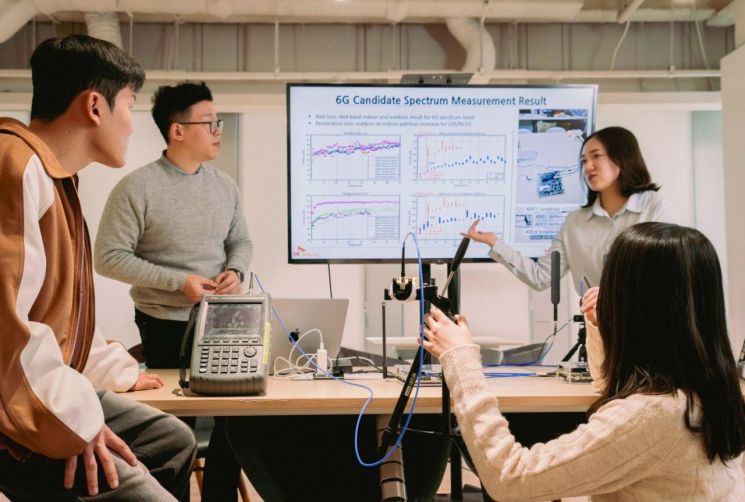 SK Telecom and researchers from Kyungpook National University are conducting field measurements of the radio wave characteristics of candidate frequency bands for 6G / Photo by SK Telecom
On the 30th, SKT announced that it conducted actual measurements and simulations on candidate 6G frequency bands in collaboration with academia to design the optimal network structure considering the characteristics of 6G frequencies.
SKT is striving to understand the stable service requirements of 6G mobile communications. Recently, through industry-academia joint research, it secured situational measurement data on the impact of building structures and human locations on communication within candidate 6G frequency bands. Additionally, it developed a graphical user interface (GUI)-based simulator that intuitively and efficiently designs 6G network structures.
The candidate 6G frequency bands used for measurements and simulations include parts of the 4 GHz band, the 7?15 GHz band, and some high-frequency bands. At the World Radiocommunication Conference (WRC-23) held last November, among the four bands proposed by the Korean government as candidate 6G frequency bands by regional organizations and countries, three bands?▲4.4?4.8 GHz ▲7.125?8.5 GHz ▲14.8?15.35 GHz?were finally adopted.
The 4?10 GHz band was proposed as a candidate frequency band in SKT’s 6G white paper, published in August last year as the first domestic operator. This band is advantageous for coverage construction and base station capacity compared to high-frequency bands, making it a band that can provide services from the early stages of 6G commercialization.
Experiments on Penetration Loss of Glass, Concrete, and Wood... Frequency Propagation Performance Increases, Loss Also Increases
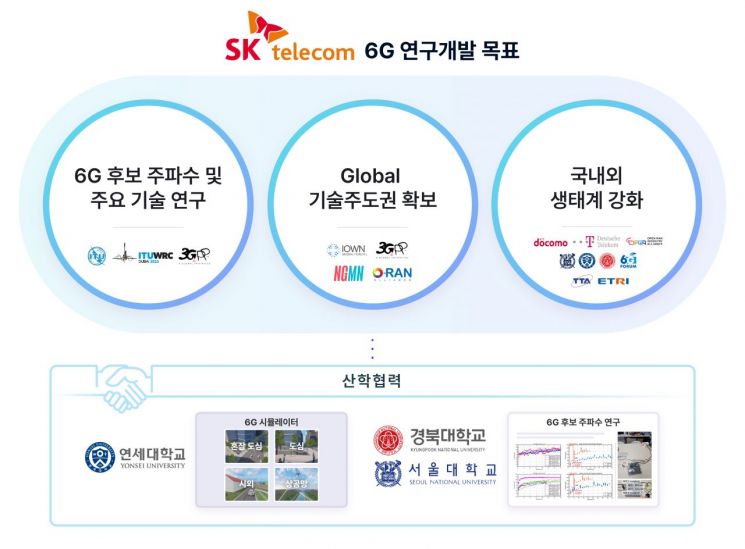
SKT, in collaboration with Kyungpook National University, comprehensively measured propagation characteristics such as path loss, building material penetration properties, and human body blocking loss in candidate 6G frequency bands. Through this, it confirmed that, compared to theoretical calculations defined in existing 5G, the propagation performance of candidate 6G frequency bands in non-line-of-sight (NLOS) environments decreases as the frequency band increases.
In experiments measuring propagation penetration loss through building materials such as glass, concrete, and wood, penetration loss increased as frequency increased. In particular, in the high-frequency band, penetration loss increased by 2.7 to 21.6 times (4.4 to 13.3 dB) when passing through 3 mm thick glass, and by 1,000 to 100,000 times (30 to 50 dB) when passing through a 22 cm thick concrete wall, confirming a decrease in outdoor-to-indoor (O2I) coverage. Signal quality was also verified according to usage environments, such as confirming signal degradation when the propagation path is blocked by the human body.
SKT co-authored a paper combining the existing 6G white paper and the results of this research with Seoul National University and Kyungpook National University, submitting it to the SCI-level academic journal 'IEEE Communications Magazine.' It also plans to contribute to global standardization organizations such as the ITU Radiocommunication Sector (ITU-R) and the 3rd Generation Partnership Project (3GPP).
Development of 6G Simulator... Research Results to be Exhibited at MWC 2024
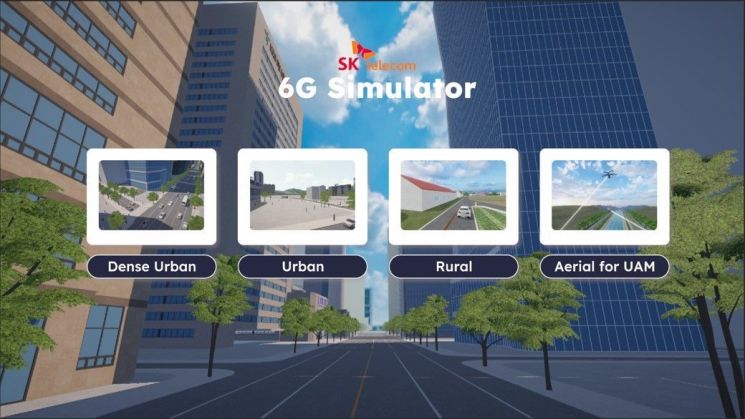
In cooperation with Yonsei University, SKT developed a 6G simulator for performance analysis by service scenario and optimal 6G network design. This simulator predicts the performance of mobile communication systems considering base stations, surrounding cells, and multiple users in wireless communication environments. It can also simulate tests related to mobile communication network performance such as data upload, download, and coverage.
SKT and Yonsei University identified the optimal network structure based on the use of candidate 6G frequency bands in real-life environments such as congested urban areas, urban centers, and suburban areas. Specifically, they predicted the performance of 6G networks applied with urban air mobility (UAM), satellite communications and aerial networks expected to be actively used in the 6G era, reconfigurable intelligent surfaces (RIS), and AI-based base station performance enhancement technologies.
The research results of the 6G simulator will be exhibited at the global IT exhibition MWC 2024 held next month in Barcelona, Spain. SKT plans to contribute these results to the IMT-2030 technical performance requirements to be conducted by ITU-R starting this year.
SKT is making efforts to lead global 6G standardization and the establishment of the technology ecosystem. It delivered keynote speeches at the '6G Brooklyn Summit' and 'Telecom World Asia' held last November. At the 3GPP technical plenary meeting in December last year, it led the global 6G standardization process by contributing on the 6G timeline and direction. Through this meeting, SKT plans to conduct research on wireless channel modeling for newly approved frequency bands, sensing-integrated communication (ISAC) standardization, and related studies.
Ryu Tak-gi, head of SKT’s Infrastructure Technology Division, said, "Through this research, we confirmed the importance of early review of candidate 6G frequency bands and optimal network design." He added, "We plan to contribute to Korea leading the global 6G technology ecosystem through active industry-academia joint research and advanced technology development."
© The Asia Business Daily(www.asiae.co.kr). All rights reserved.
![Clutching a Stolen Dior Bag, Saying "I Hate Being Poor but Real"... The Grotesque Con of a "Human Knockoff" [Slate]](https://cwcontent.asiae.co.kr/asiaresize/183/2026021902243444107_1771435474.jpg)


















