Development of Quantum Simulator Correction Technology
KAIST (President Kwang Hyung Lee) announced on the 29th that the research team led by Professor Jaeyoon Choi from the Department of Physics, in collaboration with Professor Gilyoung Cho's research team at Pohang University of Science and Technology (POSTECH), has developed an error correction technology for neutral atom quantum simulators, enabling the identification of characteristics of topological materials and high-temperature superconductors.
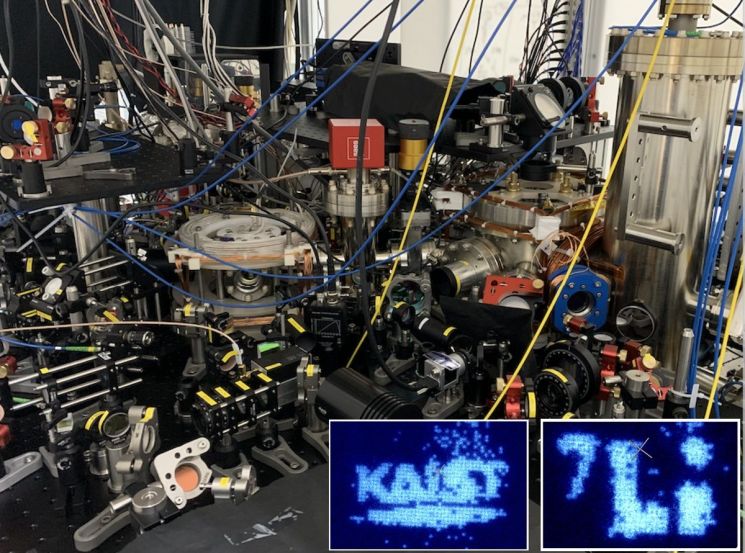 The 2024 Seoul International Book Fair will be held at COEX from June 14 to 18, featuring various events including author talks and book signings. (Photo by Kim Min-ji)
Neutral atom optical lattice quantum simulators are a type of quantum computer. The main research goal of optical lattice quantum simulators is to understand the physical laws governing complex quantum many-body problems, such as high-temperature superconducting materials. Even after several decades, the physical mechanism by which superconductivity forms in high-temperature superconductors remains unclear. High-temperature superconductors refer to materials that exhibit superconductivity with zero electrical resistance at temperatures above absolute zero (0 K, -273°C).
Optical lattice quantum simulators have recently emerged as strong candidates for solving high-temperature superconductivity problems in the future, such as observing antiferromagnetism in high-temperature superconductors. However, systematically identifying and correcting defects occurring during the observation process and quantum state preparation is extremely challenging.
 KAIST AI Graduate School Opens Applications for 2024 Academic Year
Professor Choi's research team developed a method to measure nonlocal order parameters in quantum simulators and simultaneously detect experimental defects. The team demonstrated that it is possible to characterize the properties of topological materials exhibiting quantum entanglement even in two dimensions. After successfully eliminating defects arising during the simulation process, the two-dimensional nonlocal order parameter of the topological material showed a sharp increase (more than 100 times), and the measured values remained consistent regardless of the number of atoms, confirming all theoretically predicted trends.
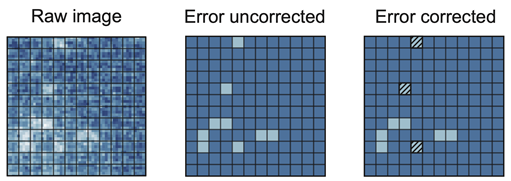 The bright blue areas correspond to places where atoms are missing. It is possible to effectively eliminate free holes through an error correction algorithm.
Professor Jaeyoon Choi stated, “This research is the first to demonstrate that experimental defects in neutral atom quantum simulators can be corrected, and it will play a key role in discovering and characterizing higher-dimensional topological materials such as quantum spin liquids used in topological quantum computation.”
Researcher Junhyuk Heo from KAIST and student Wonjun Lee from POSTECH participated as co-first authors. This study was published on January 8th in volume 14, issue 1 of the international journal Physical Review X (paper title: Measuring nonlocal brane order with error-corrected quantum gas microscopes).
This research was supported by the Samsung Future Technology Foundation and the National Research Foundation of Korea.
© The Asia Business Daily(www.asiae.co.kr). All rights reserved.


















