Authorities Struggle as They Announce Stock Market Stabilization Measures
Market Says "Still Insufficient"
China's public mutual funds recorded losses approaching 81 trillion won last year. This was due to the sluggish stock market, and authorities have recently been making continuous efforts to boost the stock market by introducing stimulus measures.
On the 28th, China’s First Financial Daily cited data from Tianxing Investment Consulting, reporting that the investment losses of China's public mutual funds last year amounted to 434.6 billion yuan (approximately 80.892 trillion won). However, the scale showed a somewhat declining trend. Losses in the fourth quarter were 228.7 billion yuan, down 34.0% compared to the third quarter (346.7 billion yuan).
Based on fourth-quarter performance, investment losses were led by equity funds. Losses from equity funds and mixed funds exceeded 330 billion yuan, recording 145.228 billion yuan and 187.281 billion yuan respectively. Bond funds showed improvement, generating profits of 50.864 billion yuan compared to 35.694 billion yuan in the previous quarter.
Last year, a total of 1,177 new funds were established, a 14.83% decrease compared to the previous year. The First Financial Daily reported that bond funds gained popularity in the investment market, accounting for 71.26% of newly established funds last year, marking the highest level in 10 years. The proportions of equity funds and mixed funds were each around 12%.
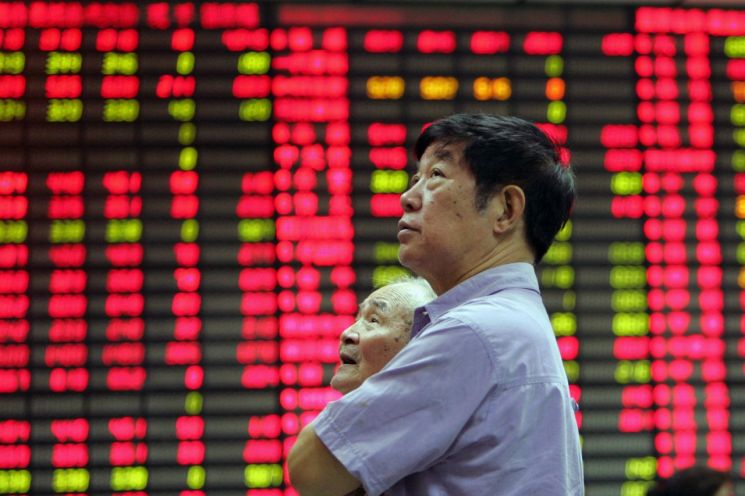
The Chinese stock market fell by 13% last year alone. The Shanghai Composite Index has dropped more than 20% since reaching a peak of 3,731 in February 2021. Authorities are attempting to boost the stock market by implementing market stabilization measures. The China Securities Regulatory Commission announced that from the 29th, the lending of restricted stocks will be completely banned for a certain period. Starting March 18, the efficiency of some stock lending in the stock refinancing market will also be limited. Stock lending services involve investors who hold stocks lending them out and receiving lending fees; the lent stocks are used for short selling or institutional supply.
Earlier, on the 24th, the People's Bank of China announced that from the 5th of next month, it will lower the deposit reserve ratio by 0.5 percentage points, providing about 1 trillion yuan of long-term liquidity to the market.
Major foreign media explained, "Restricted stocks are often provided to company employees or investors with certain trading limits, but they can be lent to others for trading purposes such as short selling, which can increase pressure on the market if the stock market is in a long-term slump."
An analyst from a securities firm told the First Financial Daily, "This move by the authorities clearly sends a signal to stabilize market confidence, but it is insufficient on its own to reverse market outlooks." He added, "Stronger and more substantial measures are expected to follow."
© The Asia Business Daily(www.asiae.co.kr). All rights reserved.
![User Who Sold Erroneously Deposited Bitcoins to Repay Debt and Fund Entertainment... What Did the Supreme Court Decide in 2021? [Legal Issue Check]](https://cwcontent.asiae.co.kr/asiaresize/183/2026020910431234020_1770601391.png)















