YouTube Polarized into Progressive and Conservative
People Exposed Only to Biased Information
Leading to Extreme Crimes
Recently, as social networking services (SNS) have begun to replace traditional media, the issue of polarized political YouTube channels has become prominent. Users unknowingly fall into ‘filter bubbles’ that show only biased information aligned with their own tendencies, accepting content without criticism. As SNS becomes a tool that injects and amplifies distorted perceptions, cases have even arisen where this leads to crime.
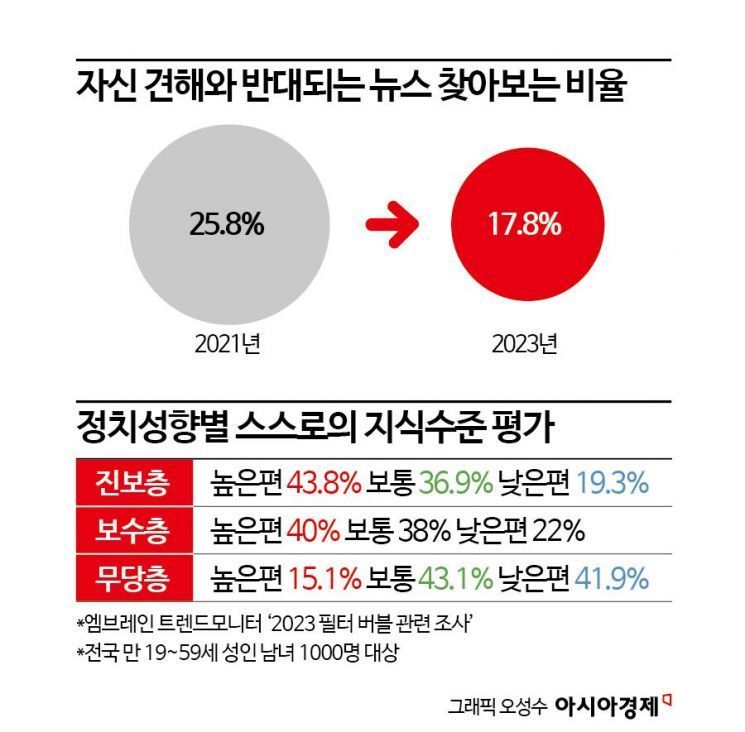
According to the results of the ‘2023 Filter Bubble Survey’ conducted by Embrain Trend Monitor on June 30, targeting 1,000 adults aged 19 to 59 nationwide, the rejection of political views and information opposing one’s own is increasing.
Among all respondents, those who said they seek out opposing information or news for balance decreased from 25.8% in 2021 to 17.8% in 2023. Only 13.1% said they deliberately watch YouTube broadcasts with different political tendencies. In contrast, supporters of both progressive and conservative camps believed their political knowledge level was high (progressive 43.8%, conservative 40%), about three times higher than the non-affiliated group (15.1%).
The tendency to avoid debates when meeting people with opposing political views both online and offline has intensified. Those who said they express their opinions even slightly dropped from 25.8% in 2021 to 20.2% online, and from 27.2% to 21.7% offline in 2023. Those who said they completely avoid conversation increased from 11.4% to 14.7% online, and from 9.7% to 13.8% offline. Overall, society has become structured in a way that makes it difficult to escape filter bubbles once trapped.
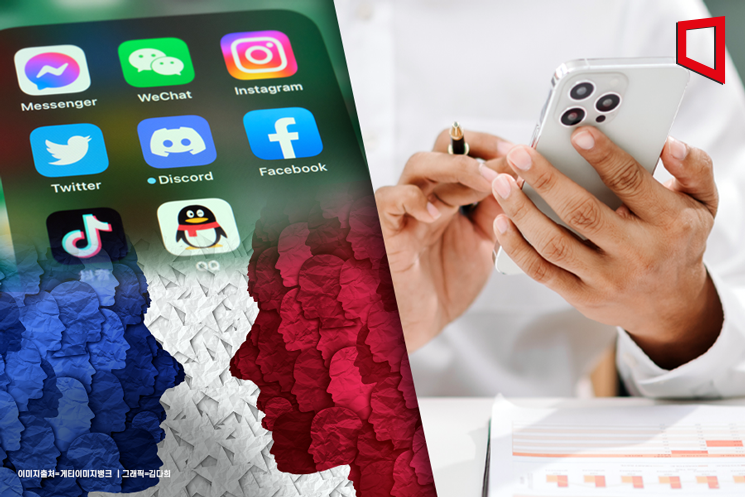
The term ‘filter bubble’ was first introduced by Eli Pariser, director of the American civic organization MoveOn. SNS platforms such as Google and Facebook collect and analyze data like users’ search histories and usage patterns to expose interests in a customized way.
For example, progressive-leaning individuals are mainly shown progressive content, while conservative-leaning individuals are mainly shown conservative content. This means people only see news and information they want to see, reinforcing stereotypes and prejudices in political and social issues. Naturally, communication with people of different tendencies is excluded, threatening the diversity that is central to democracy.
In reality, even when using the same YouTube platform, the consumed content varies greatly. Office worker Kim (33) has a progressive political tendency and has never seen conservative-related videos in recommended videos. Kim said, “There is not a single person around me who supports the government or the People Power Party.” The opposite is also true. Han (33) said, “I don’t even want to watch progressive YouTube channels,” adding, “None of my friends support the Democratic Party. I can’t trust opinion polls.”
The deepening of filter bubbles has also led to political terrorism crimes. On the 2nd, Lee Jae-myung, leader of the Democratic Party of Korea, was attacked in the neck with a weapon by a man in his 60s named Kim during a site visit to Gadeokdo, Busan. According to the police, Kim was confirmed to frequently watch conservative-leaning YouTube channel videos.
Professor Seol Dong-hoon of the Sociology Department at Jeonbuk National University said, “YouTube political channels are the root cause. They can significantly impair the judgment of teenagers and the elderly, and in severe cases, instill a misguided sense of mission that someone must be eliminated,” adding, “Ultimately, they create extreme content to make money, and it is time for social regulation.”
© The Asia Business Daily(www.asiae.co.kr). All rights reserved.



















