January FOMC Rate Hold Confirmed
Focus on Powell's Remarks on Timing and Pace of Tapering
Mixed Inflation and Growth Indicators... Employment Market as a Variable
"Real Interest Rates Rise Due to Inflation Slowdown" Claims Also Made
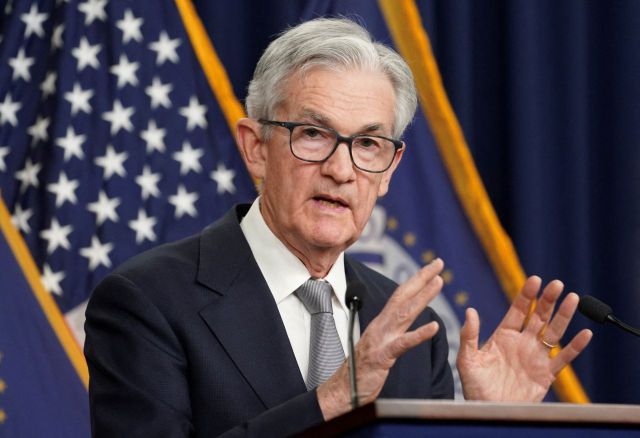
Investors are closely watching what hints Jerome Powell, Chair of the U.S. Federal Reserve (Fed), might give regarding the future interest rate path at the first Federal Open Market Committee (FOMC) meeting of the year, scheduled for the end of this month. With economic indicators such as inflation and growth rates sending mixed signals and the March interest rate outlook sharply contested, it is expected that Powell's message will help gauge the timing and speed of a potential pivot. Some analysts cautiously suggest that with inflation slowing and real interest rates rising, conditions may be ripe for the Fed to consider cutting rates.
According to the Chicago Mercantile Exchange (CME) FedWatch on the 28th (local time), the federal funds futures market sees over a 96% chance that the Fed will keep the benchmark interest rate steady at the current 5.25?5.5% level at the first FOMC meeting of the new year, held on the 30th?31st.
The key issue at this FOMC is not whether rates will be held steady, but what message Jerome Powell will deliver regarding the timing and pace of future rate cuts. Depending on Powell's remarks, the market will be able to assess the interest rate path for March, which is being watched as the likely time for the first cut. Bloomberg News analyzed, "Every signal Powell decides to send or withhold is very important," adding, "It depends on how Powell and his colleagues interpret the recent stream of economic data."
The market expects the Fed to take a symbolic step by removing the phrase in the FOMC statement that suggests rate hikes may still be necessary, rather than signaling rate cuts. This expectation has grown following last month's slowdown in the core Personal Consumption Expenditures (PCE) price index. The core PCE, a key inflation gauge closely monitored by the Fed, rose 2.9% year-over-year last month, falling into the 2% range for the first time in two years and nine months since March 2021. The inflation rate in the second half of last year was 1.9% on an annualized basis, down significantly from 4% in the first half and below the Fed's 2% inflation target. This indicates that accumulated tightening measures are rapidly bringing inflation under control.
Amid this, some analyses suggest that falling inflation has pushed real interest rates higher, creating pressure on the Fed to cut rates. The argument is that inflation is not keeping pace with the current high interest rate levels, which could excessively restrict economic activity. The Wall Street Journal (WSJ) reported, "The sharp drop in inflation is becoming a new risk for the Fed," noting, "The Fed is grappling with how real interest rates could unnecessarily constrain the economy if they do not take action as inflation slows." William English, a former senior economist at the Fed and professor at Yale School of Management, said, "If inflation figures truly become reassuring and the real economy shows some slowdown, the Fed could feel more comfortable cutting rates in March."
However, stronger-than-expected growth in the fourth quarter of last year could reignite inflationary pressures, leading the Fed to maintain a cautious stance. The U.S. Gross Domestic Product (GDP) growth rate for Q4 was 3.3%, significantly exceeding market expectations of 2%. U.S. retail sales also rose 0.6% last month compared to the previous month, beating the forecast of 0.4%. The Fed is particularly wary of a scenario where it cuts rates prematurely only to have to raise them again later. Dean Maki, Chief Economist at hedge fund Point72 Asset Management, predicted, "Given that growth and employment are expected to exceed expectations this year, the Fed will likely wait to cut rates until June."
With economic indicators sending mixed signals, the outlook for the interest rate path at the March FOMC remains tightly contested. Currently, the federal funds futures market reflects a 52% probability that the Fed will hold rates steady in March and a 46% probability of a 0.25 percentage point rate cut.
Gregory Daco, Chief Economist at global accounting and consulting firm Ernst & Young (EY), said, "We are definitely entering the territory of rate cut discussions, and this will be a topic of discussion at this month's Fed meeting."
Separately from the FOMC, employment data to be released this week is also seen as a key variable influencing future rate movements. In a situation where inflation and growth indicators diverge, reliance on employment data, which affects inflationary pressures, is expected to increase. On the 30th, the December 2023 Job Openings and Labor Turnover Survey (JOLTS) will be released, and on February 2nd, after the FOMC meeting, January nonfarm payrolls and unemployment rate data are scheduled. Market research firm FactSet forecasts January job additions at 170,000, significantly lower than December's 216,000. The unemployment rate is expected to rise from 3.7% in December 2023 to 3.8% in January 2024.
© The Asia Business Daily(www.asiae.co.kr). All rights reserved.

















