Professor Jang Sung-yeon's Team Improves Quantum Dot Ligand Exchange Method
Maintains Efficiency for Long-Term Storage, Opens Possibility for Commercialization
The world's highest-efficiency quantum dot (QD) solar cell, certified internationally, has been developed. The quantum dot solution and device used in the development maintained high performance even after long-term storage, marking a significant step toward the commercialization of next-generation solar cells.
UNIST (President Yong-Hoon Lee) announced on the 28th that Professor Sung-Yeon Jang's team from the Department of Energy and Chemical Engineering synthesized stable organic cation-based perovskite quantum dots and developed a new ligand exchange technology that suppresses internal defects in the photoactive thin film for solar cells.
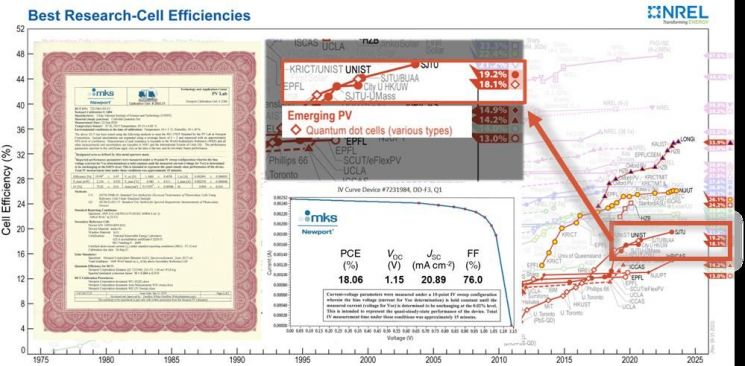
Professor Sung-Yeon Jang explained, “Based on the developed technology, we achieved an efficiency of 18.1% for quantum dot solar cells, which is the highest efficiency worldwide certified by the U.S. National Renewable Energy Laboratory (NREL) to date.”
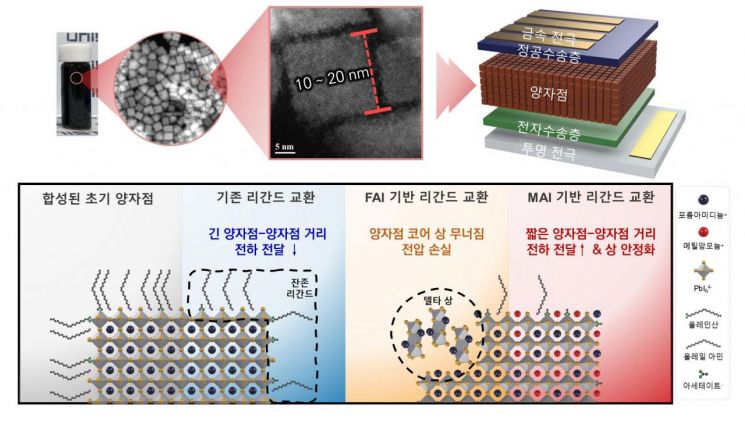 Schematic diagram of organic perovskite quantum dot materials and the structure of solar cells using them, as well as the ligand exchange method.
Last year, three scientists who discovered and advanced quantum dots, a core material in nanotechnology, were awarded the Nobel Prize in Chemistry, increasing interest in this field.
Quantum dots are semiconductor crystals at the nanometer scale whose photoelectric properties can be tuned according to particle size. In particular, perovskite quantum dots possess excellent photoelectric characteristics. Solar cells can be manufactured by spraying or coating the solution without the need for growth on a substrate. This allows for relatively simple manufacturing methods that produce consistent quality regardless of the manufacturing environment.
However, to utilize quantum dots in solar cells, a technology is required to exchange the ligands on the quantum dot surface to reduce the distance between quantum dots.
Organic perovskite quantum dots suffer from severe defects in the crystal and surface during the ligand exchange process. Therefore, until now, only inorganic perovskite quantum dots, which are limited to efficiencies up to 16%, could be used as materials for solar cells.
The research team developed a new ligand exchange method using alkylammonium-based molecules for effective ligand exchange of organic perovskite quantum dots, which have excellent solar light utilization. This resulted in a quantum dot photoactive layer for solar cells with high exchange efficiency and controlled defects.
As a result, the efficiency of organic perovskite quantum dot solar cells, which previously showed a maximum efficiency of 13% with existing ligand exchange technologies, was improved to 18.1%. The performance was maintained even after more than two years of long-term storage, demonstrating high applicability. This confirmed that the newly developed organic perovskite quantum dot solar cells possess both high efficiency and stability.
First author Researcher Sang-Hak Lee said, “Until now, most quantum dot solar cell research has been conducted using inorganic perovskite quantum dots. In this study, we solved the problems of organic perovskite quantum dots, which had been difficult to utilize, and confirmed their potential.”
Professor Sung-Yeon Jang stated, “This research presents a new direction for ligand exchange methods of organic perovskite quantum dots and will be a turning point that changes the flow of research on quantum dot solar cell materials.”
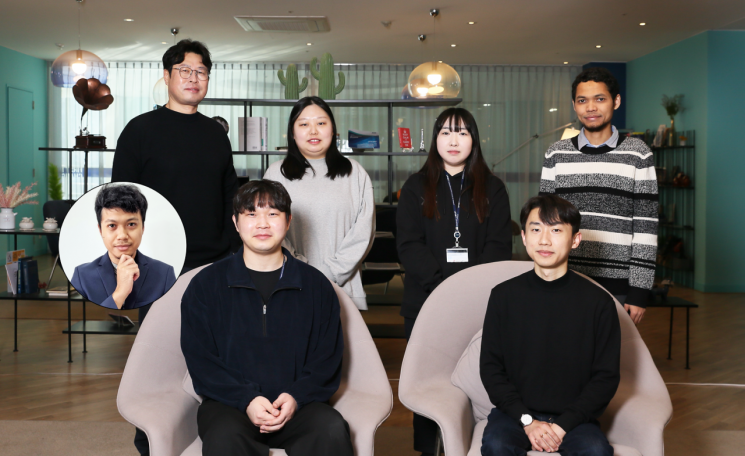 Professor Jang Sung-yeon (far left in the back row) and the research team, including first author researcher Havid Aqoma (front row, leftmost in the circle) and first author researcher Lee Sang-hak.
This study involved Dr. Havid Aqoma Khoiruddin and integrated master's and doctoral course researcher Sang-Hak Lee as co-first authors. The research results were published online in Nature Energy on January 27.
The research was supported by the Ministry of Science and ICT and the National Research Foundation of Korea through the ‘Basic Research Project for Mid-Career Researchers,’ ‘Nano and Materials Technology Development Project - Future Technology Research Lab,’ and ‘Global Basic Research Lab Support Project.’
© The Asia Business Daily(www.asiae.co.kr). All rights reserved.



















