47 Charges Including Trial Interference... Court: "No Abuse of Authority... Not an Obstruction of Rights Exercise"
Former Chief Justice Yang Seung-tae, who was implicated in the judicial scandal, was acquitted in the first trial after 4 years and 11 months since his indictment. Former Supreme Court Justices Ko Young-han and Park Byung-dae, who were tried together, were also acquitted.
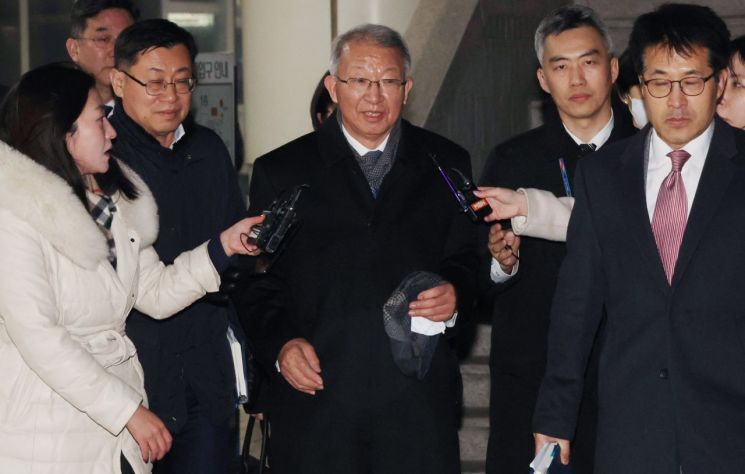 Former Chief Justice Yang Seung-tae, who was acquitted in the first trial of the so-called 'judicial farming' case, is leaving the Seoul Central District Court in Seocho-gu, Seoul, on the afternoon of the 26th. [Image source=Yonhap News]
The Criminal Division 35-1 of the Seoul Central District Court (Presiding Judges Lee Jong-min, Lim Jeong-taek, Min So-young) ruled on the 26th after a sentencing hearing lasting over four hours that although some charges could be recognized as abuse of authority, the prosecution's evidence alone was insufficient to prove collusion in the crime by former Chief Justice Yang. Among the 14 former and current judges indicted on charges related to the judicial scandal, only two?former Planning and Coordination Officer Lee Min-geol and former Supreme Court Sentencing Committee Standing Member Lee Gyu-jin?have been convicted so far.
The major allegations against former Chief Justice Yang include ▲promoting interests against the executive branch ▲promoting interests against the legislative branch ▲attempting to strengthen the status against the Constitutional Court ▲suppressing internal and external critics ▲unjust organizational protection.
First, the court ruled that former Chief Justice Yang’s intervention in cases such as the Japanese forced labor rehearing case, the National Intelligence Service’s election interference case, and the lawsuit confirming the status of former Unified Progressive Party lawmakers, in order to gain help from the Park Geun-hye Blue House for introducing the appellate court, fell under ‘general official duties’ when promoting interests against the executive branch.
Specifically, regarding the Japanese forced labor rehearing case, the court found that while he exercised authority by preparing confidential reports related to the judgment, he did not abuse that authority. Regarding the prosecution’s claim that he conveyed a dismissal opinion to former Justice Kim Yong-duk, the presiding judge at the time, thereby reversing the ruling and delaying the trial process, the court judged that he did not abuse his authority but rather exercised his rights without obstructing rights or ordering unnecessary acts.
Regarding the disclosure of official secrets such as plans to refer the rehearing case to the full bench to the defendant’s lawyer in the forced labor rehearing case, the court stated, “The plan to refer the case to the full bench or the presiding judge’s conviction about the trial’s conclusion does not constitute official secrets,” and ruled that “the statement ‘If only the Ministry of Foreign Affairs’ opinion is submitted, the Blue House and the Ministry of Foreign Affairs will actively reflect the government’s opinion and refer the forced labor rehearing case to the full bench for review’ does not constitute a secret obtained in the course of official duties.”
Regarding the order to prepare a review report on the suspension of enforcement related to the notification of the Teachers’ Union’s illegal union status, the court found it to be within general official duties. Regarding the National Intelligence Service’s election interference case, it ruled that authority was exercised but not abused or used to order unnecessary acts.
Regarding the case of former Judge Seo Ki-ho’s non-renewal of appointment, the court concluded that directing the transmission of a ‘quick closure opinion’ was within general official duties and did not constitute abuse of authority.
Regarding the allegation of leaking internal secrets of the Constitutional Court and using them to compete for status with the Constitutional Court, the court found that former Chief Justice Yang exercised general official duties and did not abuse authority in relation to the Unified Progressive Party’s administrative lawsuit response, intervention in the first trial of the National Assembly member administrative lawsuit, and intervention in the first trial of the proportional representation local council member administrative lawsuit. For some charges, the court found that there was no evidence that he even gave instructions.
Regarding the allegation of creating a ‘judiciary blacklist’ and giving personnel disadvantages to judges critical of judicial administration, the court ruled that this was done within the scope of general official duties. Regarding the allegation of collecting investigation secrets and intervening in warrant trials to prevent the expansion of the ‘Jung Un-ho Gate’ investigation, the court acknowledged some exercise of authority but ruled it was within the scope of general official duties.
Regarding the allegation that former Chief Justice Yang created a slush fund of 350 million won using the Public Relations Office’s operating expenses, the court ruled, “While some allegations involve deception, the budget allocation was not due to deception,” and judged that “there was no intent to obtain property benefits or illegal gains.”
© The Asia Business Daily(www.asiae.co.kr). All rights reserved.

![Clutching a Stolen Dior Bag, Saying "I Hate Being Poor but Real"... The Grotesque Con of a "Human Knockoff" [Slate]](https://cwcontent.asiae.co.kr/asiaresize/183/2026021902243444107_1771435474.jpg)















