Naju City in Jeollanam-do held the ‘2023 Naju Festival Evaluation Meeting’ twice, on December 14 last year and January 24 this year, with the Festival Evaluation Committee.
According to the city on the 26th, the Festival Evaluation Committee is composed of 13 members, including former Naju Cultural Center Director Choi Ki-bok as chairman, Naju City Vice Mayor Ahn Sang-hyun, Director of the Tourism, Culture and Environment Bureau Jeong Jong-do, as well as city council members, university professors, and journalists.
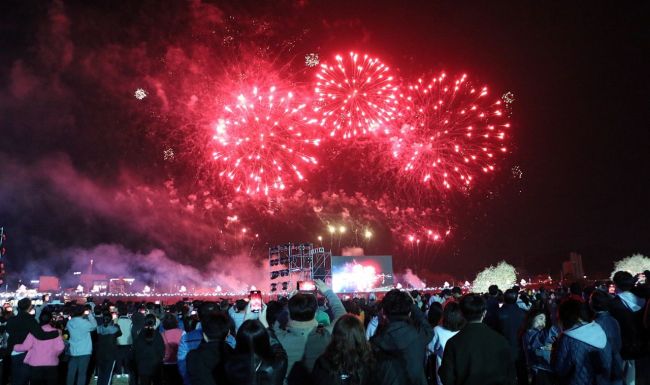 2023 Naju Festival, Yeongsangang River is Alive Festival Closing Fireworks Show.
 [Photo by Naju City]
The committee conducted a comprehensive analysis of the overall festival evaluation, along with positive and negative opinions and reactions raised from various sectors of the local community, media reports, and social networking services (SNS), focusing on discussing directions for improvement.
The city’s first integrated festival, ‘2023 Naju Festival: Yeongsangang River is Alive,’ was held for ten days from October 20 to 29 last year at the Yeongsangang Riverside Sports Park area.
It showcased a rich array of high-quality cultural and artistic performances that had never been seen before, exhibitions spanning 2,000 years of Naju history from ancient Mahan through Goryeo, Joseon, and modern times, as well as experiential activities and local delicacies, attracting a cumulative total of 270,000 visitors over the ten days.
The committee gave mostly positive evaluations, noting that the festival was the first attempt to unify and integrate small-scale festivals and events that had previously been held individually and sporadically.
The festival partially integrated and linked existing events such as the Mahan Culture Festival, Millennium Naju Mok-eupseong Cultural Festival, Naju Agricultural Festa, Yeongsangang International Installation Art Festival, Yeongsangang National Cooking Contest, and the Citizen’s Day Commemoration Ceremony.
The committee also praised the ‘Naju Agricultural Festa,’ which operated booths promoting and selling local agricultural and processed products, contributing to the income of farmers and businesses, as well as the Yeongsangang Cafeteria (food booths) operation method that reinforced the festival’s eco-friendly image by eliminating disposable products.
The festival’s positive aspects included elegant performances held day and night against the beautiful backdrop of the Yeongsangang River, diverse experiential programs, and an exhibition that harmonized the past and present all in one place.
On the other hand, the committee pointed out several major areas for improvement, such as the excessively long ten-day festival schedule, long distances between the main stage and booths, and a lack of seasonal attractions and infrastructure that could evoke the autumn atmosphere with flowers and silver grass.
Inconveniences caused by the use of reusable containers at food booths and the shortage of parking spaces were also identified as issues to be addressed.
There was criticism that the festival planning process did not sufficiently reflect local sentiments due to differences in opinions and ideas between local residents and planners. The committee suggested the need for ongoing mutual communication and empathy to overcome this.
The committee further recommended revising festival-related ordinances to specify the selection of themes reflecting the festival’s identity, the composition and expansion of the festival promotion committee considering diversity, representativeness, and locality, and clarifying the qualifications of promotion committee members and evaluation indicators. They also urged the promotion committee to continuously incorporate the evaluation committee’s improvement suggestions.
The Naju City Council announced plans to form a separate citizen participation evaluation committee to prepare additional improvement measures.
Chairman Choi Ki-bok of the Festival Evaluation Committee said, “Sufficient discussion will be needed in the future to define and develop the theme, nature, and program format of the Naju integrated festival,” adding, “Based on the evaluation results derived from the report meeting, I hope the 2024 Naju Festival will become a more fulfilling festival that satisfies both local residents and visitors.”
Meanwhile, the city also announced the results of a QR survey conducted on-site during the last festival period, targeting 1,079 visitors (362 men and 717 women) regarding overall festival satisfaction.
In response to the question ‘Was the festival fun?’ 41.3% of all respondents answered ‘strongly agree,’ and 35.7% answered ‘agree,’ showing high satisfaction.
The festival programs (zones) with the highest satisfaction were the Naju History Experience Culture Zone (29.1%), Naju Agricultural Festa Zone (25.3%), Permanent Planned Exhibition Zone (15.3%), Stage Performances (14.2%), and Administrative Booth Zone (13.6%), in that order.
The most common inconveniences or dissatisfactions were lack of parking space at 29.1%, followed by insufficient rest areas (24.9%) and inadequate traffic guidance (16.2%).
The majority of visitors were families, accounting for 58.7%, and when asked about their intention to participate in the 2024 festival, 48.2% responded ‘strongly agree’ and 29.3% ‘agree.’
Naju = Kim Yuk-bong, Honam Reporting Headquarters, Asia Economy baekok@asiae.co.kr
© The Asia Business Daily(www.asiae.co.kr). All rights reserved.

















