Sampyo Industry Reports Sales of 60,000㎥ in January
Research Results Presented at the 'Korean Society of Construction Engineering Conference'
Concrete ‘Bluecon Winter,’ which can be poured even at minus 10 degrees Celsius, is gaining attention in the construction industry, leading to increased sales. Pouring refers to the process of filling empty spaces such as formworks of structures with concrete during building construction. Usually, pouring is not done in subzero weather due to concerns about concrete freezing. This is why construction sites often come to a halt during winter when schedules are tight. SAMPYO Industry’s Bluecon Winter solves this problem by allowing pouring work even at minus 10 degrees Celsius.
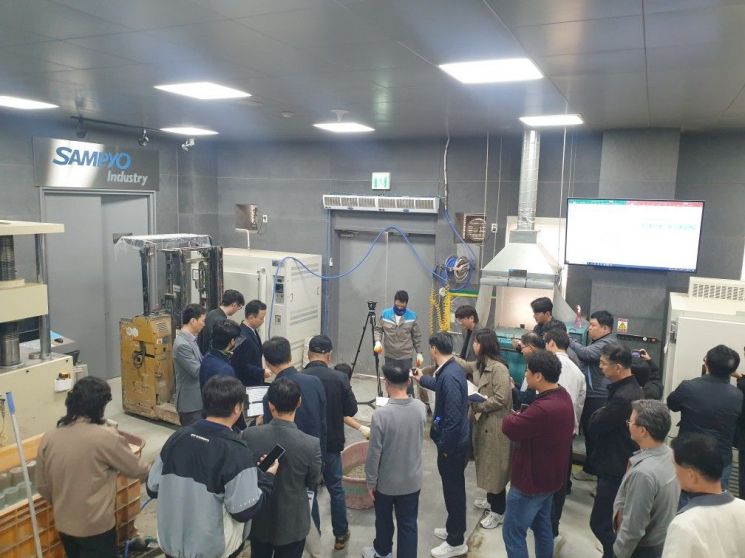 The scene during the 'Bluecon Winter' performance verification demonstration last October [Photo provided by Sampyo Industry]
According to SAMPYO Industry on the 26th, the sales volume of Bluecon Winter in January reached 60,000㎥ as of the previous day. Compared to the total sales of 220,922㎥ until last year since its launch at the end of 2017, this month’s sales volume has significantly increased.
Bluecon Winter is the first domestically developed ‘cold-resistant’ concrete by SAMPYO Industry. In winter subzero temperatures, moisture inside concrete can freeze, causing a decrease in compressive strength and cracks. In contrast, Bluecon Winter achieves a compressive strength of 5 megapascals (MPa) within 48 hours of pouring with only surface vinyl curing, without additional curing or heat curing, even at minus 10 degrees Celsius. One MPa means the strength to withstand a load of 10 kg per square centimeter of concrete. This means that Bluecon Winter can shorten construction periods and ensure uniform quality.
This product also helps enhance safety at construction sites during winter. When pouring with regular concrete in winter, solid fuels or hot air blowers used for heat curing can emit toxic gases due to incomplete combustion. From a broader perspective, using Bluecon Winter also enables the practice of ESG (Environmental, Social, and Governance) management.
In October last year, SAMPYO Industry conducted two performance verification tests of Bluecon Winter at its technology research center located in Hwaseong, Gyeonggi Province. Tests on fresh concrete properties such as slump measuring concrete fluidity, air content in concrete, and temperature measurement were conducted. Then, concrete was poured into a full-scale model similar to an actual structure, and compressive strength was measured 48 hours later.
During the demonstration, SAMPYO Industry replicated the winter environment for producing and curing concrete. Raw materials and mixing mixers used in the verification tests were cooled. The full-scale model was also placed in a chamber and cured for 48 hours at minus 10 degrees Celsius. The chamber is equipment that controls and maintains the temperature of a sealed space so that tests can be conducted at specific temperatures. To increase reliability, SAMPYO Industry directly used aggregates actually employed at each plant in the mixing experiments. Based on these tests, the research results were presented at the ‘2023 Fall Korean Construction Engineering Society Conference’ in November last year.
A representative from SAMPYO Industry said, "Awareness of winter safety accidents has increased due to construction site collapse accidents in recent years, and there have been many regulatory improvements regarding site concrete," adding, "The increase in Bluecon Winter sales reflects the construction industry’s atmosphere of wanting to use economical and good products."
© The Asia Business Daily(www.asiae.co.kr). All rights reserved.

















