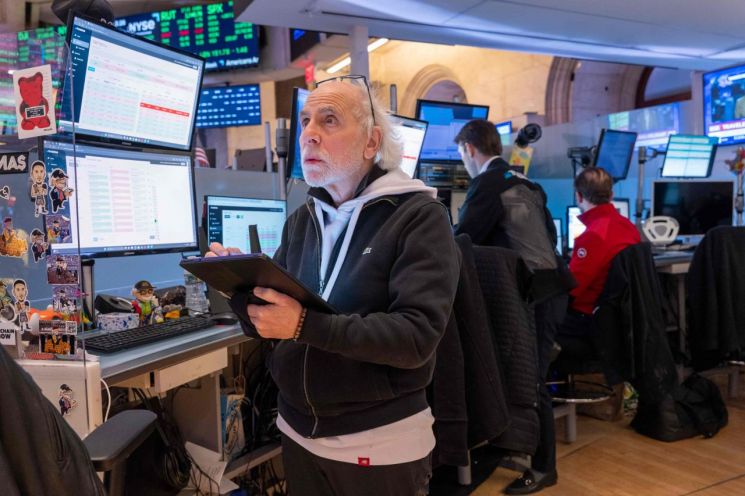
The three major indices of the U.S. New York stock market are showing an upward trend in early trading on the 25th (local time), digesting better-than-expected economic growth rates and corporate earnings.
At around 9:40 a.m. at the New York Stock Exchange (NYSE) on the day, the Dow Jones Industrial Average was trading at around 37,925, up 0.32% from the previous close. The S&P 500, which focuses on large-cap stocks, was up 0.42% at 4,889, and the tech-heavy Nasdaq index was up 0.44% at 15,548.
Currently, nine of the 11 sectors in the S&P 500 are rising simultaneously, excluding discretionary consumer goods and health-related stocks. Tesla is down more than 8% from the previous close after its earnings and earnings guidance released after the market closed the previous day fell short of Wall Street expectations. Concerns over weakening demand for electric vehicles have highlighted weakness in other EV-related stocks such as Nio, Rivian, and Lucid. On the other hand, IBM is up 8% thanks to earnings that exceeded Wall Street expectations. American Airlines and Southwest Airlines, which released earnings before the market opened, rose more than 7% and 1%, respectively. Microsoft (MS), which surpassed a market capitalization of $3 trillion for the first time during trading the previous day, is trading slightly higher.
Investors are closely watching key economic indicators such as gross domestic product (GDP) and weekly unemployment claims, as well as corporate earnings and earnings guidance. The U.S. fourth-quarter growth rate released on the day showed that solid consumption led to results exceeding market expectations. According to the Department of Commerce, the Q4 GDP growth rate was recorded at an annualized 3.3%. Although growth slowed compared to the third quarter of last year (4.9%), it was significantly higher than the market forecast (2%). The annual growth rate for 2023 was recorded at 2.5%.
This robust growth contrasts with earlier forecasts that anticipated an economic slowdown in the fourth quarter due to the Federal Reserve's (Fed) aggressive tightening. This was supported by strong consumption, which accounts for about 70% of GDP. U.S. personal consumption expenditures increased by 2.8% in Q4 last year. David Russell, Chief Market Strategist at TradeStation, said, "Consumers are recovering from the shock of inflation," adding, "The economic situation could improve further."
Accordingly, voices advocating the need to maintain high interest rates for the time being are expected to gain more strength. The market's early expectations for rate cuts have somewhat diminished compared to the beginning of the year. According to the Chicago Mercantile Exchange (CME) FedWatch, the futures market currently reflects about a 45% chance that the Fed will cut rates by 0.25 percentage points or more at the Federal Open Market Committee (FOMC) meeting in March after holding rates steady in January.
On the same day, the U.S. Department of Labor announced that new unemployment claims for the week of January 14?20 rose by 25,000 to 214,000 compared to the previous week. This exceeded expert forecasts by 14,000 claims.
On the following day, January 26, the Fed's preferred inflation indicator, the Personal Consumption Expenditures (PCE) price index, is scheduled to be released. The core PCE for December last year is expected to rise 0.2% month-over-month, slightly exceeding the previous month's increase. However, it is expected to show a slowdown with a 3% increase year-over-year.
Corporate earnings announcements are also ongoing. According to FactSet, more than one-fifth of S&P 500-listed companies have reported earnings so far, with 74% of them beating Wall Street expectations.
In the New York bond market, the benchmark 10-year U.S. Treasury yield is around 4.14%, and the 2-year yield, which is sensitive to monetary policy, is around 4.35%. The dollar index, which measures the value of the U.S. dollar against six major currencies, is up about 0.2% at 103.4.
On the same day, the European Central Bank (ECB) kept key policy rates, including interest rates, unchanged. The ECB announced at its monetary policy meeting that the benchmark interest rate was held steady at 4.50% per annum, with the deposit rate and marginal lending rate maintained at 4.00% and 4.75% per annum, respectively.
European stock markets are mixed, trading near flat. Germany's DAX and the UK's FTSE indices are slightly higher, while France's CAC index is slightly lower.
© The Asia Business Daily(www.asiae.co.kr). All rights reserved.
![Clutching a Stolen Dior Bag, Saying "I Hate Being Poor but Real"... The Grotesque Con of a "Human Knockoff" [Slate]](https://cwcontent.asiae.co.kr/asiaresize/183/2026021902243444107_1771435474.jpg)
















