Expansion of Major Autonomy vs Collapse of Basic Disciplines
"Side Effects Must Be Minimized by Activating the Double Major System"
As the Ministry of Education plans to expand the 'non-major admission' system in universities starting from the 2025 academic year, mixed reactions are emerging within the university community. Universities, which must finalize the number of admissions by department for the 2025 academic year by April, are facing dilemmas. Education experts point out that the Ministry of Education needs to gather feedback from the field and prepare measures to minimize potential side effects such as the concentration of students in popular majors.
"Expansion of Learning Choice" vs "Collapse of Basic Studies"
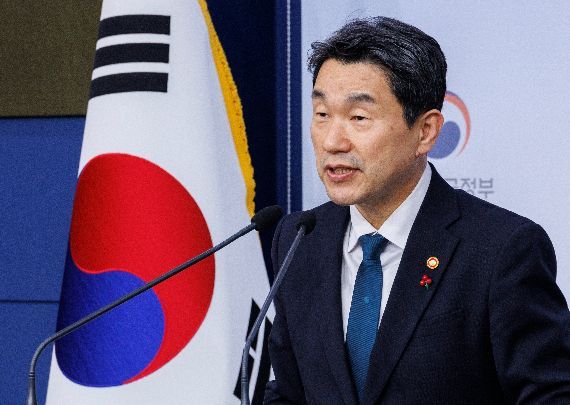 Deputy Prime Minister and Minister of Education Lee Ju-ho is giving a briefing at the Government Seoul Office Annex in Jongno-gu, Seoul.
 [Photo by Yonhap News]
On the 24th, Lee Ju-ho, Deputy Prime Minister for Social Affairs and Minister of Education, announced the '2024 Ministry of Education Major Policy Implementation Plan,' stating, "There is no wavering in the goal to select 25% of all students through non-major admission in the future," and added, "This year, we are promoting the goal of reaching 25% by combining types that allow students to choose any major within the university and those that allow selection within a field or college." Non-major admission refers to a system where freshmen are admitted without a specific major and decide their major afterward.
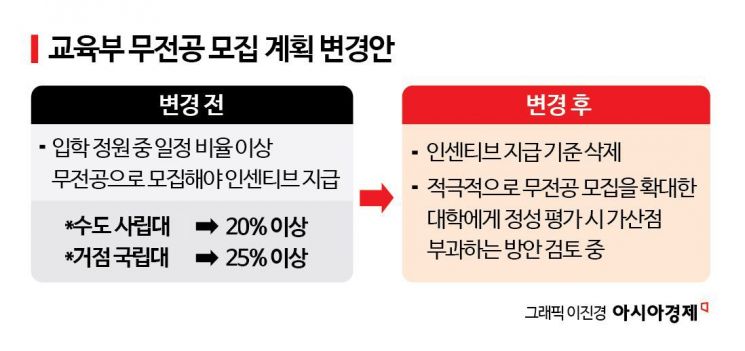
However, reflecting field opinions, the policy to provide incentives only to universities that select a certain percentage of students through non-major admission starting from the 2025 academic year has been withdrawn. Minister Lee explained, "While we are committed to pursuing the goal, we will also provide financial support to universities that fall short of the standard," adding, "This is in response to requests from some in the field for the Ministry of Education to exercise flexibility."
Earlier this month, the Ministry of Education revealed through a policy research draft that private universities in the metropolitan area would receive incentives worth 442.6 billion KRW only if they select 20% of their admissions through non-major admission, and flagship national universities would receive the same amount if they select 25% starting next year.
Universities that were at risk of losing funding have breathed a sigh of relief, but concerns continue to pour in from the field. The Ministry of Education explains that non-major admission aims to guarantee students' diverse learning rights and freedom to choose majors, but critics argue that such a system could exacerbate the concentration in popular majors and lead to the collapse of basic studies such as 'Munsacheol' (Literature, History, Philosophy).
In particular, colleges of humanities, which would be hit hard by non-major admission, are strongly opposing the policy. On the 24th, the National Association of Deans of Humanities at National and Public Universities (Gukin-hyeop) and the National Association of Deans of Humanities at Private Universities (Sain-hyeop) issued a statement at Seoul National University in Gwanak-gu, Seoul, urging the Ministry of Education to "stop expanding non-major admission and reconsider from the beginning."
Attending the event, Kang Chang-woo, Dean of the College of Humanities at Seoul National University, criticized, "In the current situation where the concentration of students in a few popular majors is severe, most students are very likely to choose popular majors following the trend," adding, "The non-major system, as originally intended by the Ministry of Education, makes it difficult for students to find and choose majors that match their aptitude and interests."
There are also criticisms that the Ministry of Education is excessively infringing on university autonomy by implementing policies uniformly without reflecting the characteristics of each university. Professor Cho Sang-sik of the Department of Education at Dongguk University said, "Private universities have strong ownership beliefs and may not easily accept Ministry of Education policies, and there could be strong opposition within the university," adding, "National/public and private universities, as well as metropolitan and regional universities, all have different educational environments and conditions, so implementing policies uniformly without considering these differences ultimately shifts all the burden onto the universities."
Professor recruitment difficulties are also cited as a problem. Some popular departments such as Business Administration, Economics, and Computer Engineering are already struggling to hire professors. Dean Kang said, "Since professors tend to serve for more than 20 years once appointed, universities have to be cautious in hiring," adding, "If students concentrate only in some popular majors according to demand, it will inevitably be difficult to recruit professors."
"Measures Needed to Prevent 'Concentration in Popular Majors'"
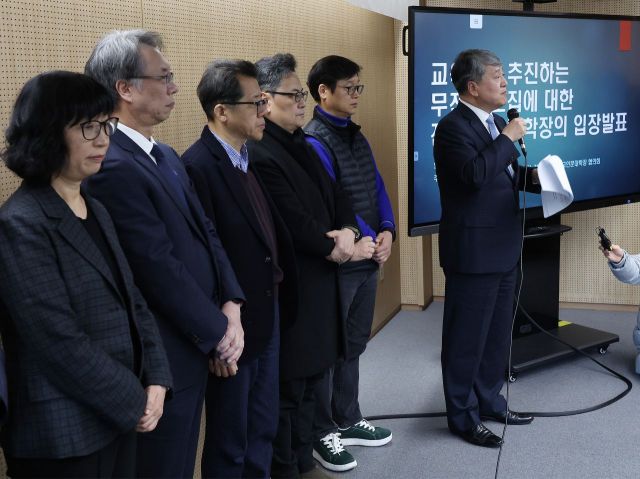 The Council of Deans of Humanities Colleges at National Public Universities and the Council of Deans of Humanities Colleges at Private Universities nationwide are issuing a statement on the Ministry of Education's policy to expand admissions without a declared major on the 24th.
 [Photo by Yonhap News]
The Ministry of Education, having abolished the originally planned incentive system and set a one-year 'grace period,' intends to observe the situation on the ground and collect opinions. A Ministry of Education official said regarding the concentration in popular majors, "There can always be majors that students particularly prefer at any given time," adding, "Not only should students be given autonomy to choose their majors after admission, but support should also be provided to help them properly plan their career paths after enrollment."
The Ministry also emphasized that contrary to concerns, the need for basic studies will increase as non-major admission expands. The official said, "When students choose their majors autonomously, their convergence capabilities are emphasized more, which increases the importance of basic studies," and added, "At the undergraduate level, basic studies can be offered more widely as general education to all undergraduates, and at the graduate level, research as an academic discipline can be intensively supported."
Regarding professor recruitment, the official added, "Currently, professors tend to belong to specific departments and only offer related courses, but in some universities or overseas, professors belong to colleges or the university itself, allowing them to offer courses across multiple majors or interdisciplinary courses," adding, "This approach would allow more flexible responses even if students concentrate in certain majors."
Experts advise that measures should be prepared to minimize the expected side effects such as the concentration in popular majors. Professor Cho said, "I partly agree with the background and purpose of the Ministry of Education's initiative," and suggested, "If students are encouraged to choose less popular majors such as Philosophy and History as their primary major, while allowing them to select popular majors as a second major through an active double major system, the gap between departments can be reduced." He further explained, "Since universities have already reduced major credits significantly, the foundation for activating the double major system is already in place."
© The Asia Business Daily(www.asiae.co.kr). All rights reserved.



















