4th Export Emergency Response Team Meeting Held
Step-by-Step Support Measures for Rising Freight Costs Established
Recently, as geopolitical uncertainties in the Middle East have increased due to Houthi airstrikes by the US and UK and successive armed clashes between Israel and pro-Iran armed groups, causing delays in maritime logistics and rising freight costs, the government has decided to expand support for logistics expenses.
The Ministry of Trade, Industry and Energy announced on the 25th that it held the 4th Emergency Export Countermeasures Meeting chaired by Jeong In-gyo, Head of the Trade Negotiation Headquarters, to review the impact on export-import logistics and discuss future response measures.
According to the Ministry, the inspection meeting found that difficulties such as transportation delays and increased freight costs are occurring across export-import logistics. However, direct impacts such as export shipment are limited, and the import of energy resources like oil and gas is proceeding normally.
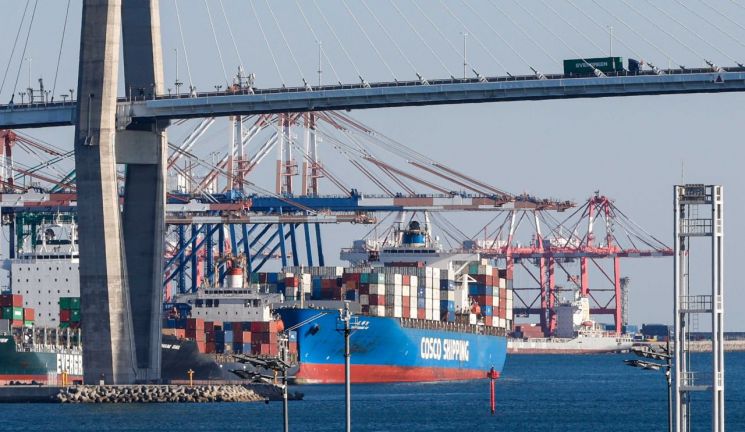 Export containers are being loaded onto a ship at Busan North Port. Photo by Jinhyung Kang aymsdream@
The Ministry plans to proactively prepare and implement phased support measures to minimize negative impacts in anticipation of prolonged disruptions in maritime logistics due to rising freight costs.
First, as an immediate first-phase measure, the logistics cost support limit within the export voucher will be urgently increased (from 20 million to 30 million KRW), and emergency support (3.6 billion KRW for 233 companies) will be provided for overseas joint logistics centers to secure pre-safety stock in Europe and the Americas. In addition, KOTRA will expand dedicated shipping space for small and medium-sized enterprises bound for the Americas and Europe by more than 40% (from 110 TEU to 155 TEU per week), and based on shipping space demand identified by the Korea International Trade Association and others, the Ministry of Oceans and Fisheries and related agencies will promptly complete follow-up procedures for secured dedicated shipping space (475 TEU per voyage, 1,100 TEU under long-term contracts).
If freight costs rise further, as a second-phase additional measure, the timing of the second half support export voucher worth 3.1 billion KRW will be advanced for early emergency deployment to expand logistics cost support, and special support such as preferential guarantee limits and guarantee fee discounts before shipment, as well as maturity extensions for guarantee loans after shipment, will be provided to support liquidity for affected companies.
If logistics disruptions prolong and freight costs increase excessively, as a third-phase emergency response measure, the Ministry will review additional logistics cost support expansion plans through consultations with related ministries.
Head Jeong said, "Since logistics disruptions in the Middle East involve complex interests of multiple countries, there is a high possibility of prolonged uncertainty," adding, "As the situation cannot be predicted, we will prepare preemptive risk management plans for various scenarios to minimize negative impacts on the export growth trend, and we will make every effort to closely monitor and resolve corporate difficulties."
© The Asia Business Daily(www.asiae.co.kr). All rights reserved.

















