'Agricultural Outlook 2024'
Last year, the 'farm household income' earned through economic activities over one year increased by 4.7% compared to the previous year. This is attributed to an increase in transfer income due to the expansion of direct payment amounts and an increase in crop disaster insurance payouts caused by frequent disasters.
The Korea Rural Economic Institute (KREI) announced the 'Agricultural Outlook 2024' report containing these details on the 25th.
According to the report, the total agricultural production value last year was 59.2 trillion KRW, up 2.3% from the same period the previous year. Due to the overall rise in rice prices last year, the production value of food crops increased by 5.0% to 10.7 trillion KRW, and vegetables also showed an upward trend due to price increases. On the other hand, fruit production declined compared to the previous year due to poor crop conditions and reduced output. Additionally, the decrease in input costs such as fuel and fertilizer due to falling oil prices contributed to the increase in farm household income.
Last year, the farm household income per household was 48.3 million KRW, a 4.7% increase from the same period the previous year. Farm household income consists of agricultural income, non-agricultural income, transfer income, and non-recurring income, with all except non-recurring income showing sharp increases. In particular, agricultural income rose by 12.9% to 10.7 million KRW, and transfer income increased by 4.2% to 15.9 million KRW due to the expansion of direct payment amounts.
Kim Mi-bok, head of the Agricultural Outlook Center at KREI, explained, "The increase in agricultural income is due to the rise in production value along with an increase in disaster insurance payouts, which are classified as miscellaneous income within agricultural income." She added, "Approximately 1 trillion KRW in disaster insurance payouts was distributed to farm households last year due to frequent typhoons and floods."
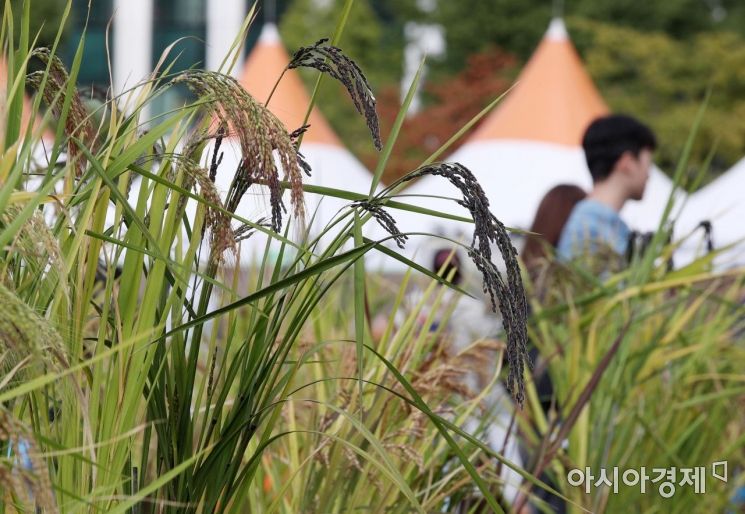 Various varieties of rice are exhibited at the 11th Seoul Urban Agriculture Expo held on the 7th at Seoul City Hall Plaza. Photo by Hyunmin Kim kimhyun81@
KREI forecasts that the increase in agricultural production value and farm household income will continue this year as well. While the production value of food crops is expected to remain roughly stable due to a decrease in production volume, fruit production is projected to increase by 5.7%, and Hanwoo (Korean native cattle) production value is expected to rise by 2.9%, resulting in a total agricultural production value increase of 0.6% to 59.5 trillion KRW.
Farm household income is also expected to reach 49.7 million KRW per household, a 2.8% increase from last year, as the burden of management costs decreases due to the stabilization of international grain prices and continued decline in input costs such as fuel and fertilizer. Agricultural income is projected to increase by 7.7%, and transfer income is expected to rise by 2.1% to 16.2 million KRW per household due to further expansion of agricultural direct payments.
On the same day, KREI will hold the 'Agricultural Outlook 2024' event at Dragon City in Seoul under the theme "Agriculture and Rural Areas in an Era of Uncertainty: Challenges and the Future." In the first part, Professor Lee Jong-hwa from Korea University will give a special lecture titled "The Korean Economy in 2024 ? Evidence of Hope in an Era of Uncertainty." In the second part, presentations and expert discussions will cover major agricultural and rural issues, including ▲ agricultural management stability and carbon neutrality measures in response to uncertainties such as climate change and food security ▲ development directions and challenges of the green bio industry and pet-related industries, which are gaining attention as new growth engines ▲ strategies to address rural depopulation and policies for revitalizing rural areas targeting rural youth.
© The Asia Business Daily(www.asiae.co.kr). All rights reserved.
![User Who Sold Erroneously Deposited Bitcoins to Repay Debt and Fund Entertainment... What Did the Supreme Court Decide in 2021? [Legal Issue Check]](https://cwcontent.asiae.co.kr/asiaresize/183/2026020910431234020_1770601391.png)
















