KAIST and Jeonnam National University Propose New Method for Bone Tissue Regeneration
Development of Biomimetic Scaffold to Accelerate Bone Regeneration Speed
A domestic research team has developed a piezoelectric material that helps promote the growth of bone tissue. The developed material functions like a bandage that can be attached to cracked bone areas to accelerate bone regeneration.
KAIST announced on the 25th that Professor Hong Seungbeom's research team from the Department of Materials Science and Engineering collaborated with Professor Kim Jangho's research team from the Department of Convergence Biosystems and Mechanical Engineering at Chonnam National University to develop this biomimetic scaffold with such functionality.
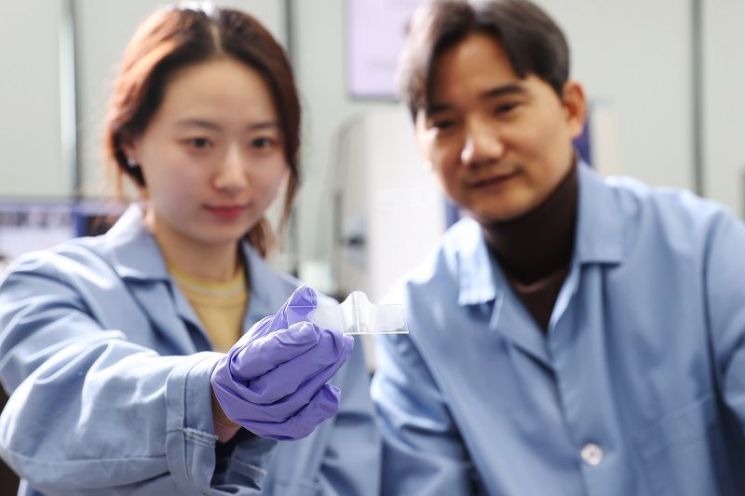 A domestic research team including KAIST has succeeded in developing a bandage-type biomimetic scaffold. The scaffold is a piezoelectric material that helps promote bone tissue growth and functions to accelerate the regeneration speed of cracked bones. Photo by KAIST
The biomimetic scaffold utilizes the inherent bone-forming ability of hydroxyapatite (HAp) and generates electrical signals when pressure is applied.
Hydroxyapatite is a basic calcium phosphate found in bones and teeth, known for its biocompatible properties and cavity-preventing characteristics, making it a mineral material also used in toothpaste.
Previous research on piezoelectric scaffolds focused on polymer-based materials to find piezoelectric bone regeneration promotion and enhanced bone fusion effects, which limited the ability to mimic the complex cellular environment necessary for optimal bone tissue regeneration.
In contrast, this study is significant in that it proposed a new method for bone tissue regeneration by developing a material that mimics the bone tissue environment of living organisms by utilizing the unique bone-forming ability of hydroxyapatite.
The research team developed a manufacturing process that fuses hydroxyapatite with polymer films, and scaffolds produced through this process demonstrated potential for accelerating bone regeneration in both in vivo and in vitro experiments on laboratory rats.
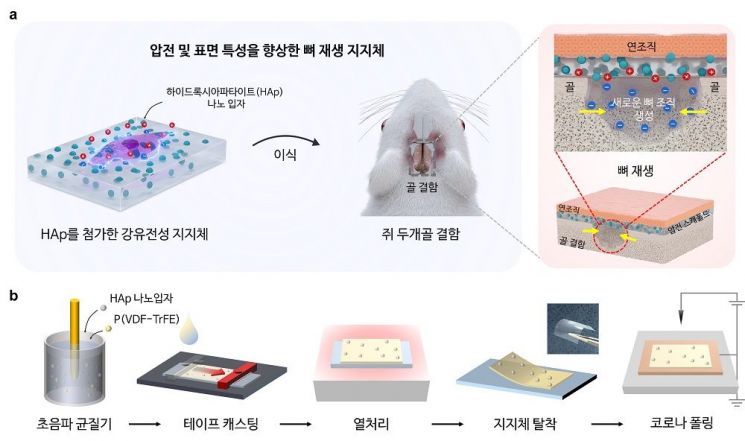 Schematic diagram of bone regeneration mechanism and fabrication method of hydroxyapatite-fused P(VDF-TrFE) scaffold. Provided by KAIST
Above all, the research team also elucidated various backgrounds on how the scaffold can effectively promote bone regeneration alongside its development.
They investigated the electrical properties of the scaffold using atomic force microscopy (AFM), conducted detailed surface characteristic evaluations of cell morphology and cytoskeletal protein formation, and examined how piezoelectric and surface area factors influence growth factor expression.
Professor Hong Seungbeom of KAIST’s Department of Materials Science and Engineering said, "The hydroxyapatite-fused piezoelectric composite material developed by our team acts as a kind of ‘bone bandage’ that accelerates the speed of bone regeneration. This research not only suggests a new direction in biomaterial design but also holds significance in exploring the effects of piezoelectricity and surface characteristics on bone regeneration."
Meanwhile, this study involved doctoral candidate Sooyeon Joo and master’s student Soyeon Kim from Professor Hong’s research team as co-first authors. From Professor Kim Jangho’s team, doctoral candidate Yonghyun Kwon was a co-first author, and Professor Kim Jangho contributed as a co-corresponding author.
© The Asia Business Daily(www.asiae.co.kr). All rights reserved.


















