The Biggest Issue Is 'Lack of Experts'
"If a 2-Year Grace Period Is Given, the Number of Experts Is Expected to Increase"
With the failure to pass the amendment to the Serious Accident Punishment Act in the National Assembly, the law's application is expanding to workplaces with fewer than 50 employees starting from the 27th, putting the small and medium-sized enterprise (SME) sector on high alert. Especially in industries handling machinery and equipment or construction, where completely preventing safety accidents is difficult, concerns have been raised that "ultimately, companies will face a wave of closures."
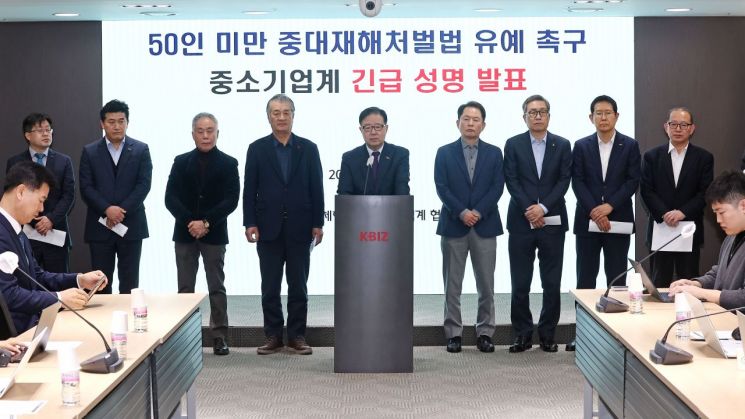 Jung Yun-mo, Executive Vice President of the Korea Federation of Small and Medium Business, along with the chairpersons of small and medium enterprise organizations, is issuing a statement on the morning of the 23rd at the Korea Federation of Small and Medium Business in Yeouido, Seoul, appealing for the postponement of the application of the Serious Accidents Punishment Act to workplaces with fewer than 50 employees.
 [Photo by Yonhap News]
On the 25th, in a phone interview with Asia Economy, Noh Sang-chul, Vice Chairman of the Korea Federation of Small and Medium Business Cooperatives and Director of the Korea Frame Industry Cooperative, stated, “The Serious Accident Punishment Act will be applied from the 27th, but SMEs will have nothing they can do, and if an accident occurs, they will automatically become lawbreakers.”
On the same day, the National Assembly failed to pass a postponement bill, resulting in the full application of the Serious Accident Punishment Act to approximately 837,000 workplaces with 5 to fewer than 50 employees. When a serious accident occurs, business owners or management responsible who neglect safety obligations may face imprisonment of more than one year or fines up to 1 billion KRW. The ruling and opposition parties continued last-minute discussions until just before the plenary session but failed to reach an agreement.
The impact on SME management, where one representative often handles everything from manufacturing to machinery management and planning due to scale, is inevitable. Ultimately, this could lead to business closures. Director Noh pointed out, “Even among workplaces with fewer than 50 employees, many have fewer than 10 people, and if an accident happens, the representative will have to undergo investigation, which means they might have to close the business, pause operations for a few days, and possibly go bankrupt.” Ryu In-gyu, Chairman of the Korea Electric Wire Industry Cooperative, also explained, “While life is extremely precious, unfair business owners should not emerge. If an accident occurs, unless it is a large corporation, the business owner must resolve it themselves, and in such cases, companies with sales in the hundreds of millions of KRW are highly likely to close.”
The biggest issue cited by the SME sector is the “lack of specialized safety and health management personnel.” Even if they want to pay for consulting, there is a limited number of personnel who can provide it. Although government consulting is available, it is mostly administrative consulting conducted by labor attorneys. Kim Young-seok, Director of the Seoul Gyeongin Ready-Mixed Concrete Industry Cooperative, emphasized, “We have received all the education and consulting provided by the Ministry of SMEs and Startups, the Korea Occupational Safety and Health Agency, and the Federation of SMEs, but it is insufficient. The labor attorneys mainly focus on post-accident measures rather than preventive strategies, so more practical consulting is needed.” A representative of a ready-mixed concrete company also criticized, “I have received consulting five times so far, but all were conducted by labor attorneys. I expected someone knowledgeable about machinery to come and say, for example, ‘If you hit the machine from the left, you should stand on the right side to avoid accidents,’ but that was not the case, so it is somewhat discouraging.”
There is also an absolute shortage of personnel to manage safety and health on-site. The SME sector expects that if a two-year postponement of the Serious Accident Punishment Act for workplaces with fewer than 50 employees is granted, some progress in training specialized personnel can be made. The Ministry of Employment and Labor also proposed solutions in its “Support Measures for Companies Vulnerable to Serious Accidents” announced in December last year, including operating specialized training courses, establishing additional industrial safety majors, and relaxing qualification requirements for safety managers to address the shortage of specialized safety and health management personnel. Through these measures, the plan is to train 20,000 specialized personnel by 2026. A manufacturing company representative said, “If we can just wait two years, the number of experts will increase. If it is difficult to hire safety and health management experts due to company size or financial reasons, perhaps multiple companies within a cooperative could jointly employ such experts.”
© The Asia Business Daily(www.asiae.co.kr). All rights reserved.

















