Full Enforcement on the 27th for Workplaces with Fewer Than 50 Employees
Business Owners Face Over 1 Year Imprisonment for Serious Accidents
“Serious Accident Punishment Act? I don’t know about that, and you’re saying it applies to us immediately?” On the afternoon of the 25th, at an industrial supplies manufacturing company in Jongno 3-ga, Seoul, Mr. A, who runs the business, responded this way when asked if he knew about the Serious Accident Punishment Act (hereafter referred to as the Act).His business has five employees and is subject to the Act, which will be enforced on the 27th. However, struggling to get through each day, he had no capacity to pay attention to the Act. When told that even companies with fewer than 50 employees are subject to it, anxiety quickly appeared in Mr. A’s eyes.
After explaining the Act, Mr. A said, “I’ve never heard of it, and even if the law is enforced, there’s nothing to do but be careful on our own.” Behind him, an employee was silently continuing to cut PVC pipes with a cutter without any protective equipment.
Despite the enforcement of the Act on workplaces with fewer than 50 employees, there was no response at the site. After visiting about ten small industrial supplies manufacturing companies densely located in Jangsadong, Jongno 3-ga, none of them said they knew about the Act. They are subject to the law without proper knowledge or preparation.
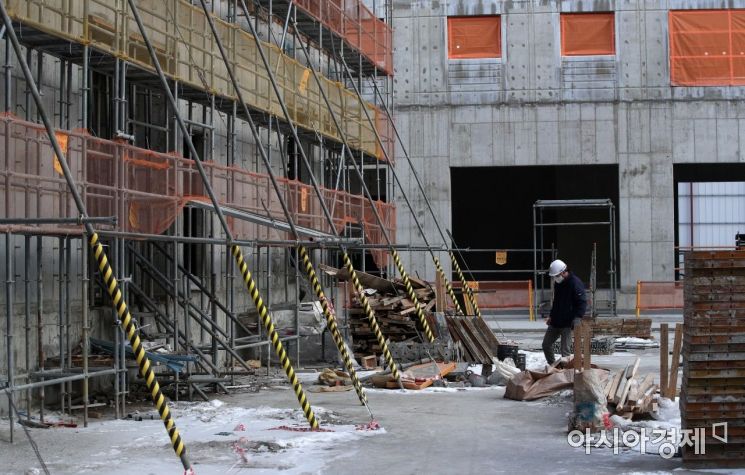 On the first day of the Serious Accidents Punishment Act enforcement, which allows for the punishment of management officials when serious accidents such as worker fatalities occur, managers are conducting safety inspections at an apartment construction site in Gyeonggi-do on the 27th. Photo by Kim Hyun-min kimhyun81@
Even those who knew about the enforcement of the Act in advance were not taking any measures. Mr. Kang, who runs a glass bottle manufacturing factory in Suwon, was aware that the Act might be enforced but could not take any special action.
Mr. Kang said, “They say we just need to hire a safety manager, but the business is so difficult that we are short-staffed as it is, so additional hiring is out of the question,” adding, “Most of the business owners around me are in similar situations.”
However, he is not without concerns about the law’s enforcement. Mr. Kang said, “Out of about ten employees, five are foreign workers, and since communication is often poor, there are sometimes dangerous situations,” adding, “We try to give as much caution and safety measures as possible, but the reality is not easy. I’m worried we might really end up in jail.”
Even if the Act applies, workplaces with fewer than 50 employees are not required to hire a safety manager. However, for small and medium-sized enterprises that lack expertise in accident prevention and cannot afford a separate organization, appointing a safety manager to delegate safety tasks could actually be helpful. Still, many companies cannot afford to hire additional staff immediately. Also, the number of qualified safety managers is limited, making recruitment difficult.
The Serious Accident Punishment Act, enforced on January 27, 2022, is a law that punishes business owners or management officials who fail to fulfill accident prevention duties in the event of serious accidents such as worker deaths, with imprisonment of one year or more or a fine of up to 1 billion KRW. Enforcement for workplaces with fewer than 50 employees was deferred for two years, and from the 27th, the law’s scope will expand to include workplaces with fewer than 50 employees and construction sites with project costs under 5 billion KRW.
© The Asia Business Daily(www.asiae.co.kr). All rights reserved.
![Clutching a Stolen Dior Bag, Saying "I Hate Being Poor but Real"... The Grotesque Con of a "Human Knockoff" [Slate]](https://cwcontent.asiae.co.kr/asiaresize/183/2026021902243444107_1771435474.jpg)
















