Opening of Agricultural Product Processing Technology Support Center, Expecting Growth in Processing Startups
Operating Processing Startup Education Programs, Promoting Development of Signature Products
Gumi City in Gyeongbuk Province is striving to establish a foundation for strengthening processing startup capabilities and fostering the right mindset to support successful agricultural product processing startups by farmers, aiming to increase farm income through the operation of the Agricultural Product Processing Technology Support Center.
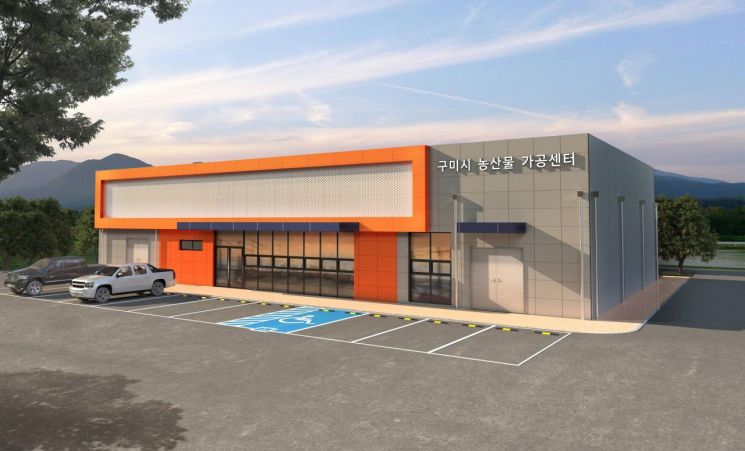
▲ Construction and Operation of the Agricultural Product Processing Technology Support Center
Selected in the 2020 Rural Development Administration public project, the Agricultural Product Processing Technology Support Center, with a total project cost of 2.6 billion KRW (500 million KRW national funds, 2.1 billion KRW city funds), is scheduled to begin operation in the first half of 2021.
The processing center supports startup success by providing a shared processing space for farmers when starting processing businesses, thereby reducing failure factors and the burden of initial investment costs.
Located within the Agricultural Technology Center, the processing center is a HACCP-certified facility ensuring the safety of processed products. It is a 495㎡ single-story building equipped with wet processing rooms, dry processing rooms, packaging rooms, and self-quality inspection rooms. Additionally, a total of 68 types and 100 units of agricultural product processing equipment will be installed to enable the production of various processed products.
The wet processing room will be equipped with pneumatic juicers, concentrators, and storage tanks for beverages, concentrates, jams, and pickled products. The dry processing room will have hot air dryers, coarse grinders, and pill-making machines for powders, pills, dried snacks, and dried fruits. Various packaging machines such as stick packers, screw packers, and roll packers will be installed to allow production of multiple product types. The self-quality inspection room will enable microbial testing before product shipment.
Only those who have completed both the basic and advanced courses of the agricultural product processing startup education program operated by the Agricultural Technology Center can use the processing center. This year, during the pilot operation period, equipment usage fees will be waived.
Dedicated personnel will provide technical support from product planning to development of saleable products, and through OEM (Original Equipment Manufacturer) production with the Agricultural Technology Center, farmers will be supported to produce and sell processed products.
▲ Operation of Agricultural Product Processing Startup Education Programs
To facilitate smooth use of the Agricultural Product Processing Technology Support Center by farmers, the agricultural product processing startup education program has been operated since 2022. So far, three basic courses with 26 sessions and two advanced courses with 20 sessions have been conducted, with a total of 826 participants.
The basic course covers education on the Food Sanitation Act, HACCP certification, processed product development, and licensing requirements for processing startups. The advanced course includes in-depth HACCP theory, processed product development, brand development, and study tours to advanced processing startup sites.
This year, the basic course will focus on theoretical education such as the Food Sanitation Act, the advanced course will provide practical training for product development, and the master course will offer practical training for individual design and brand development as well as training on using processing center equipment. The program will recruit 30 participants for the basic course, 30 for the advanced course, and 20 participants (10 per session) for two master course sessions. Recruitment will be announced in February through the Gumi City and Agricultural Technology Center websites.
▲ Development of Gumi City’s Representative Processed Products
The Agricultural Technology Center is investing 50 million KRW and conducting research in collaboration with the Korea Food Research Institute to develop processed foods that create added value from Gumi’s representative agricultural products, “melon” and the increasingly produced “Shine Muscat.” Through this research, processed foods with high popularity and preference such as jelly and beverages, as well as internal and external packaging designs and a Gumi processed food brand, will be developed.
Products that all generations from infants to the elderly can enjoy together will be developed to activate processed product sales. By diversifying packaging units and types, promotional goods for Gumi will be created and linked to tourism products. Additionally, plans are underway to supply school meals and local food stores through the Food Integrated Support Center, and online sales channels such as Gumi Farm and Smart Store will also be launched.
Mayor Kim Jang-ho said, “We plan to support farmers in various ways so that they can create added value from agricultural products through processing activities and secure income outside of farming. We will strive to ensure the sustainable growth of Gumi City’s agricultural economy.”
© The Asia Business Daily(www.asiae.co.kr). All rights reserved.

















