Emphasizing the Need for Legislation to Prevent Abuse of Monopoly and Oligopoly
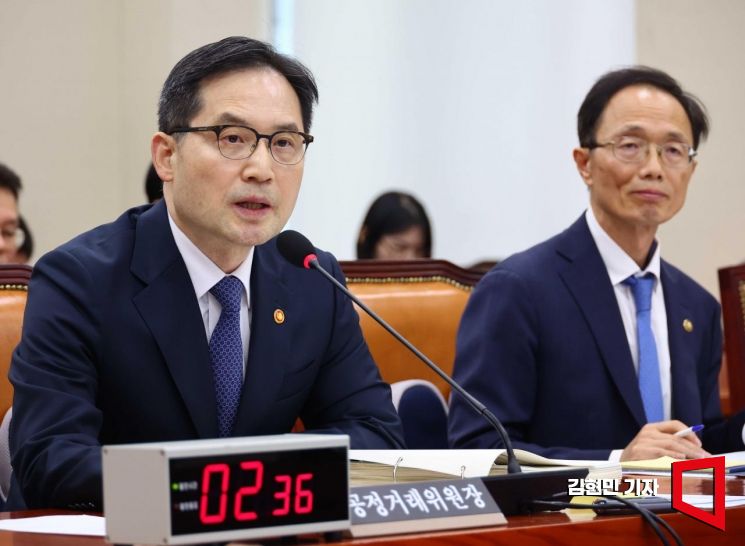 Kang Ki-jung, Chairman of the Fair Trade Commission, is responding to lawmakers' questions at the National Assembly's Political Affairs Committee audit held on the 16th. Photo by Hyunmin Kim kimhyun81@
The government repeatedly refuted market concerns that preemptive regulation of platform companies, which have become powerful entities, would hinder innovation and growth, calling such worries "groundless fears."
On the 24th, Yuk Seong-kwon, Secretary-General of the Korea Fair Trade Commission, stated at a casual meeting with reporters, "There is significant concern in the market regarding the ‘Platform Competition Promotion Act (Platform Act),’ and there is an aspect of overestimating the negative impacts the bill may cause."
Responding to criticism that the Platform Act is a regulation that stifles companies, Secretary-General Yuk emphasized, "The four unfair practices that the bill aims to regulate are unrelated to the normal business activities of platform companies." He explained that the essence of these four unfair practices lies in driving capable small and medium-sized enterprises (SMEs) and startups out of the market or blocking their market entry altogether, asserting, "Concerns that the legislation could negatively affect the business activities of SMEs and startups are merely groundless fears."
Regarding the controversy over overlapping regulations, he reiterated the need for legislation by emphasizing that current laws are insufficient to sanction abuses of monopoly power. Secretary-General Yuk explained, "Under the current Fair Trade Act, there is a significant time lag between the occurrence of unfair practices and the implementation of corrective measures," adding, "With the current legal framework, by the time corrective actions are taken, monopolization in the market is already complete, making it difficult to restore competitive market order."
The platform market experiences monopolization much faster than traditional markets, and once monopolistic structures are established, restoring competitive order as before is practically impossible. Therefore, it is important for competition authorities to quickly recognize and respond to issues before monopolistic structures take hold. However, under current laws, the time required to implement corrective measures is too long, often resulting in a "closing the barn door after the horse has bolted" situation.
He further pointed out, "(If legislation is delayed) ultimately, foreign platform companies will dominate the Korean market, or the monopolization by domestic giant companies will be left unchecked, eventually harming consumer welfare through price increases and other effects."
He also refuted claims that the enactment of the Platform Act contradicts the current government's policy of self-regulation, stating, "The legislative push to regulate platform monopolies does not conflict with the self-regulation policy, and self-regulation among platforms, tenant businesses, and consumers will be consistently pursued."
Self-regulation pertains only to governing the power dynamics between platforms and tenant businesses, while the government’s consistent policy is to strictly respond to monopoly issues within the market.
Secretary-General Yuk added, "Apart from the principles of platform self-regulation, the policy to strictly respond to prevent monopoly damages in the platform market has already been announced," emphasizing, "Unfair practices such as blocking market entry or driving out competitors of monopolistic platforms cause market disruption and worsen public welfare, making self-correction unlikely."
The Platform Act aims to pre-designate dominant platform operators by comprehensively considering sales, user numbers, and market share, and prohibits four unfair practices: self-preferencing, tying sales, restricting multi-homing, and forcing most-favored-nation treatment. The government announced its plan to enact the Platform Act to prevent the harms of platform monopolies at the Cabinet meeting on the 19th of last month.
The Fair Trade Commission explained that it will establish criteria for designating dominant operators in a way that regulates monopoly abuse without hindering innovation and growth in the platform industry, and will guarantee operators opportunities to submit opinions, raise objections, and file administrative lawsuits before designation. Secretary-General Yuk said, "We plan to continue communication with various stakeholders to fully resolve misunderstandings about the bill."
© The Asia Business Daily(www.asiae.co.kr). All rights reserved.
![Clutching a Stolen Dior Bag, Saying "I Hate Being Poor but Real"... The Grotesque Con of a "Human Knockoff" [Slate]](https://cwcontent.asiae.co.kr/asiaresize/183/2026021902243444107_1771435474.jpg)










