"Fund Position Recovery Could Lead to $70 Billion Outflow"
Global investment bank Goldman Sachs has warned that in the worst-case scenario, foreign investor funds worth up to $170 billion (approximately 227.545 trillion KRW) could exit the Chinese stock market this year.
According to Chinese economic media Caixin on the 23rd, Goldman Sachs made this prediction based on the worst-case scenario at the '2024 Global Macro Forum Media Conference' held on the same day.
Jinjin Liu, Goldman Sachs' Chief China Strategist, explained, "The current Chinese stock positions of overseas investors in the US, Europe, and other regions, including A-shares, Hong Kong stocks, and American Depositary Receipts (ADRs), amount to about $1 trillion," adding, "This assumes that all overseas mutual funds and hedge funds' Chinese stock positions fall to record lows, and some investors closely linked to the US government liquidate all their Chinese stocks."
Strategist Liu added, "However, this forecast is not Goldman Sachs' base case," and elaborated, "If global mutual funds and hedge funds' positions in Chinese stocks return to historical average levels, the scale of foreign investor fund outflows would be around $70 billion." Meanwhile, the investment rating for the Chinese A-share market was maintained at 'overweight.'
The investment proportion of overseas investors in Chinese stocks is approaching historical lows. According to Goldman Sachs, the current mutual fund position in Chinese stocks accounts for only 6.2% of total assets under management. This is a rapid decline compared to about 10% in 2022 and last year, and about 15% in early 2021.
Separately, Goldman Sachs forecasted that profits of Chinese listed companies will increase by 8-10% year-on-year this year. It projected China's GDP growth rate at 4.8% and the Consumer Price Index (CPI) increase at 0.4% for this year. The Chinese real estate market is expected to follow a stabilization process but will still delay economic growth.
Shanhui, a Goldman Sachs China economist, assessed, "Real estate reduced China's GDP growth by 1.5 percentage points last year, and this year the impact will ease to 1.0 percentage point." Timothy Moe, Goldman Sachs Asia-Pacific Chief Equity Strategist, mentioned, "Investors still have concerns about the Chinese stock market and are showing more interest in Indian and Japanese stocks."
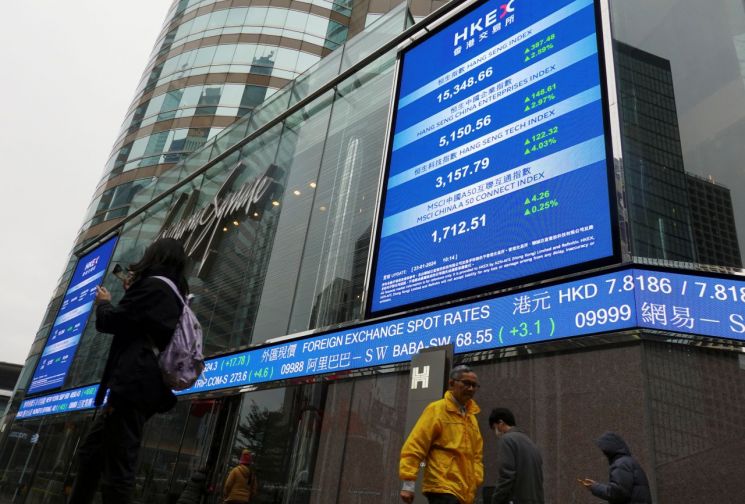
Goldman Sachs also noted that if reports about the Chinese government considering the establishment of a stock market stabilization fund worth 2 trillion yuan (approximately 373.44 trillion KRW) are confirmed to be true, the impact on the market would be very significant. Although the fact has not yet been confirmed, the news led to the Hang Seng Index in Hong Kong closing up 2.63% and the CSI 300 Index rising 0.4% on the 23rd.
Earlier, Bloomberg News reported, citing sources, that Chinese authorities are considering mobilizing about 2 trillion yuan (approximately 370 trillion KRW) from offshore accounts of state-owned enterprises to create a securities market stabilization fund. It was explained that this fund would purchase mainland stocks through the Stock Connect program linking the Chinese mainland and Hong Kong stock markets. The sources also said that at least 300 billion yuan of domestic funds have been allocated to invest in onshore stocks through China Securities Finance Corporation and Central Huijin Investment. Central Huijin Investment is a sovereign wealth fund established in December 2003.
© The Asia Business Daily(www.asiae.co.kr). All rights reserved.

















