The Supreme Court has made its first ruling that, under the Environmental Pollution Damage Relief Act, the causal relationship between environmental pollution damage and the installation and operation of a facility can be sufficiently proven by demonstrating a 'substantial likelihood' that the damage was caused by pollutants emitted from the facility.
Until now, the Supreme Court had held that to recognize liability for damages caused by environmental pollution, the victim must prove the fact that the offending company emitted harmful substances, that these substances reached the victim, and that the damage occurred. This ruling significantly eases the burden of proof on the victim.
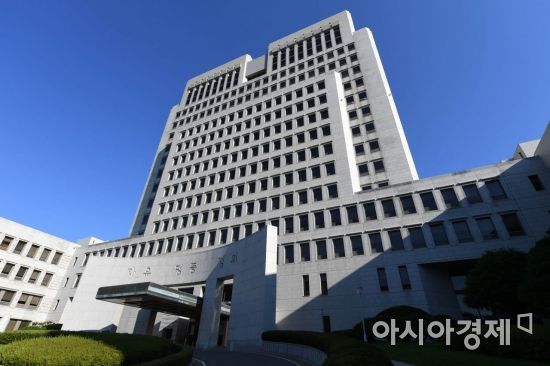
According to the legal community on the 24th, the Supreme Court's 3rd Division (Presiding Justice No Jeong-hee) affirmed the appellate court's partial ruling in favor of the plaintiffs, ordering Lam Technology, a semiconductor chemical manufacturer, to pay 7 million won each to 19 plaintiffs including Mr. Hwang in a damages lawsuit.
The court stated the reason for dismissing the appeal was that "the appellate court's judgment was proper and there was no error affecting the judgment by misunderstanding the legal principles regarding recognition of causality and burden of proof in liability for damages under the Environmental Pollution Damage Relief Act, as argued in the grounds for appeal."
Mr. Hwang and others filed a lawsuit in February 2017 against the company and the state, jointly demanding 20 million won each in compensation, claiming they suffered headaches and respiratory diseases due to a hydrofluoric acid leak accident at Lam Technology's factory in Geumsan, Chungnam, on June 4, 2016.
The first-instance court dismissed the claim against the state but partially accepted the claim against the company, ordering compensation of 5 million won each to the plaintiffs.
The court did not recognize direct physical harm or mental damage caused by physical harm from the hydrofluoric acid leak but acknowledged liability for mental damage caused by anxiety.
The court explained, "Even if direct physical harm or mental damage caused by physical harm did not occur due to the harmful act, if psychological health impairment beyond pure mental distress arises from psychological reactions to the harmful act, it can be presumed based on experience that mental damage occurred due to the harmful act," adding, "Based on experience, it can be seen that the plaintiffs suffered mental damage beyond pure mental distress due to the installation and operation of the factory in this case."
The appellate court increased the compensation amount to 7 million won each.
The court stated, "There is a substantial likelihood that the hydrofluoric acid leaked from the factory dispersed in gaseous form into the air and then fell to the ground, causing damage to the plaintiffs, so it is reasonable to recognize a causal relationship between this accident and the damage suffered by the plaintiffs," and "Therefore, the defendant is liable to compensate the plaintiffs for the damages caused by this accident."
Article 9 (Presumption of Causality) Paragraph 1 of the Environmental Pollution Damage Relief Act stipulates, "When there is a substantial likelihood that a facility caused the occurrence of environmental pollution damage, it shall be presumed that the environmental pollution damage occurred due to that facility."
Paragraph 2 of the same article states, "Whether there is a substantial likelihood under Paragraph 1 shall be determined by considering the operation process of the facility, the equipment used, the types and concentrations of substances input or emitted, weather conditions, the time and place of damage occurrence, the state of damage, and other circumstances affecting the occurrence of damage."
Paragraph 3 of the same article provides that to rebut this presumption of causality, the business operator must prove that the damage was caused by other reasons or that the operator fulfilled their duties by complying with relevant laws, regulations, and permit conditions and making efforts to prevent damage.
Meanwhile, the Daejeon District Prosecutors' Office, which investigated the hydrofluoric acid leak accident, decided not to prosecute Lam Technology and its employees, who were suspected of professional negligence causing injury, based on factors such as the wind blowing from the village toward the factory at the time of the accident, the absence of hydrofluoric acid detected in the victims' urine tests, and the fact that hydrofluoric acid is lighter than air while the factory's elevation is higher than the village.
However, the court judged, "Even though hydrofluoric acid is mostly excreted through urine within 24 hours after entering the body, the absence of hydrofluoric acid in the plaintiffs' urine tests alone does not mean that the symptoms they complain of are unrelated to this accident."
The Supreme Court also found no problem with the appellate court's judgment.
The court stated, "Considering the legislative purpose and intent of the Environmental Pollution Damage Relief Act and the content of related provisions, when holding a facility operator liable for damages caused by environmental pollution, if the victim proves, through various indirect facts stipulated in Article 9 Paragraph 2 of the Act, that there is a substantial likelihood that damage to another person's life, body, or property occurred due to pollutants emitted in connection with the installation and operation of the facility, the causal relationship between the facility and the damage should be presumed."
It added, "At this time, it is not necessary to directly prove that pollutants emitted from the facility reached the victim or the damaged object and caused the damage."
The court concluded, "There is a substantial likelihood that the hydrofluoric acid leaked from the factory dispersed in gaseous form into the air and then fell to the ground, causing damage to the plaintiffs, and there is no other circumstance to deny the causal relationship between this accident and the damage suffered by the plaintiffs."
A Supreme Court official said, "This ruling is the first to declare the legal principle that in compensation liability cases under the Environmental Pollution Damage Relief Act, the burden of proof on the victim regarding causality is eased compared to previous precedents, and if the victim proves a substantial likelihood, causality is presumed," highlighting the significance of this decision.
© The Asia Business Daily(www.asiae.co.kr). All rights reserved.

















