The Era of 10,000 Serving Robots Begins
Robot Solution Supply Increases by 200%
Robots have stepped firmly into our daily lives. Not only in industrial sites such as factories and logistics centers where robots were mainly introduced in the past, but now robots are encountered in various aspects of everyday life. The places where robots work are expanding, including restaurants, offices, hospitals, large shopping malls, and hotels. As demand increases, companies supplying robots are also moving quickly.
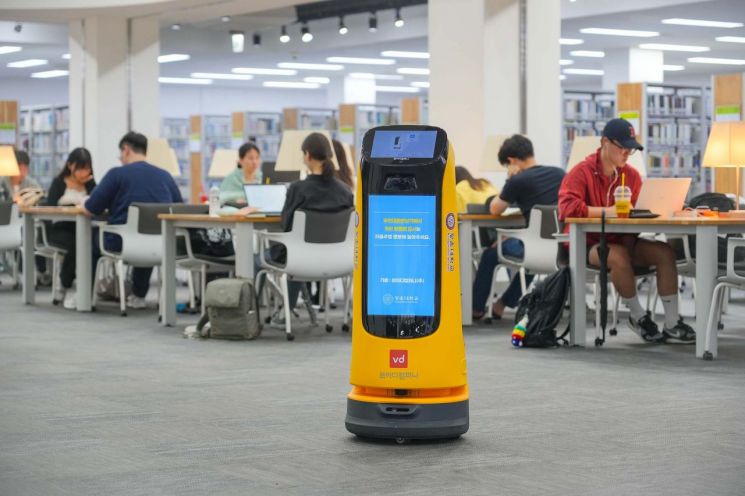 VD Company's serving robot 'Ketibot' is transporting books returned without staff at Kwangwoon University Central Library to the return desk.
On the 24th, B-Robotics announced that it supplied about 1,000 new serving robots last year, currently operating about 2,200 serving robots in 1,600 stores. B-Robotics is a subsidiary of Woowa Brothers and, together with VD Company, forms the leading group in this market. VD Company had already sold 3,000 serving robots by 2022 and set a supply target of 2,500 units last year. The company believes it has achieved this goal. This means that about 5,000 serving robots supplied by these companies are operating nationwide. Adding to this the robots supplied by telecommunications companies such as KT and LG Uplus, which have entered the market as latecomers and are accelerating related businesses based on their nationwide sales networks, the industry estimates that the total number of serving robots distributed nationwide exceeds 10,000 units.
Considering that only about 50 serving robots were first introduced in restaurants in Korea in 2019, the market has grown 200 times in four years. The growth potential still remains. The industry estimates that there are about 700,000 restaurants nationwide, and about 10% of them, 70,000, could adopt serving robots. Moreover, the range of applications for serving robots is expanding recently. They are being introduced not only in food establishments but also in various spaces such as screen golf courses, billiard halls, PC rooms, and libraries. An industry insider explained, "Self-employed business owners who face difficulties in managing manpower due to the burden of labor costs and labor shortages are turning to serving robots."
Besides serving robots, various other robots are being introduced in many places. In particular, sales of cleaning robots have been remarkable. According to Marosol, a robot solution company, sales of cleaning robots increased by more than 500% compared to the previous year. Cleaning robots have mainly been introduced in places requiring clean environment management such as semiconductor factories, hospitals, large shopping malls, and hotels. Cleaning robots have powerful cleaning functions and some models are autonomous, allowing cleaning of necessary areas at desired times without human operation.
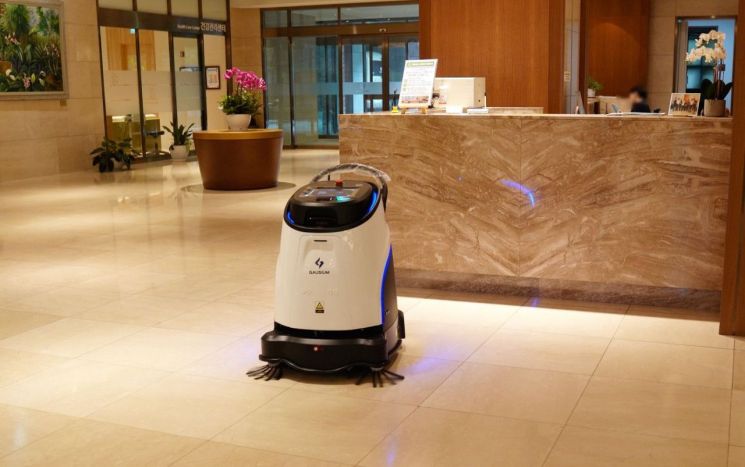
Robots are also actively being introduced in industrial sites. Marosol supplied about 300 robot automation solutions to domestic companies last year, a 200% increase compared to the previous year. Robot automation integrates industrial robots, collaborative robots, and logistics robots organically to automate production processes. Marosol explained that among the 300 robot automation projects, companies showed high interest in logistics robots. Logistics robots are used for various purposes such as sorting, inbound and outbound processing, and transportation of goods. Their use is becoming active in factories, large logistics warehouses, airports, ports, hospitals, and more.
Kim Min-gyo, CEO of Marosol, said, "Last year, by supplying various robot solutions, we focused on restoring the health of the domestic robot ecosystem and spreading robot automation. This year, we will also strive to increase the utilization of the robots that have been distributed."
© The Asia Business Daily(www.asiae.co.kr). All rights reserved.
!["The Woman Who Threw Herself into the Water Clutching a Stolen Dior Bag"...A Grotesque Success Story That Shakes the Korean Psyche [Slate]](https://cwcontent.asiae.co.kr/asiaresize/183/2026021902243444107_1771435474.jpg)

















