"Creation of Worker Residential Complex Completes Gwangju-type Job Policy"
"Public Rental Housing Construction → Not Subject to Greenbelt Total Volume System"
Park Gyuntaek, a preliminary candidate for the National Assembly representing Gwangsan-gu (Gap), Gwangju Metropolitan City, promised the "creation of Gwangju-type job residential complexes and attraction of excellent companies."
On the 23rd, Park announced his fifth pledge at the Gwangju City Council, stating, "We will establish residential complexes for workers to indirectly support the Gwangju-type job policy."
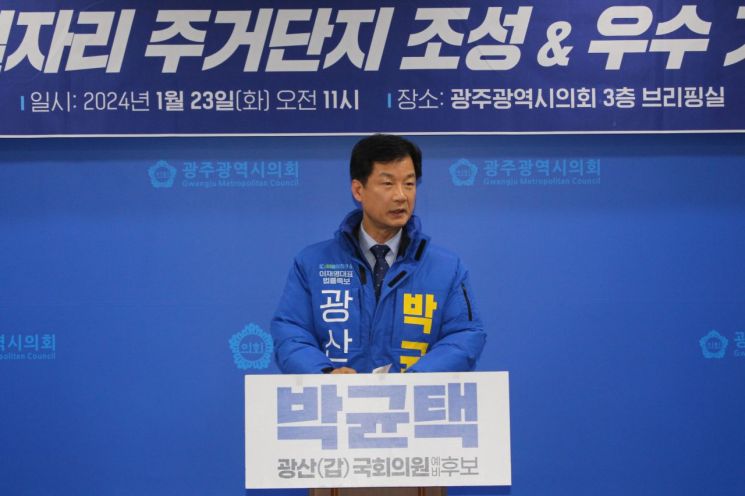
He plans to develop a housing site for 30,000 to 50,000 people near the Bitgreen National Industrial Complex and the future national automotive industrial complex to be established, creating residential complexes for workers.
Park explained that the creation of Gwangju-type job residential complexes involves constructing public rental housing, which is not subject to the total volume control system of development-restricted areas, thereby reducing the burden on Gwangju City.
Park said, "The Gwangju Global Motors automobile factory, the first company under the Gwangju-type job policy, moved in without having the infrastructure for indirect support such as residential complexes, so workers are not receiving indirect residential support," adding, "Other companies that previously expressed their intention to move into the Bitgreen Industrial Complex are also postponing their move because the indirect support system promised by Gwangju City has not been established."
He also emphasized, "By faithfully providing indirect support such as housing, education, and medical guarantees promised by the state while promoting the Gwangju-type job policy, we will not only operate companies already settled in Gwangju normally but also attract excellent companies to Gwangju in the future to revitalize the local economy and create jobs for young people."
He added, "The Gwangju-type job policy was incorporated as a national policy during the Moon Jae-in administration, and the Ministry of Land, Infrastructure and Transport finalized plans to create residential complexes for indirect support, but it was postponed due to the change of government," and said, "We will expedite its implementation from the perspective of balanced regional development."
Meanwhile, the Gwangju-type job policy is a measure discovered by Gwangju City to improve the poor corporate environment in local areas and create new jobs. The core idea is to lower the apparent wages to about 50% of those of general large corporations to prevent local young people from moving to other regions due to low wages, while matching the level of general large corporations through indirect support.
The indirect support method involves Gwangju City providing long-term permanent rental apartments, opening municipal daycare centers and kindergartens, and building municipal or designated hospitals to reduce housing, education, and medical expenses, thereby indirectly supporting workers' income.
© The Asia Business Daily(www.asiae.co.kr). All rights reserved.

![Clutching a Stolen Dior Bag, Saying "I Hate Being Poor but Real"... The Grotesque Con of a "Human Knockoff" [Slate]](https://cwcontent.asiae.co.kr/asiaresize/183/2026021902243444107_1771435474.jpg)















