‘Clean Hydrogen Power Bidding Market’ Webinar
Discussion on Corporate Strategies in the Hydrogen Market
"Rapid Growth from 2030"
As the global hydrogen market is expected to grow exponentially from 2030 onwards, the government plans to propose the Hydrogen Business Act this year and open the world's first clean hydrogen power generation bidding market within the first half of the year. In line with the successive introduction of hydrogen-related regulations and systems, there are calls for companies to develop scenario-based response strategies.
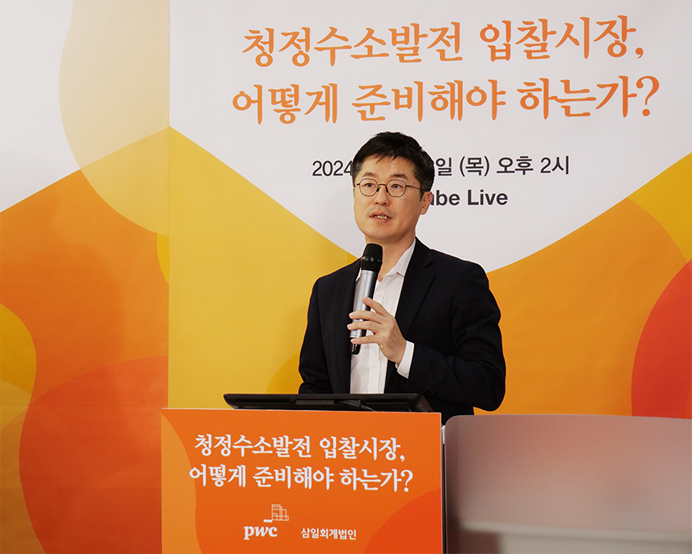 Han Jeong-tak, Partner at Samil PwC, is giving a presentation on the topic of "Economic Feasibility Review of Hydrogen Power Generation Projects." [Photo by Samil PwC]
On the 19th, Samil PwC announced, “We held a webinar on the previous day titled ‘How to Prepare for the Clean Hydrogen Power Generation Bidding Market.’” The webinar was conducted under two themes: ‘Hydrogen Market Trends and Hydrogen Business Models’ and ‘Clean Hydrogen Power Generation Bidding Market System and Participation Strategies,’ aiming to help companies interested in entering the clean hydrogen power generation bidding market understand and prepare for it. More than 400 corporate representatives participated.
The bidding market, scheduled to open in the first half of this year, is a system where hydrogen power generation companies, as clean hydrogen power suppliers, competitively bid on purchase volumes to supply hydrogen-generated electricity to buyers (Korea Electric Power Corporation or regional electricity operators). The government plans to open the bidding market as the world’s first to promote competition among power generation technologies and induce price reductions.
In the first part of the webinar, J?rgen Peterseim, a global hydrogen expert at PwC, shared trends in the global hydrogen market. He emphasized, “The global hydrogen market will focus on infrastructure development intensively over the next five years and then grow exponentially from 2030 onwards. If we do not start the hydrogen economy now, we will miss the opportunity.” He presented the necessary conditions to start the hydrogen economy as ▲cost reduction through economies of scale ▲timely regulations ▲securing a demand base willing to pay a green premium.
Kim Il, an official from the Ministry of Trade, Industry and Energy, lectured on the government’s hydrogen industry roadmap. He said, “It is necessary to diversify and scale up demand currently centered on fuel cells for passenger cars and shift from gray hydrogen to clean hydrogen-based sources.” He introduced the government’s hydrogen economy activation strategy, consisting of ▲scale-up (economies of scale) ▲build-up (infrastructure development) ▲level-up (technology acquisition), and shared the achievements so far.
Wonseok Yoo, a partner at PwC Consulting, introduced various overseas companies’ business models under the theme ‘Suggestions for Domestic Companies’ Hydrogen Business Models.’ He also emphasized, “Since the economic viability of the hydrogen business itself has not yet been secured, it is important to understand the government’s policy framework and prepare accordingly.”
In the second part, Dr. Lim Yeon-i from the Korea Power Exchange’s Hydrogen Market Team explained the operational plan and evaluation methods of the clean hydrogen bidding market. Partner Han Jung-tak also gave a lecture on ‘Economic Feasibility Review Related to Hydrogen Power Generation Business’ and discussed companies’ bidding preparation strategies. Partner Han said, “It is important to consider not only macroeconomic factors but also market trends when reviewing the economic feasibility of power generation projects and calculating bid prices,” adding, “Companies preparing for clean hydrogen bidding should monitor exchange trends and prepare bids through various simulations.”
Additionally, during the Q&A session, when asked about ‘Key points companies should focus on for this year’s general hydrogen and clean hydrogen bidding,’ Partner Han responded, “Since the clean hydrogen bidding is newly introduced and some aspects, including the power generation period, have not yet been decided, it is necessary to conduct multifaceted scenario analyses,” and added, “From the perspective of operators or financial institutions, it is advisable to observe until the final plan is confirmed and approach as conservatively as possible.”
© The Asia Business Daily(www.asiae.co.kr). All rights reserved.

















