Venture Industry Aims for Global Market Entry through Innovation Growth This Year
Ministry of SMEs and Startups Takes Active Steps for Startup Global Expansion
This year, South Korea's venture and startup companies will actively pursue entry into the global market. Both the government and the venture industry have identified 'globalization' as a key priority for this year. Although globalization has been continuously emphasized across all industrial sectors for the growth of our economy, the overseas expansion rate of startups remains below 10%, showing minimal results. This year, with the determination of Oh Young-joo, Minister of SMEs and Startups, who comes from the Ministry of Foreign Affairs, the industry is also showing proactive efforts, raising expectations higher than in previous years.
Venture Industry, ‘Global Market Entry through Innovative Growth'
On the 19th, Seong Sang-yeop, Chairman of the Korea Venture Business Association, stated at the ‘2024 Innovative Venture Industry New Year Meeting’ held at EL Tower in Seocho-gu, Seoul, “This year, we must focus on innovative growth rather than crisis, discover innovative ideas, and challenge technological innovation and global market entry through research and development (R&D).” He added, “Venture companies are still confined to the domestic market, which accounts for only about 1% of the global gross domestic product (GDP), so globalization is an essential task to achieve growth for venture companies.” They set ‘Global Market Entry through Innovative Growth’ as this year’s goal.
The Ministry of SMEs and Startups has significantly strengthened support policies related to startups this year. The budget for startup support is 3.4038 trillion KRW, larger than the record-high budget in 2022. In particular, support projects for overseas expansion of startup companies and activation of domestic startups by overseas talent have increased by eight items compared to the previous year, with the budget rising by 27.3 billion KRW. Specifically, there is the ‘2024 Ultra-Differentiated Startup 1000+ Project.’ This ultra-differentiated project is a five-year (2023?2027) public-private joint initiative investing 2 trillion KRW to nurture over 1,000 foundational technology startups in 10 new industry sectors such as system semiconductors and artificial intelligence (AI), which will lead the future of the national economy. Following the selection of 275 new startups last year, about 380 new ultra-differentiated startups are planned to be selected this year.
Venture companies hesitate to enter overseas markets due to lack of experience, funds, and personnel, and even after entry, they face difficulties due to lack of buyer discovery and market information. According to a venture company survey announced last year by the Ministry of SMEs and Startups, only 22.3% of venture companies are exporters, and among those exporters, only 17.8% have directly entered overseas markets through branch or subsidiary management. Venture companies cited ‘buyer discovery’ and ‘lack of overseas market information’ as obstacles to overseas expansion. The stagnation of global capital inflow is also a factor hindering venture companies’ exports. The domestic investment amount by overseas venture capital (VC) global funds decreased from 117.3 billion KRW in 2019 to 109.4 billion KRW in 2020 and 80.4 billion KRW in 2021.
The industry’s efforts to achieve the goal of global market entry have already begun. The Korea Venture Capital Association plans to focus this year on market regulation reform, expansion of private capital bases, and deregulation of corporate venture capital (CVC). The Korea Women’s Venture Association will seek to discover overseas private organizations supporting women entrepreneurs’ growth and expand the signing of memorandums of understanding (MOUs) for information exchange and business cooperation between companies. They have requested the government to establish and operate a control tower to oversee venture companies’ global expansion policies, which are currently scattered across ministries. A representative from the Korea Venture Business Association said, “Rather than supporting individual companies’ global expansion, we need to strengthen strategic connections by creating infrastructure such as capital, personnel, and technology input factors for companies.” He added, “Globalization of companies should aim to establish local factories through overseas investment, hire local personnel, finance through local capital, and foster cooperation between our personnel and local personnel.”
Ministry of SMEs and Startups Takes the Lead in Startup Global Expansion
The government also plans to focus its policy capabilities this year on the globalization of the venture and startup ecosystem. Minister Oh Young-joo of the Ministry of SMEs and Startups said, “Considering the borderless digital economy era and the limited domestic market, overseas expansion of startups is not a choice but a necessity.” He emphasized startup global expansion in his inauguration speech on the 2nd of this month.
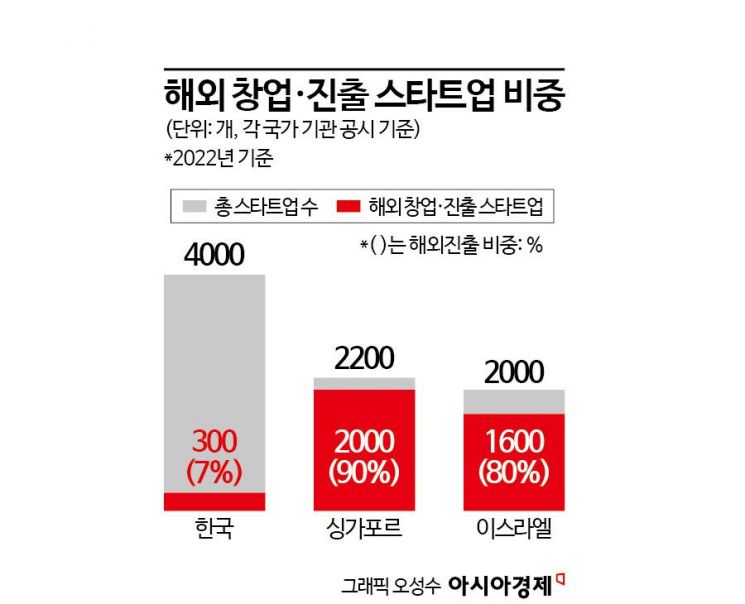
The reason Minister Oh repeatedly stresses strengthening support policies for startup globalization lies in the poor domestic startup environment. According to the ‘2023 Startup Korea’ report by the Asan Nanum Foundation, which studied the global openness of the Korean startup ecosystem last year, as of 2022, there were only about 300 cases where Korean founders started startups overseas or Korean startups expanded abroad. This is significantly lower compared to Singapore (about 2,000 cases) and Israel (1,600 cases). In terms of proportion, Korea’s rate was only 7% among about 4,000 unlisted startups, while Singapore and Israel had overseas expansion rates of 90% and 80%, respectively.
Minister Oh said, “For innovative products of venture companies to be spotlighted and grow in the global market, active overseas expansion, smooth supply of talent, timely investment and funding for corporate growth need to be evenly supported, and it is necessary to actively utilize the government’s various overseas bases.”
© The Asia Business Daily(www.asiae.co.kr). All rights reserved.


















