Minjoo to Receive Nomination Criteria Suggestions via Party Website
'Overrepresentation of Hardline Supporters'... "Will Ensure Transparency"
Im Hyuk-baek "Will Set Criteria After Consulting 500,000 Citizens"
The Democratic Party of Korea decided to apply a 25% additional score for female, youth, and disabled candidates while implementing the 'National Participation Nomination System' for the April 10 general election. As the People Power Party introduced a 'system nomination' and started to replace senior lawmakers with three or more terms, competition for 'nomination innovation' is heating up.
The Democratic Party's Nomination Management Committee held its second meeting on the afternoon of the 18th at the party headquarters in Yeouido, Seoul, to discuss the operation method of the newly introduced National Participation Nomination System, nomination screening criteria, and methods. Lim Hyuk-baek, chairman of the Nomination Committee, explained about the National Participation Nomination System, saying, "The public does not directly nominate candidates, but sets the criteria for nomination." He added, "We will gather opinions from about 500,000 people through public opinion polls, YouTube, and the party homepage to establish the nomination criteria."
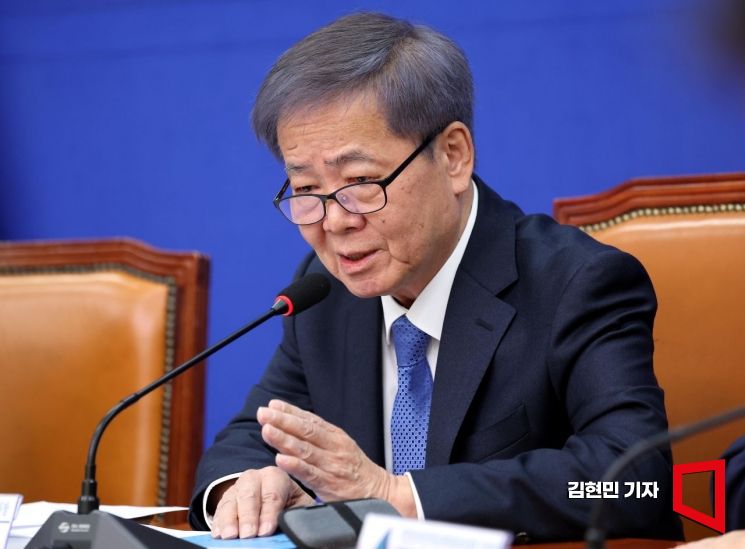 Im Hyuk-baek, Chair of the Nomination Management Committee of the Democratic Party of Korea, is presiding over the 1st Central Party Public Office Candidate Recommendation Management Committee meeting held at the National Assembly on the 12th. Photo by Kim Hyun-min kimhyun81@
Park Hee-jung, spokesperson for the Nomination Committee, told reporters immediately after the meeting, "We discussed the screening criteria and primary election methods for candidates in the 22nd general election," and added, "It was decided to add 25% to the screening scores for women, youth, and disabled candidates." She emphasized, "There was discussion about the National Participation Nomination System. It is the Democratic Party's system nomination where the public participates from the stage of establishing nomination criteria."
Specifically, she explained, "Based on the nomination criteria in the party constitution and regulations, detailed evaluation indicators will be used, and various methods such as public opinion polls targeting 2,000 people, collecting opinions through the homepage, and analyzing public opinion reflected in the media will be conducted."
Regarding concerns that "strong supporter opinions might be overly reflected," she dismissed them by saying, "The scoring items for screening will be quantified so that they cannot be arbitrarily manipulated," and added, "Rather, transparency and rationality will be strengthened, which can prevent such issues."
Assemblyman Kim Byung-gi, who attended the Nomination Committee meeting, commented on the fact that individuals with criminal allegations or moral controversies were deemed eligible as preliminary candidates, saying, "The difference between the People Power Party's nomination system and the Democratic Party's nomination system is that there is a verification committee in advance." He added, "The Nomination Screening Committee discusses based on the evaluation of the verification committee, including political evaluation, identity, contribution, and morality." He further explained, "Eligibility or ineligibility does not mean receiving the nomination but gaining the qualification to apply to the Nomination Screening Committee, nothing more and nothing less," comparing it to "just as one must have a high school diploma to enter university."
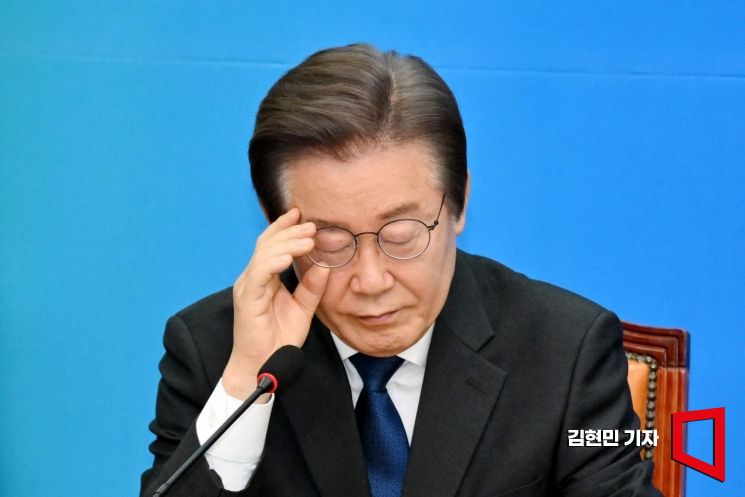 Lee Jae-myung, leader of the Democratic Party of Korea, is giving a greeting speech at the welcoming ceremony for Kim Yong-man, the 8th recruited talent and director of the Provisional Government of the Republic of Korea Memorial Project Association, held at the National Assembly on the 17th. Kim, who was recruited as talent on this day, is the great-grandson of Baekbeom Kim Gu. Photo by Kim Hyun-min kimhyun81@
Although the Democratic Party is repeatedly contemplating innovation ahead of the full-scale nomination process, noise continues as pro-Lee Jae-myung faction figures, who sparked controversy over 'assassin candidacies,' have consecutively passed the central party verification committee's screening.
The '12th verification screening pass list' announced by the verification committee on this day included Kim Woo-young, standing representative of the Democratic Party's National Innovation Council, and Yang Moon-seok, former standing commissioner of the Korea Communications Commission. Both are considered pro-Lee Jae-myung faction figures and have thrown their hats into the ring for Seoul Eunpyeong-eul and Gyeonggi Ansan Sangnok-gap, respectively. Seoul Eunpyeong-eul is the constituency of Kang Byung-seon, a two-term lawmaker classified as anti-Lee faction, and Ansan Sangnok-gap is the constituency of Jeon Hae-cheol, a three-term lawmaker.
Regardless of the pro-Lee or anti-Lee issue, both Kim, the standing representative, and Yang, the former standing commissioner, were deemed eligible despite having been disciplined by the party recently, which is expected to continue controversies over the fairness of the verification committee.
Kim, the standing representative, announced his intention to run in Seoul Eunpyeong-eul last December while maintaining his position as Gangwon Provincial Party Chairman and received a 'warning' sanction. Yang, the former standing commissioner, was punished with a '3-month suspension of party duties' last November after criticizing Assemblyman Jeon Hae-cheol as a 'subak' (watermelon). 'Subak' is a slang term used by Lee Jae-myung's hardcore supporters to disparage the anti-Lee faction, meaning 'democratic on the outside, People Power Party on the inside.'
© The Asia Business Daily(www.asiae.co.kr). All rights reserved.


















