Expectations for the Launch of the Space Aviation Agency
"I hope that the tasks previously handled by KAERI are carried out as much as possible by the industry. Instead, KAERI should focus on proactive research on future new technologies and utilization strategy technologies."
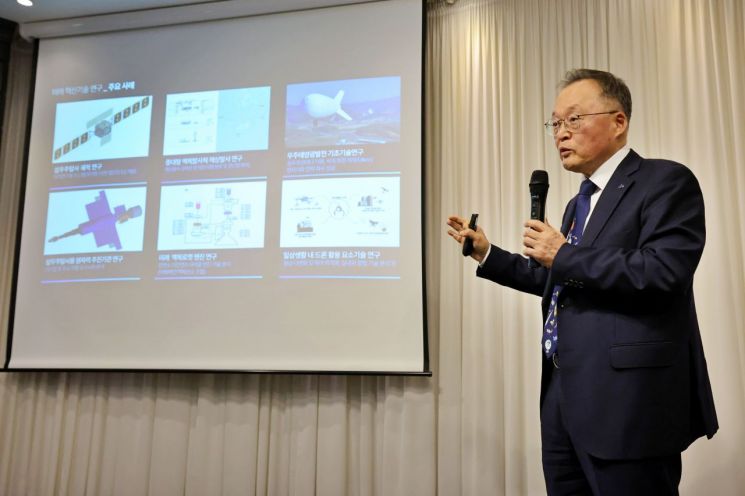 ???????? Han????????????????????? ???????? 18??? reporter is making a statement. Photo by Hangwoo Research Institute
Lee Sang-ryul, President of the Korea Aerospace Research Institute (KARI), said this during a press briefing at a restaurant in Jongno-gu, Seoul, on the 18th. He emphasized the need for a change in KARI's role as it moves under the newly established Korea Space Agency (KSA) by the end of May. He argued that Korea's declaration to participate in the U.S.-led Artemis manned lunar exploration program lacks substance and that changes aligned with new aerospace policies are necessary.
President Lee stated, "From a technical perspective, we should do as much as we can, but the industry should be enabled to develop the new space industry."
He explained that KARI should handle issues of national interest such as space solar power, space debris collection, space factories, and planetary habitation. Other areas should be managed by the private sector.
He also expressed hope that "for areas not pursued solely by the military, once the Korea Space Agency is established, KARI should take a more leading role through the civil-military cooperation center."
President Lee claimed that Korea's participation in the U.S.-led Artemis manned lunar exploration program is merely declarative. He said, "Although the government consistently invests in space development, it remains at the level of declarative plans, and there is too much that has not been actually done beyond what is visible."
He added that discussions between the government and the U.S. on Artemis participation began in 2017, but there is still no substantial progress.
He diagnosed that this situation stems from the fact that government-funded research institutes, which should proactively move for future innovation, did not have concrete plans. Ultimately, R&D is trapped within budgetary systems, so there is no unique plan tailored to align with the U.S. program. He also pointed out that the government does not plan properly.
He continued, "Institutional changes are necessary to produce better results than now," expressing hope that the Korea Space Agency will serve as an effective control tower for the aerospace industry after its establishment.
President Lee said he will launch a task force (TF) next week to organize and convey KARI's opinions for the transfer under the Korea Space Agency.
He expected that the launch of the Korea Space Agency will become an opportunity for the government and government-funded research institutes to cooperate closely again. He said, "When space research first started in the early 1990s, the government and research institutes really moved as 'one team,' but now there seems to be a gap. I hope we can work as one team again like in the past."
President Lee said it would not be a problem even if personnel necessary for the Korea Space Agency's establishment leave KARI. Rather, he said KARI personnel should move to the space agency to help build the still non-existent leading institution. He also predicted that it is not necessary to secure all 300 personnel announced by the government before the Korea Space Agency's launch.
© The Asia Business Daily(www.asiae.co.kr). All rights reserved.
![Clutching a Stolen Dior Bag, Saying "I Hate Being Poor but Real"... The Grotesque Con of a "Human Knockoff" [Slate]](https://cwcontent.asiae.co.kr/asiaresize/183/2026021902243444107_1771435474.jpg)
















