Care Classroom Complaints Up 45% Over 3 Years
Concentrated in Winter Break Months of January to March
Challenges Remain with This Year's Neulbom School Implementation
Lee Eun-hye (38), a dual-income parent raising a first grader in Gunpo-si, Gyeonggi Province, recently enrolled her child in a local art academy. She had planned to leave her child at the school's 'Elementary Care Classroom' during the winter vacation period, but she received a text message saying that her child was placed on the 'waiting list' after failing to be selected in the lottery for 40 spots.
When she inquired about the waiting situation with the school, she was told, "The chances are almost none." Ultimately, Lee decided to leave her child at a study room and art academy three days a week and with her parents for two days.
Lee said, "I heard that the winter vacation is about twice as long as the summer vacation, so more applicants apply for the care classroom. No matter what, I was relying solely on the elementary care classroom, but when I actually received a waiting list number, I felt completely lost."
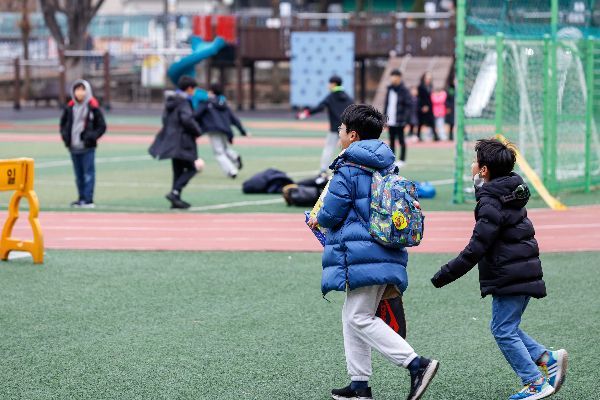
"Few spots and strict qualifications"... Winter care classroom complaints up 45%
As winter vacation begins, concerns about 'care gaps' among dual-income parents with young children are growing. Although each education office operates elementary care classrooms for dual-income parents, many parents either cannot use the system because they are not selected in the lottery or must use additional private education due to reduced operating hours compared to the school term.
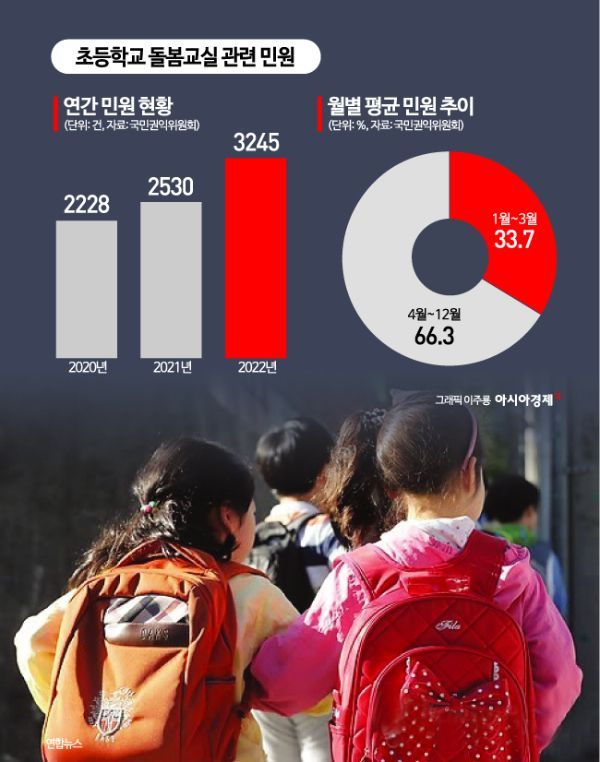
According to the 'Elementary Care Classroom Complaints in the Last 3 Years' announced by the Anti-Corruption and Civil Rights Commission, the number of complaints about elementary care classrooms received in 2022 was 3,245, a 45% increase compared to 2,228 in 2020. Complaints have been on the rise: 2,228 in 2020, 2,530 in 2021, and 3,245 in 2022.
Looking at the monthly data, January to March, which includes winter vacation and the new semester, accounted for 898 complaints, or 33.7% of the total. The main complaints were requests for expansion of care classrooms, objections to the selection of care classroom recipients, and demands for improved operation of care classrooms.
Elementary care classrooms refer to care activities conducted outside regular learning hours for families in need of care, such as grandparent-headed households, single-parent families, and dual-income parents. The Ministry of Education recommends operating elementary care classrooms from 1 p.m. to 5 p.m. and targeting all grades (1st to 6th grade). However, detailed operational guidelines are autonomously set by schools due to varying learning conditions by city, province, and school.
An official from the Ministry of Education said, "In principle, we recommend that elementary care classrooms operate the same hours during both semesters and vacations, but since conditions such as personnel and facilities differ by region, we cannot enforce this, and operation hours, target students, and capacity are left to the schools' autonomous guidelines."
Given this situation, parents who desperately need care but cannot use the system are left relying on a "roundabout" of private academies. Schools lacking adequate facilities and personnel have significantly shortened the operating hours and periods of care classrooms during winter vacation. Kim (42), raising a second grader in Gimhae-si, Gyeongnam Province, said, "When I recently inquired at the school, they said the winter vacation is two months, but the care classroom operates for only five weeks. I don't know how to manage the rest of the time, so my husband and I are looking into piano academies."
Students classified as upper elementary grades (3rd to 6th grade) are often excluded from support. Most benefits go to 1st and 2nd graders who need care due to limited capacity, and the slots are filled before additional priority is given to upper graders.
Park Sung-ho (43), raising a third grader in Eunpyeong-gu, Seoul, said, "I asked the homeroom teacher about the care classroom, and was told that although my child can apply, the chances are almost none because upper graders are lower priority. I think it's unfair because kids in 3rd grade are not yet adults who can handle everything on their own."
This year’s 'Neulbom School' initiative... concerns remain
The government plans to fully implement 'Neulbom School' this year, operating from 7 a.m. to 8 p.m. to address such care gaps. It combines the previously implemented 'care classroom' and 'after-school program' concepts, providing year-round learning and play education for children in need of care.
After piloting the program last year in 459 schools across 8 education offices, it will be expanded nationwide this year. The target grades will start with 1st and 2nd graders and gradually expand to all grades.
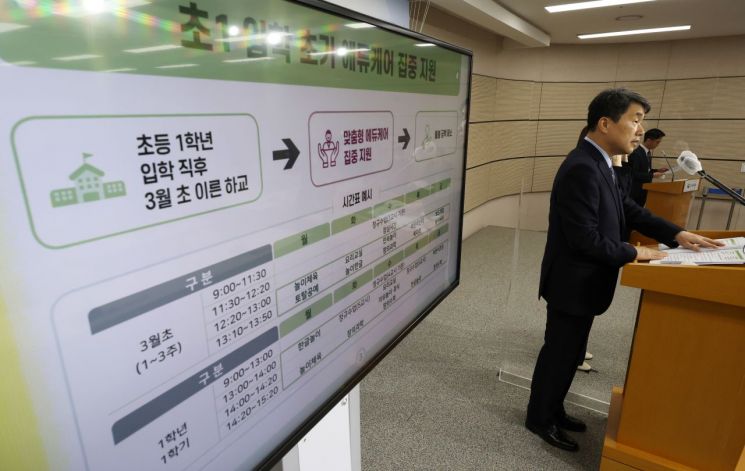 Deputy Prime Minister and Minister of Education Lee Ju-ho is announcing the plan to promote Neulbom School in January last year.
 [Image source=Yonhap News]
However, experts warn that rushing to implement Neulbom School without resolving issues revealed in existing care classrooms could lead to repeating the same problems. There are also calls for alternative solutions to fill care gaps until Neulbom School is fully established.
Lee Min-jung, Policy Director at the Korea Federation of Teachers' Associations, said, "During the operation of existing care classrooms, many teachers had to use their personal time to handle miscellaneous tasks due to lack of space and teacher recruitment issues. If these problems are not resolved and the expanded concept of Neulbom School is operated, the same side effects will inevitably repeat."
Professor Yoon Sang-chul of Hanshin University’s Department of Sociology suggested, "Alternatives are needed to fill care gaps for dual-income parents until Neulbom School is implemented. One option could be establishing additional childcare facilities through collaboration with local governments."
© The Asia Business Daily(www.asiae.co.kr). All rights reserved.



















