Seoul-Tokyo Price Inversion Deepens
Average Lunch Prices in Major Metropolitan Business Districts
Yeouido 12,800 KRW · Gangnam 10,800 KRW
In Japan, One Meal from Food Trucks... Increase in Dosirak Jok
"Korean office workers seem to think of lunch as costing over 10,000 won, while in Japan it's about 5,000 won."
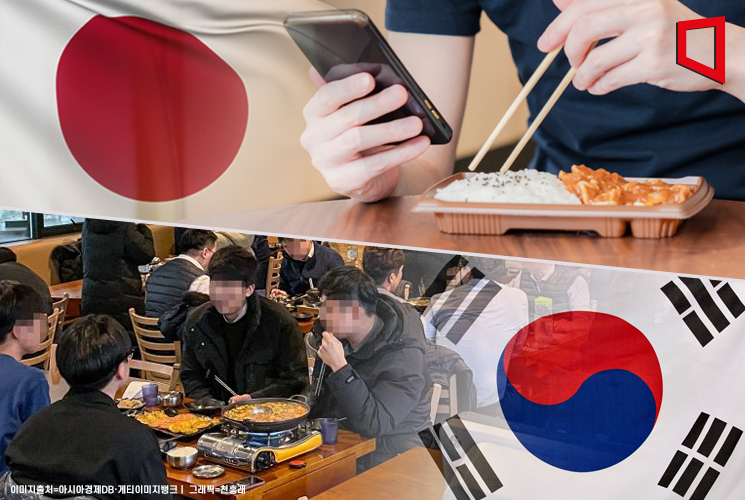
Mr. Song, a man in his 30s who frequently travels to Japan for business, said that when asked how much office workers in the two countries spend on a meal, the price of lunch in Korea is about twice that of Japan. In fact, it has been found that Korean office workers usually spend nearly twice as much on lunch compared to their Japanese counterparts. Due to rising prices of ingredients, labor costs, and other factors, lunch menu prices have also increased, causing a serious price inversion phenomenon between Tokyo and Seoul amid the effects of 'lunchflation.'
Average Lunch Price in Major Seoul Metropolitan Business Districts: 10,000 to 12,000 Won Range
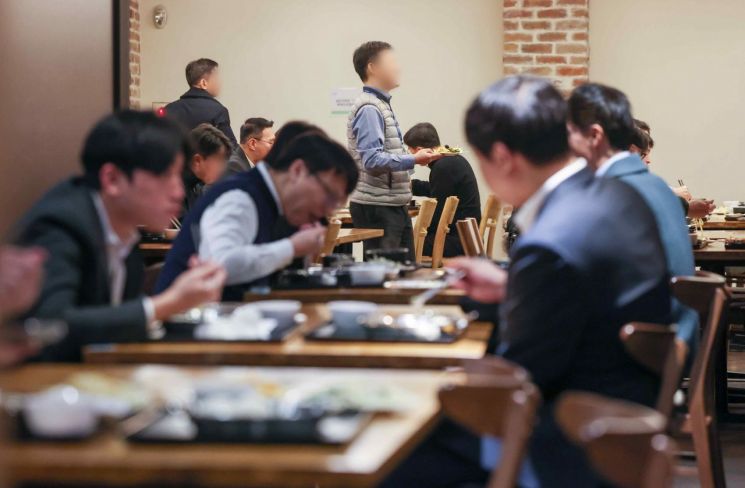
Office workers in Seoul and the metropolitan area, where many companies are concentrated, are already finding it difficult to buy lunch with just a 10,000 won bill. According to an analysis by KB Kookmin Card of card usage amounts during lunch hours from January to May last year in five major business districts (Yeouido, Gangnam, Gwanghwamun, Guro, and Pangyo), the average lunch payment in Yeouido was 12,800 won. In Gwanghwamun, it was 12,400 won, and in Gangnam, 10,800 won.
According to the Korea Consumer Agency's comprehensive price information portal 'Chamgagyeok,' the average price of eight major dining items in Seoul last month rose by 6% compared to a year ago. The price of a single serving of kimchi jjigae set meal surpassed 8,000 won. One serving (200g) of samgyeopsal (pork belly) costs 19,429 won, naengmyeon (cold noodles) 11,308 won, bibimbap 10,577 won, and samgyetang (ginseng chicken soup) 16,858 won.
Meal costs in company cafeterias are also rising sharply. The consumer price index for cafeteria meals increased from 2.6% in 2020 to 4.2% in 2021, and soared to 6.9% last year. Notably, last year's increase was 1.9 times the overall consumer price inflation rate of 3.6%. It also exceeded the rise in dining-out prices (6.0%) and processed food prices (6.8%), which are representative food price indicators. Not only cafeterias but also convenience store lunchbox prices, which were an affordable alternative meal, are rising rapidly. Among processed food subcategories last year, the price increase rate for convenience store lunchboxes was 5.2%, 2.5 times higher than the previous year's 2.1%.
Average Lunch Price for Japanese Office Workers: 5,000 to 6,000 Won Range
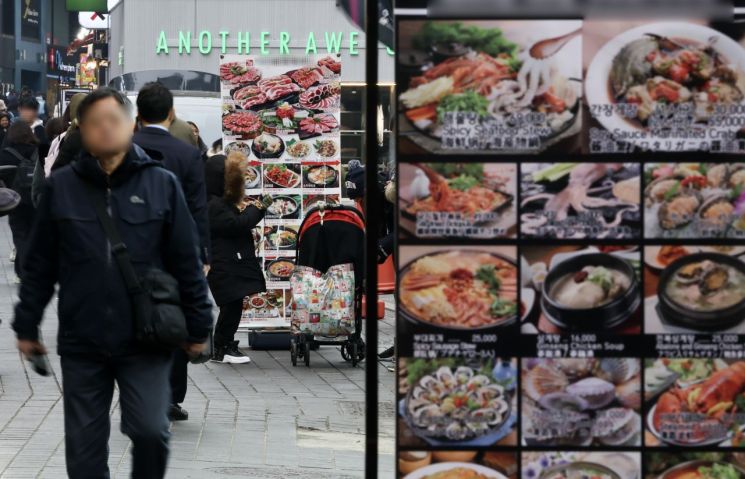
On the other hand, the lunch cost borne by Japanese office workers is about half that of Seoul. Looking at a report on pocket money for office workers released by Japan's SBI Shinsei Bank on the 18th, the average lunch price for male office workers in 2023 was 624 yen (5,700 won), and for females, 696 yen (6,357 won). Another survey by Japanese loan-type crowdfunding company Lendex, targeting Japanese male office workers aged 20 to 50, found that 22.6% said they spend less than 500 yen (4,540 won) on lunch daily, and 26.1% said they bring their own lunchbox and do not spend money at all.
Even the half-price lunch cost is a significant burden for Japanese office workers. Due to a long-standing deflationary trend, inflation rates were low, but since last year, Japan has experienced inflation exceeding 2% for the first time in 41 years, causing prices to soar. The most popular lunch menu among Japanese office workers is beef bowl 'gyudon.' The famous gyudon franchise Yoshinoya raised prices last year again after a price increase in 2021, the first in seven years. The regular size gyudon price increased by 18 yen (163 won) from the previous price. The new price, including tax, is 468 yen (4,249 won). Japanese people complain that the price is too high, but from a Korean perspective, it seems like a price that still yields profit.
Although it looks cheap to us, restaurant prices in Japan have risen so much that relatively inexpensive meal solutions are popular. For example, rice balls sold at food trucks called 'kitchen cars' roaming office districts, priced at 250 to 300 yen (2,600 to 2,700 won), are popular. Convenience store lunchboxes can usually be purchased from 300 to 500 yen (2,700 to 4,500 won). Due to high prices, convenience store franchises like Lawson are competing by releasing low-priced lunchboxes. Lawson's 'Lawson Store 100,' which mainly sells low-priced items, introduced a '200 yen lunchbox' containing rice and one side dish such as pork cutlet, which became wildly popular. It is a lunchbox that can be bought for about 1,800 won. In short, if one wants, they can have lunch with a single 500 yen coin, which is called a 'one coin lunch' in Japan.
Severe Lunchflation... Increase in Lunchbox Users in Japan
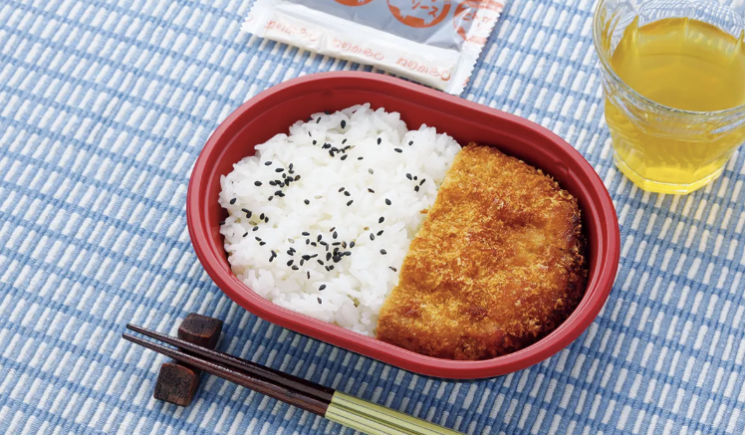 A 200 yen (approximately 1800 won) lunchbox released by Japan's Lawson 100 Store. (Photo by Lawson 100 Store)
Some Japanese office workers who even find this burdensome bring their own lunchboxes. During lunch hours, it is not uncommon to see office workers in suits eating lunch alone in parks or company break rooms. A 20-something Japanese reporter based in Tokyo, who requested anonymity, said, "If I don't have plans, I buy rice balls or lunchboxes from convenience stores and eat them at the office," adding, "Tokyo's prices are high, so it's hard to imagine eating at restaurants every day for lunch."
Foreign media have also paid attention to this unique culture. The British daily The Guardian reported on Japanese office workers' lunch habits, stating, "Japan, the world's third-largest economy, is struggling with a cost-of-living crisis as most food prices have risen over the past year," and analyzed that "frugality ranks first in office workers' lunch menu choices."
Recently, even student cafeterias where meals cost 400 to 500 yen (3,600 to 4,520 won) have seen office workers in suits entering. At the University of Tokyo, due to increased entry of outsiders during lunch hours, a notice was posted requesting understanding that only school affiliates be allowed during certain times. Da-eok Kwon, a university student studying in Tokyo, said, "Since the issue of rising prices in Japan became prominent, many outsiders in suits have been coming to student cafeterias," and added, "In schools located in central Tokyo, it is now common to see students and office workers mixed during lunch hours." Although hard to believe, the inflation felt by office workers in Japan has grown so much that calls for government countermeasures are increasing.
Professor Eunhee Lee of Inha University's Department of Consumer Studies said in a phone interview with Asia Economy, "Due to factors like the weak yen and exchange rates, a perfect comparison between the two countries is difficult, but it is necessary to reflect on the dining-out prices in Korea," adding, "It is time to check whether the burden is increasing due to rising costs in the distribution process or price hikes following word of mouth."
© The Asia Business Daily(www.asiae.co.kr). All rights reserved.



















