Industrial and Energy R&D Innovation Round Table
Support for High-Difficulty Projects Increased from 1% to 10%
Large-Scale Projects Over 10 Billion KRW Increased from 57 to 160
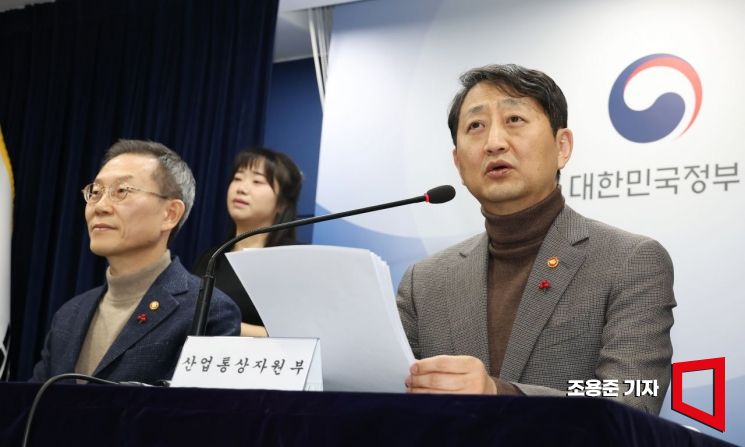 Minister of Trade, Industry and Energy Anduk Geun (right) and Minister of Science and ICT Lee Jong-ho are announcing the public discussion on livelihood (semiconductor sector) and related major policy matters with the people on the 15th at the Government Seoul Office in Jongno-gu, Seoul. Photo by Jo Yong-jun jun21@
The government has decided to discontinue subsidy-type research and development (R&D) support. Instead, it will focus the R&D budget on developing next-generation technologies that are difficult for the private sector to challenge.
On the 18th, the Ministry of Trade, Industry and Energy held an 'R&D Innovation Round Table' chaired by Minister An Deok-geun at Samsung Electronics' Seoul R&D Campus and announced the 'Industrial and Energy R&D Investment Strategy and Institutional Innovation Plan.' The ministry explained that it had gathered field voices by meeting with about 500 researchers over more than 20 sessions.
First, the ministry will stop subsidy-type R&D support and concentrate support on world-class, challenging R&D. It will focus 70% of the ministry’s new budget on 40 ultra-gap projects across 11 major fields. This year, the public and private sectors will jointly invest 2 trillion won (1.3 trillion won from the government) to strengthen selection and concentration.
Investment in the development of 10 major changer technologies with a high failure rate but great ripple effects upon success, and technologies to solve industrial challenges, will increase from the current level of about 1% to around 10% over the next five years. To this end, a preliminary feasibility study for the 1 trillion won scale 'Alchemist Season 2' will be promoted.
The project system will be reorganized to focus on large-scale projects. The number of projects exceeding 10 billion won will increase significantly from 57 in 2023 to 160 this year. To encourage participation by excellent companies, the cash burden ratio of companies in research funding will be reduced by up to 45 percentage points (p), and R&D projects will be kept confidential if they involve corporate secrets.
To rapidly absorb and commercialize advanced overseas technologies, international joint research on 180 source technologies will also commence this year.
The government will shift the R&D process to be demand-driven. The government will only present challenging goals, while companies and researchers will lead project planning. More than 10 pilot cascading projects will be introduced, granting the lead institution authority to form consortia and allocate research funds. In particular, the investment-linked R&D method, where the government provides matching support to companies that receive private investment, will be greatly expanded.
The Program Director (PD) will move beyond the existing role of project planning to serve as the overall manager supporting the entire R&D cycle, including selection, execution, and evaluation. R&D specialized institutions will also be reorganized into support-type organizations.
This year, the ministry will increase the budget for workforce training by 11% and strengthen investment in human resources by adding eight specialized graduate schools for advanced industries (currently three). Support for international joint research will be expanded to cover local dispatch research expenses and living costs, and educational programs at overseas universities and advanced industry sites will be operated.
Participation of young researchers in the entire R&D cycle process, including planning and evaluation, will be expanded, and the documentation requirements for student researchers’ expenses will be simplified to create an environment conducive to research immersion. Additionally, to facilitate smooth startups by capable researchers, full permission for leave, concurrent positions, and stock acquisition will be pursued. From January, the tax exemption on researchers’ compensation for job-related inventions will be expanded to 7 million won, and the compensation rate will be increased to 60%.
Minister An Deok-geun stated, "We will focus industrial and energy R&D on high-risk next-generation technology development to lead challenging private investment, while fully transforming into a demand-driven R&D system that respects the autonomy and creativity of companies and researchers."
© The Asia Business Daily(www.asiae.co.kr). All rights reserved.

















