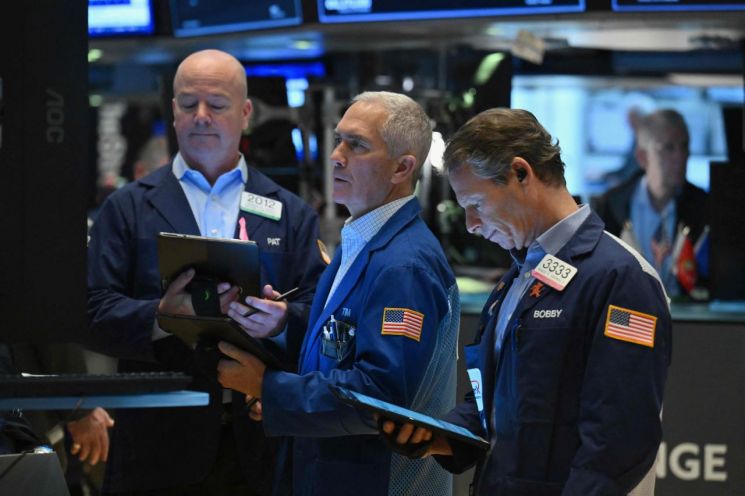
The three major indices of the U.S. New York stock market showed a unified decline in the early session on the 17th (local time) due to the rise in Treasury yields. The U.S. retail sales data released before the market opened also exceeded expectations, reinforcing the view that the Federal Reserve (Fed) may maintain high interest rates for some time.
At around 9:40 a.m. at the New York Stock Exchange (NYSE), the Dow Jones Industrial Average was trading at around 37,226, down 0.36% from the previous close. The S&P 500, which focuses on large-cap stocks, was down 0.74% at 4,730, and the tech-heavy Nasdaq index was down 1.21% at 14,762.
Currently, all sectors except healthcare within the S&P 500 are in decline. Notably, technology, consumer discretionary, and communication sectors are experiencing significant drops. Tesla fell more than 2% following news of price cuts for the Model Y in Germany after China. Apple, facing growing concerns over slowing iPhone growth, also continued to decline by over 1%. Nvidia, which is scheduled to report earnings next week, dropped 2.16%, and Amazon fell 1.23%. Concerns over the Chinese economy have also led to declines in Alibaba, Nio, and Tencent, all listed on the New York stock market. Spirit Airlines is also plunging nearly 20% after a U.S. federal court blocked JetBlue’s merger deal the previous day.
Investors are closely watching the U.S. retail sales data and Treasury yield movements released today to gauge the future direction of the Fed’s monetary policy. According to the U.S. Department of Commerce, retail sales in December last year increased by 0.6% compared to the previous month, surpassing Wall Street’s forecast of 0.4%. Retail sales are considered a pillar accounting for two-thirds of the U.S. real economy and a comprehensive indicator of economic health.
With consumer spending remaining robust in December, hawkish voices advocating for maintaining high interest rates for the time being have gained strength. Christopher Waller, a Fed governor known as a hawk, dampened market expectations for an early rate cut at a Brookings Institution event, stating, "In many previous cycles, rate cuts were relatively quick and large, but in this cycle, there is no reason to lower rates quickly." Chris Larkin, Managing Director at Morgan Stanley, said, "The Fed has consistently emphasized that there is no need to rush rate cuts," adding, "Given that retail sales were stronger than expected, there is no need to change the policy stance of not rushing rate cuts."
The Fed is not the only institution drawing a line against early rate cut expectations. Christine Lagarde, President of the European Central Bank (ECB), reiterated a data-driven policy approach in an interview with Bloomberg, forecasting that rate cuts would only be possible by the end of this year. Earlier, Fran?ois Villeroy de Galhau, an ECB policymaker attending the World Economic Forum (WEF) annual meeting in Davos, Switzerland, also pointed out, "It is too early to declare victory in the fight against inflation. It is not over yet."
According to the Chicago Mercantile Exchange (CME) FedWatch tool, the futures market currently reflects about a 59% probability that the Fed will keep rates steady in January and then cut rates by at least 0.25 percentage points at the March Federal Open Market Committee (FOMC) meeting.
This has led to a rise in Treasury yields. In the New York bond market today, the benchmark 10-year U.S. Treasury yield rose to around 4.11%, and the 2-year yield, which is sensitive to monetary policy, increased to about 4.38%. The dollar index, which measures the value of the U.S. dollar against six major currencies, moved above 103.6, up more than 0.2%. The Chicago Board Options Exchange (CBOE) Volatility Index (VIX), known as Wall Street’s fear gauge, fell nearly 11% to 15.3.
This afternoon, the Fed’s Beige Book, a report on economic conditions, will be released. Since the Fed uses the Beige Book as a reference for rate decisions, attention is focused on its assessments of the economy and inflation. Previously, the Beige Book released at the end of November indicated that inflation had significantly eased across regions. John Williams, President of the New York Fed and the third-ranking Fed official, is also scheduled to make public remarks today.
Corporate earnings announcements are also ongoing. Economic media have evaluated that fourth-quarter earnings could be the next major test for the market in 2024. Jeffrey Buchbinder, Chief Investment Strategist at LPL Financial, said, "2023 was a year that benefited greatly from valuation improvements, and this year earnings will bear a significant burden." Additionally, investors are monitoring economic indicators such as GDP released by China’s National Bureau of Statistics. Earlier, Asian markets declined amid concerns over China’s economic slowdown.
European markets are also down today. Germany’s DAX index fell 1.20%. The UK’s FTSE index dropped 1.88%, and France’s CAC index declined 1.48%.
© The Asia Business Daily(www.asiae.co.kr). All rights reserved.

![Clutching a Stolen Dior Bag, Saying "I Hate Being Poor but Real"... The Grotesque Con of a "Human Knockoff" [Slate]](https://cwcontent.asiae.co.kr/asiaresize/183/2026021902243444107_1771435474.jpg)














