Foreigners and Institutions Sell Nearly 1 Trillion Won
Lowered Rate Cut Expectations Due to North Korea Risk
KOSDAQ Sees 1,408 Stocks Fall... Approaching Record High Level
The KOSPI index gave back all the gains made over the past two months due to selling pressure from foreigners and institutions.
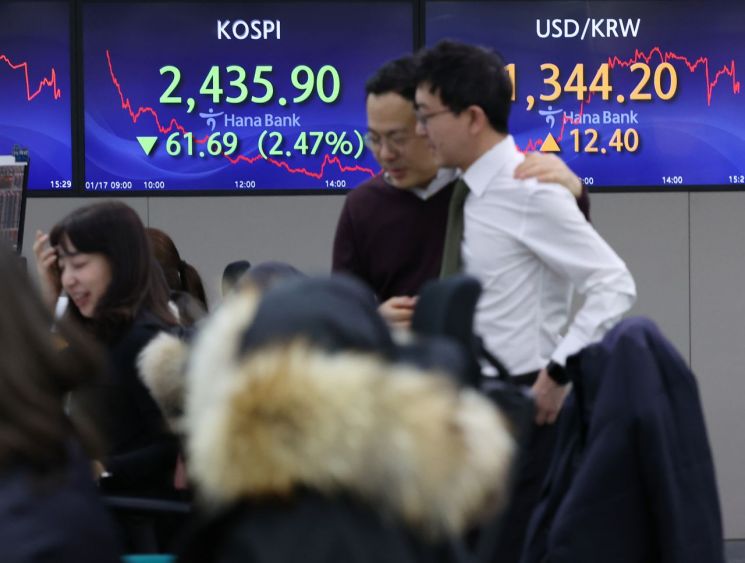
On the 17th, the KOSPI index closed at 2,435.90, down 61.69 points (2.47%) from the previous trading day. This is the lowest level since November 14 last year (2,433.25). The KOSPI index had been on an upward trend for nearly two months, including the 'Santa Rally,' but started to decline after reaching 2,645.47 on the 2nd. Including the 17th, it fell on 10 out of 12 trading days this year. Ultimately, it gave back all the gains made over the past two months.
By investor type, foreigners sold off 902.2 billion KRW, and institutions also sold 11.3 billion KRW. Individuals were the only buyers, purchasing 851.6 billion KRW. The net selling by foreigners was the largest in six months since July 26 last year, when it was 946.5 billion KRW. On July 26, EcoPro, then considered a 'king stock,' surged intraday to 1,539,000 KRW before closing at 1,228,000 KRW, marking the beginning of the cooling off of the secondary battery boom.
Geopolitical risks triggered by North Korean State Affairs Commission Chairman Kim Jong-un's hardline remarks and Federal Reserve Board member Christopher Waller's cautious stance on early rate cuts were cited as causes that worsened the supply and demand from foreigners and institutions. The won-dollar exchange rate closed at 1,344.20 KRW, rising sharply by 12.4 KRW from the previous day.
Kim Seok-hwan, a researcher at Mirae Asset Securities, said, "There are three main reasons for the recent weakness in the domestic stock market: nearly 7 trillion KRW of net selling by institutions this year, weakened investment sentiment due to Samsung Electronics' Q4 and 2023 provisional earnings announcement, and geopolitical instability such as the prolonged war between Israel and Hamas and the spread of North Korean risks." He added, "For the time being, it is necessary to focus on risk management rather than increasing exposure to domestic stocks."
Labor Gil, a researcher at Shinhan Investment Corp., said, "Most sectors declined due to lowered expectations for rate cuts and geopolitical conflicts." In fact, except for the telecommunications sector, which rose 0.19% on the 17th, all sectors were down. Especially steel and metals (-3.45%), chemicals (-3.45%), machinery (-3.08%), and medical precision (-3.02%) showed declines exceeding 3%.
By stock, 852 stocks fell, 72 rose, and 13 remained unchanged. Most of the top market capitalization stocks were weak. Samsung Electronics (-2.20%), LG Energy Solution (-2.62%), and Hyundai Motor (-2.36%) fell by around 2%, while Celltrion (-5.07%), Naver (-4.78%), and POSCO Holdings (-4.23%) closed down 4-5%.
The KOSDAQ index closed at 833.05, down 21.78 points (2.55%).
By investor type, foreigners sold 177.8 billion KRW, while individuals and institutions bought 173.4 billion KRW and 14.5 billion KRW, respectively.
Out of 1,702 stocks, 1,408 declined, 183 rose, and 111 remained unchanged. This is close to the record high number of daily declining stocks (1,446) on the KOSDAQ on March 14 last year, following the aftershocks of the Silicon Valley Bank (SVB) collapse. That day was known as 'Black Tuesday.' Among the top market capitalization stocks, EcoPro BM (-4.89%), Celltrion Pharm (-4.96%), and LS Materials (-5.04%) closed down 4-5%.
© The Asia Business Daily(www.asiae.co.kr). All rights reserved.
![Clutching a Stolen Dior Bag, Saying "I Hate Being Poor but Real"... The Grotesque Con of a "Human Knockoff" [Slate]](https://cwcontent.asiae.co.kr/asiaresize/183/2026021902243444107_1771435474.jpg)
















