Appointment Status Over the Past 12 Years
Over the past 12 years, 37.7% of newly appointed prosecutors who graduated from law schools were from the so-called ‘SKY’ law schools, including Seoul National University, Korea University, and Yonsei University. Among all prosecutors who graduated from law schools, 62.2% had completed their undergraduate studies at SKY universities.
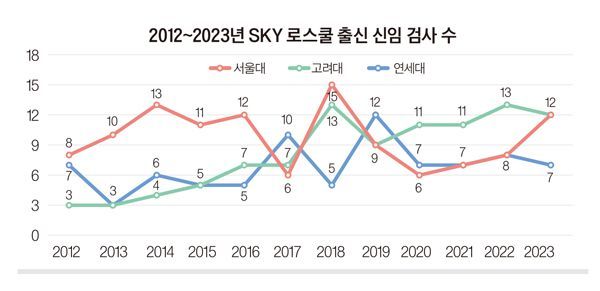
According to the Ministry of Justice on the 12th, from 2012, the year the first law school graduates were produced, to last year, 788 prosecutors who graduated from law schools were appointed, with Seoul National University producing the most prosecutors. A total of 117 prosecutors graduated from Seoul National University Law School, accounting for 14.8% of all law school graduate prosecutors. Next were Korea University with 98 (12.4%) and Yonsei University with 82 (10.4%), making SKY law school graduates 37.7% of the total. Following were Sungkyunkwan University with 76 (9.6%), Hanyang University 51 (6.5%), Pusan National University 48 (6.1%), Ewha Womans University 39 (4.9%), Kyungpook National University 33 (4.2%), Kyung Hee University 31 (3.9%), and Chung-Ang University 28 (3.6%). Chungnam National University produced 26 (3.3%), University of Seoul 23 (2.9%), and Inha University 19 (2.4%) prosecutors.
Among the 788 prosecutors who graduated from law schools, those who completed their undergraduate studies at Seoul National University were the largest group with 209 (26.5%). Next were Korea University with 147 (18.7%), Yonsei University with 134 (17%), and Sungkyunkwan University with 62 (7.9%). Ewha Womans University and Hanyang University each produced 31 (3.9%), the Korean National Police University 20 (2.5%), Sogang University 16 (2%), KAIST 14 (1.8%), and Kyung Hee University 12 (1.5%) prosecutors.
By undergraduate major, law was the most common. A total of 316 people who majored in law at university and then entered law school to become prosecutors accounted for 40.1% of the total. Next were business administration majors with 84 (10.7%) and economics majors with 67 (8.5%). Political science and diplomacy majors numbered 38 (4.8%), English language and literature 19 (2.4%), public administration 15 (1.9%), and sociology 14 (1.8%).
Meanwhile, from 2012 to 2023, a total of 1,337 new prosecutors were appointed, of whom 549 (41%) were from the judicial examination system and 788 (59%) were law school graduates. The number of judicial examination graduates was 87 in 2012, 73 in 2013, and 85 in 2014, then gradually decreased from 2015 with 64 in 2015, 61 in 2016, 39 in 2018, and 34 in 2020. From the following year, the numbers sharply dropped to single digits with 5 in 2021, 4 in 2022, and 1 in 2023.
Law school graduates numbered 42 in 2012, 37 in 2013, 40 in 2014, and 45 in 2015, remaining in the 40s, then increased to the 70s from 2018. In 2023, a total of 94 law school graduates were appointed as prosecutors.
Jang Seok-cheon, dean of Chungbuk National University Law School, said, “Students at Seoul-based law schools are relatively more likely to prepare for the prosecutor appointment exam than those at regional law schools,” but added, “The concentration of prosecutors’ alma maters in a few schools is concerning from the perspective of regional law schools.” He further stated, “Just as the courts operate a regional judge system, the so-called ‘Hyangpan (鄕判) system,’ if the prosecution also selects one or two outstanding prosecutors from the local law schools at regional prosecutor’s offices and requires them to work in the region for several years, it would have a positive impact on regional law schools and local development.”
Hong Yoon-ji, Legal Times Reporter
※This article is based on content supplied by Law Times.
© The Asia Business Daily(www.asiae.co.kr). All rights reserved.
![Clutching a Stolen Dior Bag, Saying "I Hate Being Poor but Real"... The Grotesque Con of a "Human Knockoff" [Slate]](https://cwcontent.asiae.co.kr/asiaresize/183/2026021902243444107_1771435474.jpg)
















