President Yoon Suk-yeol Hosts Fourth 'Public Livelihood Discussion'
Online Debt Consolidation Service Now Includes Mortgage and Jeonse Loans
Extension of Increased Loan Limits for Microfinance Products by One Year
Activation of Private Debt Adjustment... Customized Financial Support for Youth and Elderly
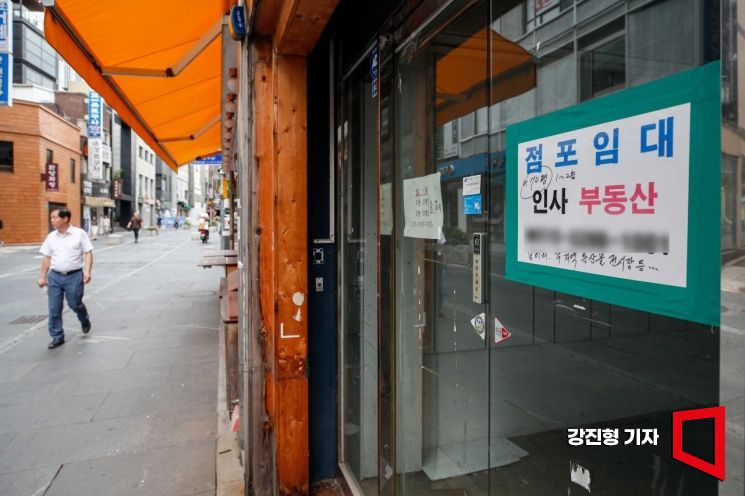 On the 16th, a rental notice is posted at a store in Insadong, Jongno-gu, Seoul. Photo by Jinhyung Kang aymsdream@
The government is accelerating policies to reduce the interest burden on self-employed individuals and small business owners. Banks will independently invest 'KRW 2 trillion + alpha (α)' to support interest payments up to KRW 3 million per borrower. Additionally, for those who borrow from secondary financial institutions at interest rates of 5-7%, the government will provide partial interest support using public funds. The government will also extend the loan limit increase measures for low-income financial products until the end of this year and establish a comprehensive low-income financial platform to enhance the convenience of loan execution.
On the 17th, the Financial Services Commission announced these plans at the 'Public Livelihood Discussion with the People' (government work report) presided over by President Yoon Seok-yeol at the Korea Exchange in Yeouido, Seoul. This is a countermeasure in response to the increased interest repayment burden and ongoing management difficulties faced by small business owners and the self-employed due to prolonged high interest rates, high inflation, and rising raw material costs. According to the Household Financial Welfare Survey, the average annual interest cost per household increased by more than 18%, from KRW 2.09 million in 2021 to KRW 2.47 million in 2022.
Major commercial banks will independently invest KRW 1.6 trillion for interest refunds and KRW 400 billion to support vulnerable groups. The interest refund plan involves reimbursing 90% of the interest paid exceeding 4% on loans up to KRW 200 million for one year, with a maximum of KRW 3 million per borrower.
Furthermore, the government will use public funds to partially support the interest of self-employed individuals and small business owners who borrowed from secondary financial institutions at interest rates of 5-7%. The goal is to support one year's worth of interest payments exceeding 5% on loans up to KRW 100 million, with a maximum of KRW 1.5 million. Additionally, support will be expanded by increasing low-interest refinancing loans for borrowers with interest rates above 7%, and the eligibility criteria for direct COVID-19 damage will be abolished to broaden the scope of the New Start Fund support.
Policies to institutionally ease interest burdens will also be expanded and strengthened. Since the 9th, online one-stop refinancing loan services have included mortgage loans, and from the 31st, jeonse (key money deposit) loans will be added to the service targets. Moreover, to promote interest rate competition among banks, the standards for disclosing loan interest rates?including base rates, additional rates, and preferential rates?will be revised.
Establishment of a Comprehensive Low-Income Financial Platform... Activation of Private Debt Adjustment
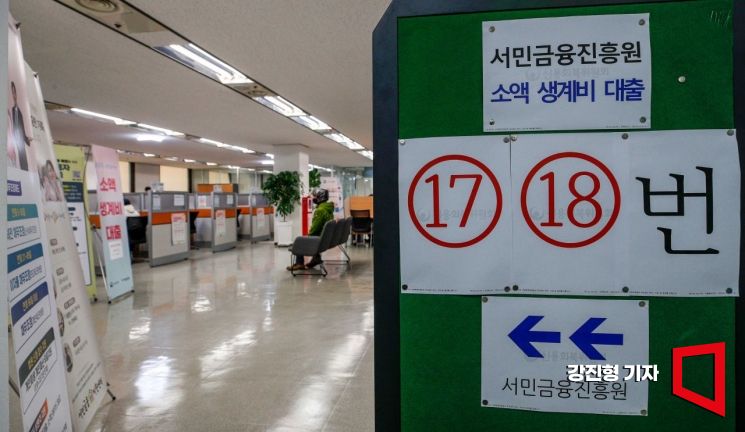 On the 27th, citizens visiting the Jung-gu Central Microfinance Integrated Support Center in Seoul applied for loans from a small living expense loan product offering up to 1 million won with an annual interest rate of up to 15.9%. Photo by Kang Jin-hyung aymsdream@
The Financial Services Commission will extend the loan limit increase measures for low-income financial products for one year until December of this year and establish a comprehensive low-income financial platform that provides integrated counseling services starting from low-income financial products. The loan limits have been increased as follows: Worker’s Sunshine Loan from KRW 15 million to KRW 20 million, Sunshine Loan Bank from KRW 20 million to KRW 25 million, and Sunshine Loan 15 from KRW 14 million to KRW 20 million. The comprehensive low-income financial platform will guide users through these products, allowing them to compare products and execute loans in one place, while also providing non-face-to-face integrated counseling services covering employment, welfare, and debt adjustment.
By implementing the Personal Debtor Protection Act, the government will ease the interest and collection burdens on delinquent debtors and activate private debt adjustment to support rapid recovery. The Financial Services Commission plans to prohibit the imposition of overdue additional interest on principal amounts whose repayment dates have not yet arrived and allow delinquent debtors to directly request debt adjustment from financial institutions. The interest rate reduction for basic livelihood security recipients, severely disabled persons, and the elderly will be expanded from 30-50% to 50-70%.
Customized Financial Support for Youth and Elderly... Reduction of Financial Costs such as Fees
The Financial Services Commission will strengthen support for youth leap accounts currently in operation to help asset formation. It will allow the lump-sum payment of maturity proceeds from the Youth Hope Savings into the Youth Leap Account and exempt early withdrawal from taxation even after maintaining the account for three years. Special early withdrawal reasons will be expanded to include marriage and childbirth.
For the elderly, benefits of the housing pension will be enhanced, and those moving to Silver Towns will continue to receive housing pension payments. The target for the preferential housing pension with higher monthly payments will be expanded from houses priced at KRW 200 million or less to KRW 250 million or less. Additionally, moving to Silver Towns will be recognized as an exception to the actual residence requirement, allowing continuous receipt of housing pension benefits.
Financial costs such as fees and insurance premiums that citizens bear in daily life will also be reduced. The Financial Services Commission will establish guidelines to ensure that early repayment fees reflect only essential costs related to loan handling and will strengthen disclosure by banks. Furthermore, through rational adjustments of automobile insurance premiums and indemnity insurance premiums, the government plans to reduce the overall insurance premium burden on the public.
© The Asia Business Daily(www.asiae.co.kr). All rights reserved.
![Clutching a Stolen Dior Bag, Saying "I Hate Being Poor but Real"... The Grotesque Con of a "Human Knockoff" [Slate]](https://cwcontent.asiae.co.kr/asiaresize/183/2026021902243444107_1771435474.jpg)

















