Altman "Small Amounts of High-Quality Data Are Important"
Benihoff "AI Training Data Was Stolen"
At the World Economic Forum Annual Meeting (WEF, Davos Forum), discussions also took place regarding intellectual property (IP) infringement by artificial intelligence (AI). OpenAI, which sparked the generative AI craze, argued that concerns about AI-related IP infringement are greatly exaggerated. However, on the opposing side, it was countered that AI companies stole the data used for training.
Sam Altman, CEO of OpenAI, the developer of ChatGPT, said in an interview with Bloomberg on the 16th (local time) in Davos, Switzerland, "Most of our research is about learning more from a small amount of high-quality data."
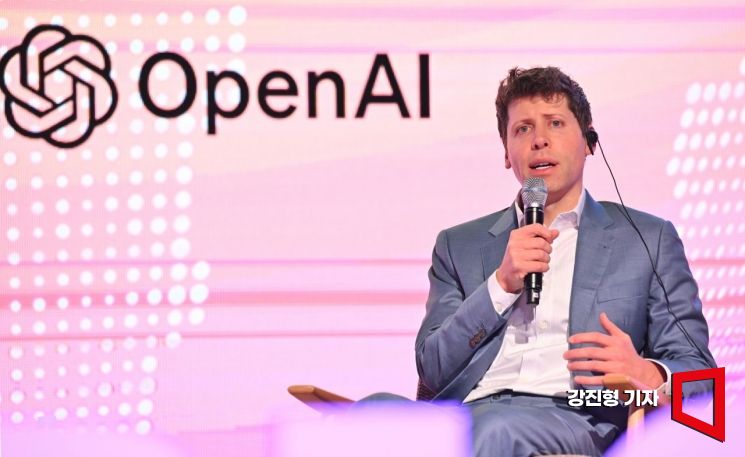 Sam Altman, CEO of OpenAI, is having a conversation at the 'K-Startups meet OpenAI' event hosted by the Ministry of SMEs and Startups on the 9th at 63 Square, Yeouido, Seoul. Photo by Jinhyung Kang aymsdream@
This is a direct rebuttal to the criticism that AI startups like OpenAI use copyrighted materials without permission to train AI. CEO Altman said, "There are people who believe that my training data is needed by everyone and is very valuable. But generally, that is not the case." He added, "For example, OpenAI does not want to train on NYT data," drawing a clear line.
Last December 27, The New York Times (NYT) filed a lawsuit against OpenAI and Microsoft, claiming that millions of articles produced by NYT were used without permission in training ChatGPT, resulting in ChatGPT competing with NYT as an information provider. They also argued that advertising, licensing, and subscription revenues decreased during this process, causing damages amounting to billions of dollars. Prior to this, cultural figures such as comedian Sarah Silverman, George R.R. Martin, the original author of the popular drama "Game of Thrones," and Pulitzer Prize-winning author Michael Chabon also filed lawsuits against OpenAI for copyright infringement.
OpenAI has minimized legal risks by signing news usage agreements with media groups such as Axel Springer, which owns Politico, Business Insider, and Bild, as well as news agencies like the Associated Press (AP).
CEO Altman said, "What OpenAI wants to do with news organizations is, for example, when a user asks what happened today in Davos, to show both Bloomberg and NYT articles," adding, "Some people want to cooperate with OpenAI, but some do not."
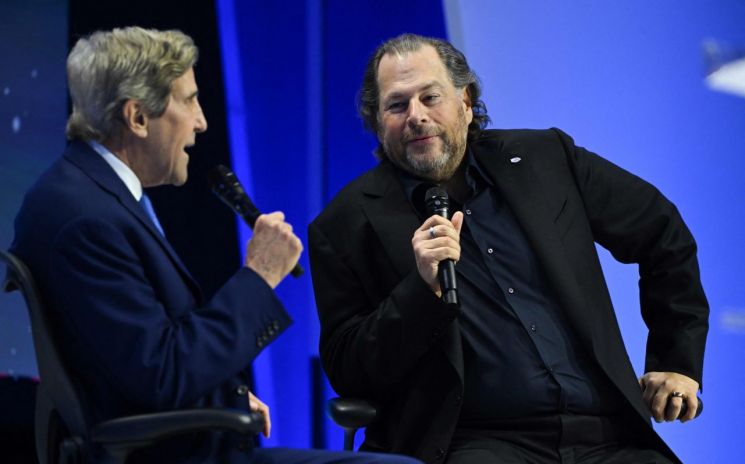
On the other hand, Marc Benioff, CEO of Salesforce, which owns the weekly news magazine TIME, pointed out that AI companies stole intellectual property (IP) to build their technology.
In an interview with Bloomberg on the same day, CEO Benioff said, "All training data has been stolen," adding, "Content from media outlets including The Times and NYT is appearing as the output of AI companies." According to Bloomberg, The Times, CNN, and Fox are currently pursuing licensing agreements with OpenAI.
CEO Benioff also pointed out difficulties in measuring the value of data used for AI training. He said, "No one knows exactly what the fair price is for the data AI learns from." However, AI companies should standardize payment systems to treat content creators fairly.
© The Asia Business Daily(www.asiae.co.kr). All rights reserved.
![Clutching a Stolen Dior Bag, Saying "I Hate Being Poor but Real"... The Grotesque Con of a "Human Knockoff" [Slate]](https://cwcontent.asiae.co.kr/asiaresize/183/2026021902243444107_1771435474.jpg)

















