Total Reservoir Capacity Secured at 9.5 Billion Tons
"Maximum Storage of Rainfall During Last Year's Flood Season"
Dams Will Not Dry Up Before This Year's Flood Season
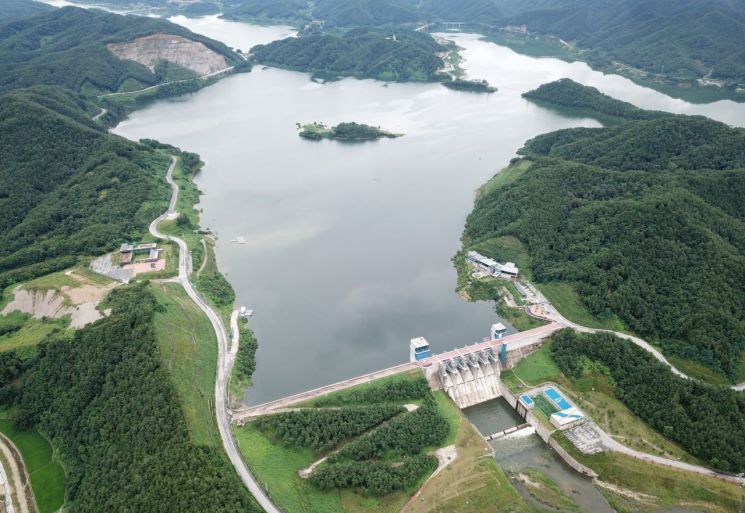
As multipurpose dams nationwide record the highest water storage ever, it is expected that no dam drought will occur before this year's flood season (June 21 to September 20).
On the 17th, the Ministry of Environment announced that the water storage of 20 multipurpose dams nationwide was recorded at a historic high of 9.497 billion tons (as of 5 p.m. the previous day). The storage rate based on total capacity (12.923 billion tons) is 73%, which is 1.5 times the average of previous years.
The 14 water supply dams also show favorable conditions with a water storage of 282 million tons and a storage rate of 63% (136% of the average).
The increase in the storage rate of multipurpose dams is due to last year's extreme drought and record-breaking rainfall. The multipurpose dam basins received 1716 mm of rain, 37% more than usual, but the rainfall from January to April was only 69% of the average (129 mm average rainfall for multipurpose dams). In particular, due to the drought centered in the southern regions continuing since 2022, Juam Dam recorded the lowest storage rate ever at 20% in April last year.
At that time, to overcome the extreme drought, the Ministry of Environment formed a joint task force (TF) with related agencies from November 2022, managing a total of 11 dams at drought stages and implementing various drought countermeasures such as water management and demand reduction. By July last year, all 11 dams had exited the drought stage.
The Ministry of Environment stated, "It is expected that no dam drought will occur before this year's flood season," and added, "To prepare for the intensifying climate crisis, we plan to strengthen the safety net protecting the public from droughts and floods through new dam construction and remodeling of existing dams."
Additionally, considering future water supply forecasts and flood risk, the Ministry is reviewing the appropriateness of 20 dams proposed by local regions from May to November last year, alongside Ministry-led dam construction plans. The Ministry plans to proceed with basic planning for 10 sites and feasibility studies for 3 sites, prioritizing urgency and other factors.
Kim Gu-beom, Director of Water Resources Policy at the Ministry of Environment, said, "The role of dams is becoming increasingly important amid the deepening climate crisis. We will prioritize public safety by effectively operating dams and steadily advancing new dam construction and remodeling of existing dams."
© The Asia Business Daily(www.asiae.co.kr). All rights reserved.

















