Last year, South Korea's automobile export value exceeded $70 billion, marking the highest level ever recorded. Despite domestic and international challenges such as the U.S. Inflation Reduction Act (IRA), aggressive overseas expansion proved successful.
According to the status of the automobile industry released by the Ministry of Trade, Industry and Energy on the 16th, the export value reached $70.872 billion, a 31% increase compared to the previous year. The previous record for the highest export was set in 2022 ($54.1 billion), but a new record was established within just one year. Exports of automobile parts decreased by 1.5% during the same period, totaling $22.965 billion.
The trade surplus alone amounted to $55 billion, the largest among the 15 major export items tracked by the government. Exports of eco-friendly vehicles, including electric cars, also reached a record high of $24.2 billion. Although there were expectations that domestic electric vehicle sales would be difficult in the U.S. due to the IRA, exports of eco-friendly vehicles to the local market increased by 70% to 144,000 units compared to the previous year.
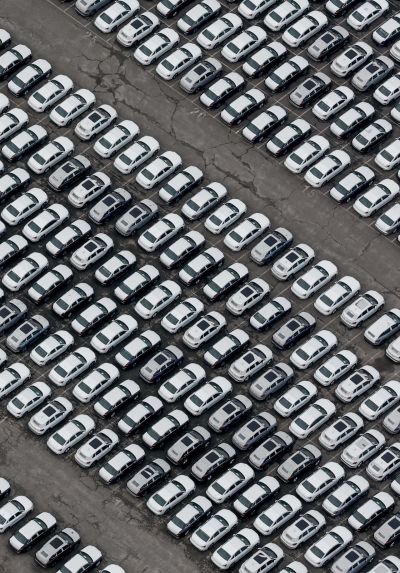 Cars are waiting to be shipped at Pyeongtaek Port, viewed from the air. [Aerial shooting cooperation=Seoul Metropolitan Police Agency Aviation Unit, Pilots: Lieutenant Shin Seung-ho - Lieutenant Park Ji-hwan, Crew: Lieutenant Park Sang-jin] Photo by Kang Jin-hyung aymsdream@
By region, exports to North America reached $37 billion, a 45% increase compared to the previous year, while exports to the European Union (EU) rose 33% to $10.8 billion. Following were Asia with $5.7 billion (29%), the Middle East with $5.5 billion (13%), other European countries with $4.8 billion (10%), Oceania with $3.9 billion (4%), and Latin America with $2.7 billion (15%). Exports increased in all regions except Africa ($0.5 billion, down 12%).
Domestic automobile production last year reached 4.24 million units, surpassing 4 million units for the first time in five years since 2018. The export price per vehicle also exceeded $23,000 for the first time, setting a new record. Approximately two-thirds of the vehicles produced domestically, about 2.77 million units, were sold overseas.
Domestic sales volume was 1.74 million units, a 3% increase from the previous year. The accumulated demand backlog since COVID-19 was resolved, leading to a year-on-year increase for the first time in three years since 2020. The market size for eco-friendly vehicles, including hybrids, grew by 45% compared to the previous year.
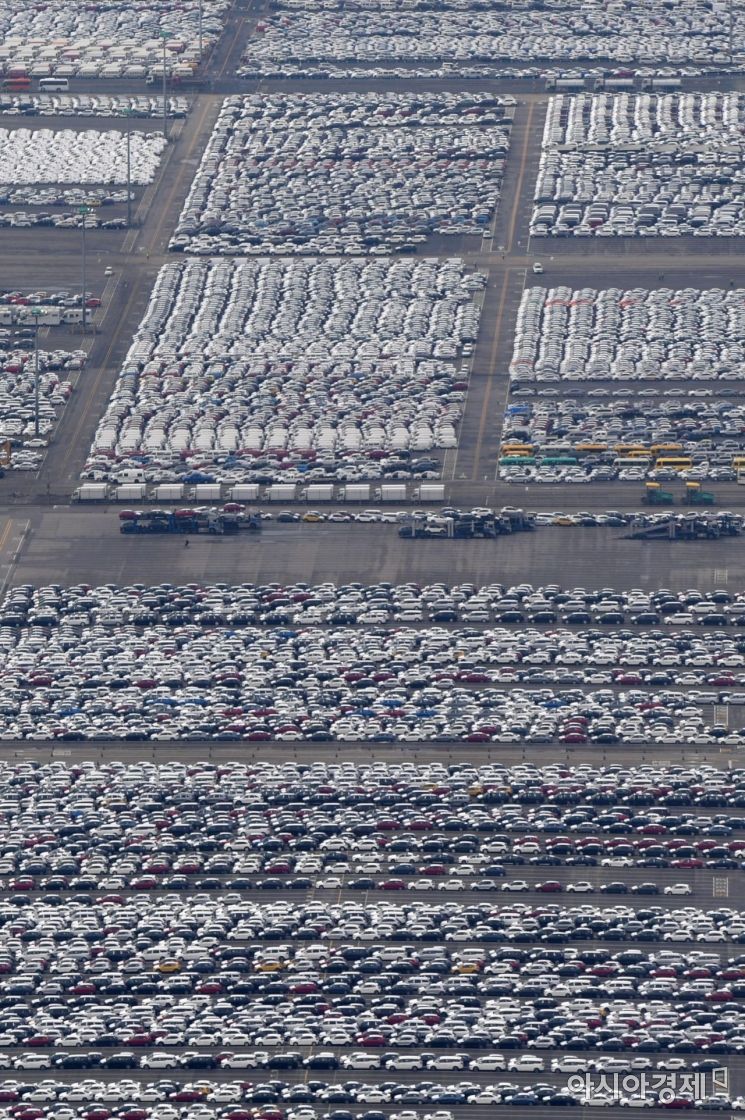 Export vehicles are waiting to be loaded at Pyeongtaek Port in Gyeonggi-do. (Aerial photography cooperation = Seoul Metropolitan Police Agency Aviation Unit Chief Lieutenant Colonel Lee Sang-yeol, Pilot Lieutenant Kim Doo-soo, Crew Lieutenant Kwak Sung-ho, Sergeant Park Sang-jin) / Photo by Moon Ho-nam munonam@
The Ministry of Trade, Industry and Energy stated, "Last year's automobile exports were the result of full cooperation between the public and private sectors in line with the global trend toward eco-friendliness and electrification." They added, "Although the domestic and international economic conditions remain challenging due to global consumption stagnation and the Israel war, the government will do its best to ensure that export momentum continues this year."
First, the government plans to extend the temporary investment tax credit to ensure that companies can proceed with investments in electric vehicle-exclusive factories being promoted in Ulsan and Hwaseong without disruption. They also plan to announce regulatory innovation measures soon to expand the market for eco-friendly mobility.
© The Asia Business Daily(www.asiae.co.kr). All rights reserved.


















