Achievements in Securing Special Provisions Including Expansion of Welfare Benefits and Fire Safety Grants
Changwon Special City in Gyeongnam marked its 2nd anniversary and plans to focus on changing the criteria for special city designation following the securing of financial, organizational, and planning authority.
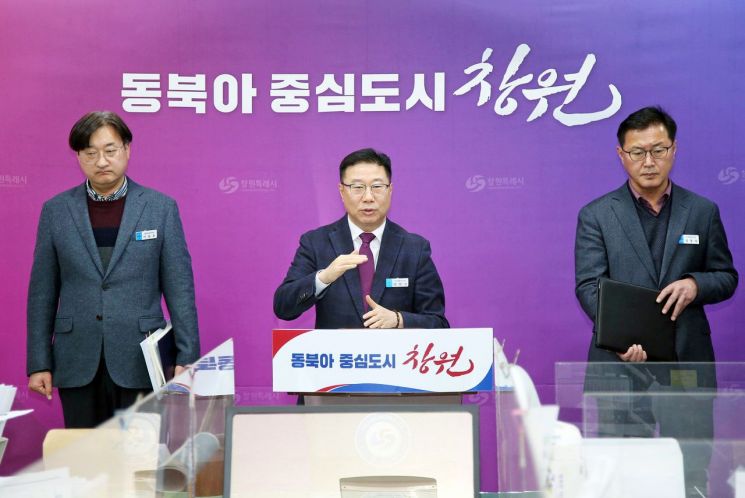
Since becoming a special city in 2022, the basic property amount for social welfare benefits was raised to the metropolitan city level, increasing the number of citizens receiving welfare benefits. The fire safety grant tax was significantly increased, making the fire safety network more robust. By receiving the transfer of nine special administrative tasks, it has become easier to reflect local development projects and regional demands, improving the quality of administrative services.
Notably, it is the only basic local government to have secured autonomous development and management authority over a local management trade port (Jinhae Port). Accordingly, the port facility usage fees, which were previously national revenue, have been converted to local revenue, and from this year, Changwon City will directly collect these fees. It is expected to collect over 2 billion KRW annually, which will be used to improve aging port facilities, prevent port accidents, and create citizen-friendly waterfront spaces, developing Jinhae Port into an urban-friendly port.
However, many challenges remain for Changwon City to address.
◆ Enactment of a Special Act on Support for Special Cities
The process of authority transfer is complicated and lengthy, resulting in delayed receipt of necessary powers, and even then, the transferred tasks are limited to simple execution functions without planning functions that allow direct participation in central government planning. Even if administrative authority is transferred, manpower does not meet the requirements, and basic government funding for task processing is lacking. Since mountains, seas, national industrial complexes, and rural fishing villages coexist within the administrative district, significant administrative effort is required, but the organizational size is determined solely by population, limiting the enhancement of staff capabilities through rank elevation.
Accordingly, Changwon is collaborating with three special cities to make the enactment of a ‘Special Act on Support for Special Cities,’ which provides legal grounds for granting financial, organizational, and planning authority to special cities, a campaign pledge in the 22nd National Assembly elections. They are determined to ensure the special act passes in the next National Assembly.
◆ Maintaining Special City Authority
The declining population trend in non-metropolitan areas has revealed issues with the population criteria for special cities. As of the end of 2023, the proportion of the non-metropolitan population nationwide is 49.3%, already below half. According to Statistics Korea’s population projections, it is expected to steadily decrease to 47.3% by 2050. If the current population criteria for special city designation continue, special cities will exist only in Gyeonggi Province, potentially hindering regional balanced development.
Changwon City’s population is also continuously decreasing. The registered resident population has fallen to the one million level, and the population meeting the special city designation criteria, including registered residents, domestic residence reporters, and registered foreigners, has decreased to approximately 1,028,000 (as of the end of 2023).
Therefore, the city is taking proactive measures to maintain special city authority. It plans to gather opinions from various sectors on ways to maintain Changwon Special City’s authority and prepare an optimal plan by early 2024.
Furthermore, it will actively publicize the irrationality of judging administrative demand solely based on population criteria under the current system and strongly demand improvements to the special city system from central government agencies by highlighting Changwon Special City’s contribution to the national economy, its status as a hub city, and its symbolic significance as the only non-metropolitan special city.
Jung Hyun-seop, Director of the Autonomous Administration Bureau, said, “Changwon Special City holds symbolic significance as the only city with a population of one million in non-metropolitan areas and plays a role in supporting Gyeongnam’s population and finances as a regional hub city.” He added, “The role of Changwon Special City is very important for the development of Changwon City, Gyeongnam, regional balanced development, and the realization of the local era.”
He continued, “Despite carrying a great mission, there is still a long way to go for Changwon Special City to become a special city that citizens, as administrative demanders, can feel. While national support is important, the support of citizens is equally crucial, so we ask for your attentive interest.”
© The Asia Business Daily(www.asiae.co.kr). All rights reserved.

















