President Yoon Chairs Cabinet Meeting... Criticism of Abuse of 'Quasi-Taxes' and 'Shadow Taxes'
Orders Restructuring of 91 Existing Charges... "Economic Will Weakening"
President Yoon Suk-yeol stated on the 16th, "We must not indiscriminately impose charges simply because it is easy to secure funding," and added, "The current 91 charges should be thoroughly investigated and reconsidered from the ground up." This directive calls for a major restructuring of the statutory charges, which have a quasi-tax nature and amount to about 24 trillion won annually collected from the public and businesses. A total of 91 items are subject to this review.
On the morning of the same day, President Yoon presided over a Cabinet meeting at the Yongsan Presidential Office, saying, "For a dynamic and sustainable free market economy, charges that excessively suppress the free economic will must be boldly eliminated," delivering this instruction.
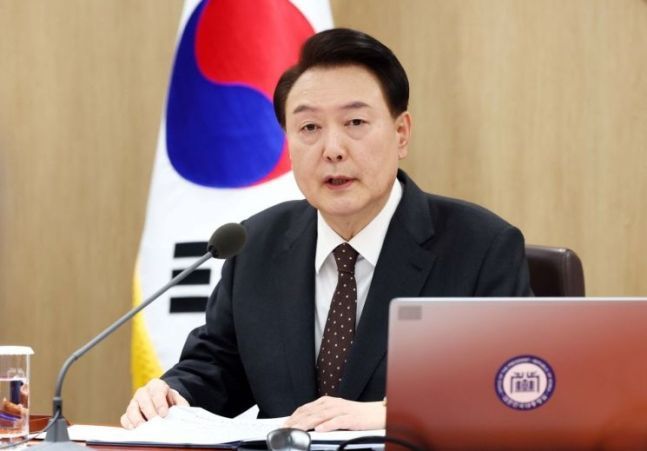 President Yoon Suk-yeol is delivering opening remarks at the Cabinet meeting held on the 16th at the Yongsan Presidential Office Building in Seoul.
 [Photo by Yonhap News]
Charges are not taxes, but money that must be paid compulsorily under the law in connection with specific public interest projects. According to the Ministry of Economy and Finance and others, the amount collected from statutory charges increased more than threefold from 7.4 trillion won in 2002 to 24.6157 trillion won this year. During this period, the number of charge types decreased from 102 to 91, but the increase in various economic activities carried out by the public and businesses led to the rise in collection amounts.
In response, the government has set a policy to significantly reduce unreasonable charges and expand exemption targets to lessen the burden on the public and businesses, despite concerns about reduced fiscal revenue. President Yoon also said, "The agenda today includes the amendment bill of the 'Basic Act on Charge Management,' which abolishes and integrates unreasonably imposed charges," but he reiterated the government's call for a review, stating, "The five charges being reorganized this time have been rendered ineffective due to unconstitutional rulings or are being converted into association fees, so the burden on the public is not actually reduced."
In particular, President Yoon pointed out, "While there are positive charges that prevent environmental pollution or promote public health, charges that are abused as 'quasi-taxes' or 'shadow taxes' remain everywhere." He further explained, "The principle is that the state secures costs through taxation and executes them, and charges are exceptionally imposed on acts that cause social costs."
President Yoon also expressed concerns about the 'Serious Accident Punishment Act,' which is set to take effect on the 27th. He said, "With the expansion to workplaces with fewer than 50 employees, small businesses on the ground feel like they are being pushed onto thin ice," adding, "The government has prepared support measures for vulnerable sectors, and economic organizations have promised this is the last grace period request, but the National Assembly remains silent."
Previously, the government had pushed for a two-year postponement of the expansion of the application target, citing the burden and lack of preparation of small and micro enterprises, but the amendment bill failed to pass the plenary session of the National Assembly on the 9th. President Yoon supported the view, saying, "Protecting workers' safety is important, but punishment alone is not the answer," and "Considering the realistic conditions of small businesses, more time is needed."
© The Asia Business Daily(www.asiae.co.kr). All rights reserved.

















