Five out of Eight Resign After Judicial Administrative Power Abuse Allegations Scandal
The Chief Judicial Researcher at the Supreme Court is a position reserved for the top elite judges. There was even a saying that "the Chief Judicial Researcher is more important than a Supreme Court Justice" (former Chief Justice Lee Yong-hoon), and it was once considered a "gateway to becoming a Supreme Court Justice," but the situation has changed now. This is because there has not been a single case in the past 10 years where a Chief Judicial Researcher was appointed as a Supreme Court Justice.
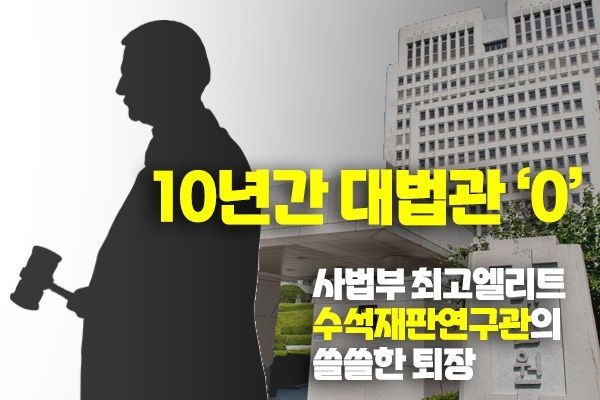
Last week, the news of the resignation of Hong Seung-myeon (60, Judicial Research and Training Institute class 18), a former Chief Judicial Researcher and presiding judge at the Seoul High Court, sent shockwaves through the judiciary. He chose to resign ahead of the regular personnel reshuffle, going beyond merely disagreeing with the vetting of Supreme Court Justice candidates. Among the 19 Chief Judicial Researchers in history, 7 (36.8%) have served as Supreme Court Justices. That's about one in three. They include the late Son Ji-yeol (9th Judicial Examination), Park Jae-yoon (76, 9th Judicial Examination), Kim Yong-dam (77, Judicial Research and Training Institute class 1), Park Il-hwan (73, class 5), Kim Neung-hwan (73, class 7), Kim Yong-duk (67, class 12), and Kwon Soon-il (65, class 14). The problem is that since 2014, no one from this position has become a Supreme Court Justice.
In particular, after the judicial administrative power abuse scandal that erupted in 2018, judges who were former Chief Judicial Researchers and considered the "top candidates" for the next Supreme Court Justice left the judiciary one after another. Lawyers Song Woo-cheol (62, class 16), Han Seung (61, class 17), Yoo Hae-yong (58, class 19), and Kim Hyun-seok (58, class 20) resigned early. Including former presiding judge Hong Seung-myeon, five have left the judiciary. Only presiding judges Ma Yong-joo (55, class 23), Oh Young-jun (55, class 23) of the Seoul High Court, and the current Chief Judicial Researcher Hwang Jin-gu (54, class 24) remain in service. Among them, presiding judges Ma Yong-joo and Oh Young-jun have been nominated and are undergoing vetting as successors to former Supreme Court Justices Ahn Cheol-sang and Min Yoo-sook, who retired on January 1 this year. Whether they will be selected remains uncertain.
Regarding the repeated exclusion of Chief Judicial Researchers from Supreme Court Justice appointments, some in the legal community point out that "the position of Supreme Court Justice has deteriorated from being a seat for the 'best judges' to one influenced by politics, region, gender, and other vested interests, with nominations and appointments being swayed accordingly."
Park Soo-yeon, Legal Newspaper Reporter
※This article is based on content supplied by Law Times.
© The Asia Business Daily(www.asiae.co.kr). All rights reserved.
![Clutching a Stolen Dior Bag, Saying "I Hate Being Poor but Real"... The Grotesque Con of a "Human Knockoff" [Slate]](https://cwcontent.asiae.co.kr/asiaresize/183/2026021902243444107_1771435474.jpg)
















