"Gathering Hastily Means Porridge, Not Bibimbap"
"Sharing Vision and Values More Important Than Physical Integration"
Former leaders Lee Nak-yeon and Lee Jun-seok, lawmaker Yang Hyang-ja, and former lawmaker Geum Tae-seop are accelerating efforts to establish a new third-party political party. Amid this, there are warnings to be cautious of the 'early unification theory.' In political circles, there is consensus that the shared goal of 'breaking the extreme politics of the two major parties' can serve as a major driving force for the third-party new parties to unite. However, for parties with different orientations to succeed in a chemical fusion, they must have a unified vision encompassing both conservative and progressive views, as well as address future tasks such as electoral system reform.
On the 14th, Lee Jun-seok, chairman of the Policy Committee of the Reform New Party (tentative name), delivered a congratulatory speech at the founding promoters' meeting of the Future Coalition, centered on lawmakers Kim Jong-min, Cho Eung-cheon, and Lee Won-wook, stating, "If we rush to gather and mix everything, it won't be bibimbap but porridge." He likened key figures of the third-party to ingredients of bibimbap, emphasizing that an alliance that preserves each other's individuality is essential. Earlier, on the 12th, he also said on KBS Radio, "Blindly saying let's unite or form an alliance will neither interest party members nor receive public support in approval ratings."
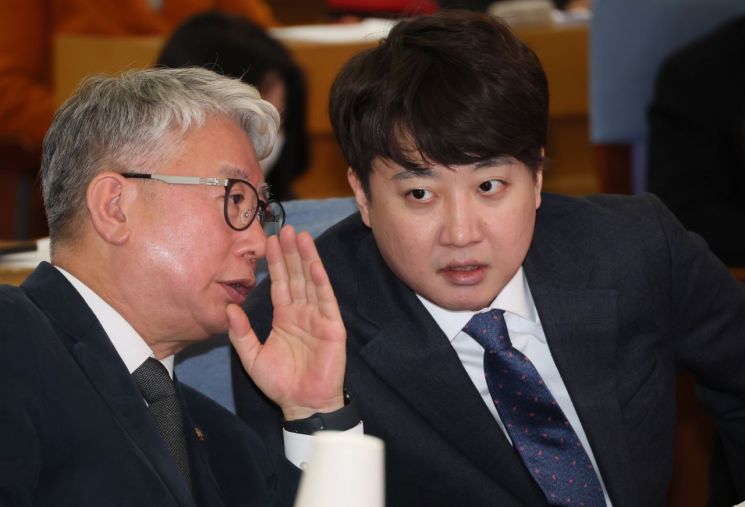
The reason Lee shows caution toward physical unification with opposition new parties is interpreted as a determination not to repeat the failure of the Bareunmirae Party, which previously positioned itself as a centrist party. The Bareunmirae Party was formed ahead of the 2018 local elections by merging the Honam-based People's Party led by Ahn Cheol-soo and the Yeongnam-centered Bareun Party led by former lawmaker Yoo Seung-min, but it disappeared within two years due to factional conflicts. Ultimately, the key to unification lies not in physical integration but in how well each party's vision and values can achieve chemical fusion.
Political engineering considerations must also be taken into account. The intensity and scope of alliances among third-party new parties can be determined by the method of selecting proportional representation members in the general election. For the Reform New Party, if the proportional representation system becomes a mixed-member proportional system, it is possible they will pursue a 'loose alliance.' The mixed-member proportional representation system is a 'one person, two votes' voting method where voters cast one vote for a district candidate and one vote for a party. This system aims to align the total number of seats each party obtains as closely as possible with the party vote share, leading to the judgment that the Reform New Party could secure a significant number of proportional representation seats based solely on its support rate.
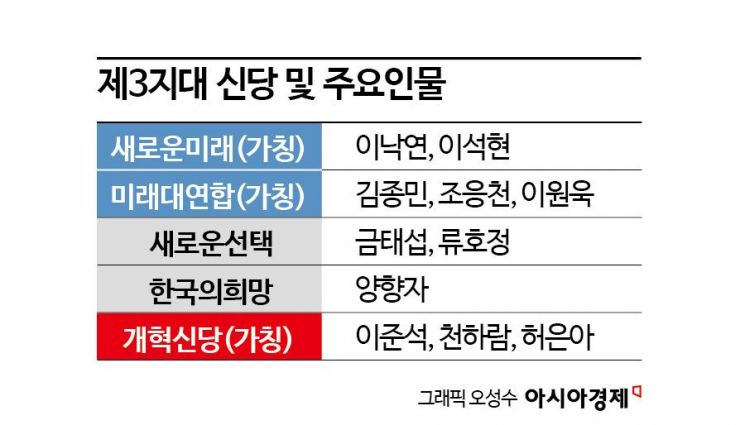
Control over candidate nominations is also a challenge. Noise among third forces originating from the Democratic Party is also detected. Recently, some reports claimed that the Future Coalition demanded former leader Lee Nak-yeon of the New Future not to run in the presidential election, but former lawmaker Shin Kyung-min dismissed this, saying "There was no such demand." However, political circles judge that a psychological battle has begun among the new parties to gain leadership in the general election.
Choi Byung-chun, former deputy director of the Democratic Research Institute, commented on the concerns of each new party, saying, "If Lee Jun-seok, chairman of the Policy Committee of the Reform New Party, moves too far ahead with former leader Lee Nak-yeon and the Future Coalition, those considering further defections from the People Power Party may feel burdened about joining." He added, "The Democratic Party faction's existing support base is Honam and the 40s-50s age group, while the People Power Party faction's base is Yeongnam and the 60s-80s age group. There will likely be concerns about adjusting the pace depending on whether the new party alliance will create a synergy effect." Professor Park Myung-ho of Dongguk University's Department of Political Science and Diplomacy also evaluated, "The most important thing in attempting a big tent is how reasonable it is (unlike the two major parties), and secondly, how much political leadership can be demonstrated within the third party."
© The Asia Business Daily(www.asiae.co.kr). All rights reserved.
![Clutching a Stolen Dior Bag, Saying "I Hate Being Poor but Real"... The Grotesque Con of a "Human Knockoff" [Slate]](https://cwcontent.asiae.co.kr/asiaresize/183/2026021902243444107_1771435474.jpg)

















