Verification of AI Semiconductors with 'K-Cloud'
Target to Reduce Power Consumption to One-Tenth
"Low-Power Semiconductors Also Attract Industry Interest"
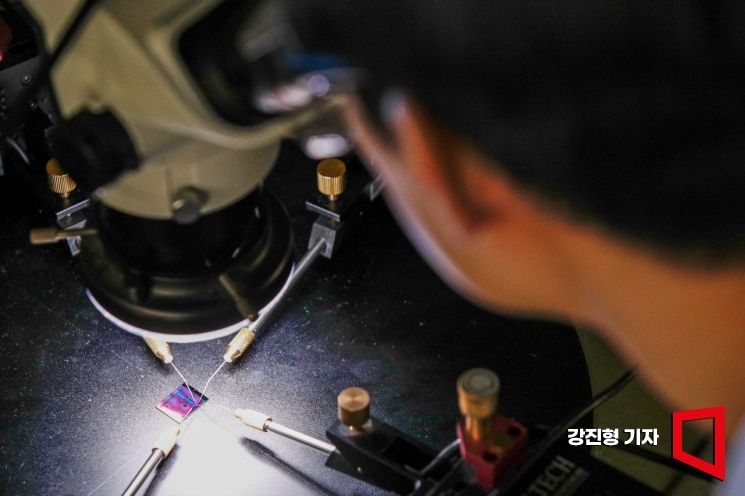 Next-generation ultra-low power magnetic memory device developed by the Korea Institute of Science and Technology (KIST). Unlike conventional silicon semiconductors, the next-generation ultra-low power spin memory device is a new concept semiconductor device that operates using very low ultra-low power by utilizing 'spin'. Photo by Jinhyung Kang aymsdream@
"K-Cloud is a content I personally proposed. We will apply domestically produced artificial intelligence (AI) semiconductors, which are in the early stages of commercialization, to data centers to secure references."
Lee Jong-ho, Minister of Science and ICT, stated this during a pre-briefing for the public livelihood discussion held at the Government Seoul Office on the 12th. The Ministry of Science and ICT is promoting the 'K-Cloud Project,' which utilizes low-power, high-performance AI semiconductors to revitalize the livelihood economy through the semiconductor industry. They plan to verify the technology and performance by applying AI semiconductors to data centers and push for commercialization.
Minister Lee said, "We are promoting the K-Cloud Project to develop and demonstrate low-power, high-performance domestic AI semiconductors by leveraging our memory semiconductor capabilities centered in Pangyo, where fabless companies are concentrated."
He added, "The energy consumption of components used in cloud systems is very high. As someone who has researched low-power semiconductors, I thought that if we create a cloud using low-power AI semiconductors effectively, it would be competitive." He also stated, "For carbon neutrality and responding to climate change, it is essential to convert AI semiconductors to low power," and noted that "the industry has shown great interest."
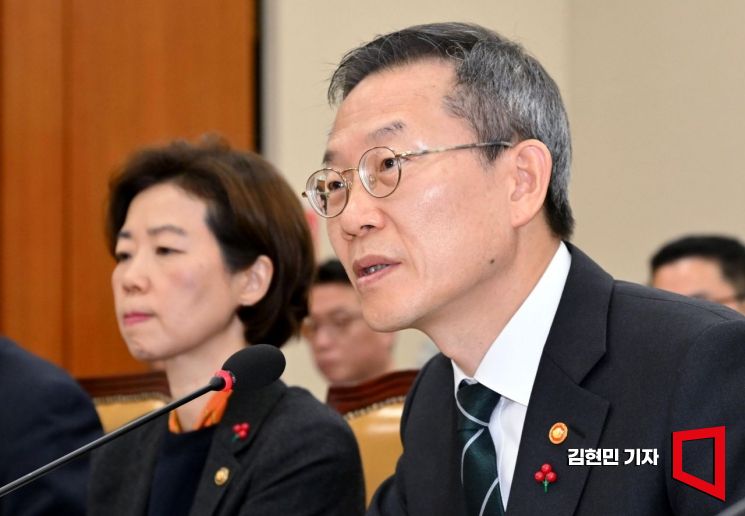
The Ministry of Science and ICT plans to gradually advance domestic AI semiconductors by 2030 and prioritize their application in areas closely related to citizens' lives, such as intelligent traffic control and AI digital textbooks, to improve quality of life.
An approximately 1 trillion KRW preliminary feasibility study for K-Cloud technology development is also underway. Through this feasibility study, the ministry aims to achieve a reduction in AI service power consumption to one-tenth compared to the world's top-level GPUs and double the efficiency of AI training.
Additionally, a 500 billion KRW investment will establish the KAIST Pyeongtaek Campus by 2029, building the KAIST Next-Generation Design Research Center and Device Research Center. This will be developed as a semiconductor research and development (R&D) hub linked with other technology research institutions. The KAIST Pyeongtaek Campus plans to train 1,000 core semiconductor talents annually and secure advanced technologies through international joint research with major domestic companies such as Samsung Electronics and SK Hynix, as well as leading overseas research institutions.
Alongside this, the ministry will connect and integrate national semiconductor research infrastructure scattered nationwide in Suwon, Daejeon, Pohang, and other locations online, and continuously improve infrastructure services through collaboration with private fabs.
© The Asia Business Daily(www.asiae.co.kr). All rights reserved.
![Clutching a Stolen Dior Bag, Saying "I Hate Being Poor but Real"... The Grotesque Con of a "Human Knockoff" [Slate]](https://cwcontent.asiae.co.kr/asiaresize/183/2026021902243444107_1771435474.jpg)












