Taiwan President-Elect Lai Ching-te 'Pro-US'
Cross-Strait Conflict Poses Potential Risk to Domestic Stock Market
TSMC Expected to Expand Influence... Positive for Korean Semiconductor Industry
With the election of Lai Ching-te, the Democratic Progressive Party (DPP) candidate, in the Taiwanese presidential election held on the 13th, attention is focused on the potential impact on the domestic stock market. Given that Lai Ching-te, who has a pro-American and pro-independence stance, won the election, there is concern that cross-strait (China and Taiwan) and US-China tensions could escalate, posing potential risk factors for the stock market.
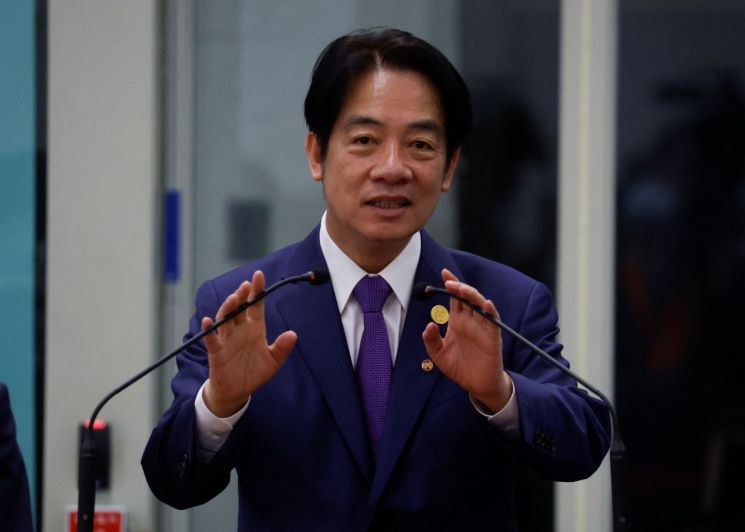 On the 13th, Lai Ching-te, the Democratic Progressive Party candidate who won the Taiwan presidential election
 According to the financial investment industry on the 15th, although there are concerns that the election results could worsen cross-strait relations and intensify US-China conflicts, the likelihood of radical changes occurring immediately is low, so the market impact is expected to be limited. Suhyun Park, a researcher at KB Securities, analyzed, "While the election of the pro-American DPP candidate Lai Ching-te has realized concerns about intensified US-China conflicts, the DPP failed to secure a majority of seats in the legislative election, which functions similarly to a parliament, making it difficult to implement unilateral pro-American and anti-China policies."
In this election, the DPP succeeded in securing a third consecutive term for the first time but only obtained 51 out of 113 seats in the legislature. The combined seats of the Kuomintang and the People First Party amount to 57, forming a minority government for the first time since 2000, which is expected to make the DPP's future governance challenging. Wonseok Choi, a researcher at Shinhan Investment Corp., said, "Although there are significant concerns about cross-strait relations due to the DPP's re-election, immediate radical changes are unlikely. Considering the historically low approval ratings and the minority government situation, provoking public sentiment through cross-strait issues early in the administration would not be beneficial. China may conduct warning military demonstrations or economic sanctions against Taiwan, but these would likely remain at the level of warning messages, with a very low possibility of escalating into armed conflict or war."
Considering Taiwan's minority government situation and the US elections in November, the possibility of intensified cross-strait conflicts is low, so the impact is expected to be limited. Seungmin Yoo, a researcher at Samsung Securities, also stated, "With the US presidential election in November approaching, both the US and China will focus on managing the situation, so the tension across the strait is unlikely to escalate into a serious crisis. In this regard, the impact of the Taiwanese election results on the Korean and global financial markets is limited."
While the easing of uncertainty is expected to have a positive effect on the stock market, the ongoing potential risks remain a burden. Junki Cho, a researcher at SK Securities, analyzed, "The Taiwanese election results are somewhat satisfactory to the US but unsatisfactory to China, which raises concerns about the expansion of geopolitical risks. However, from the perspective of uncertainty removal, it is a positive factor for the stock market." Dongyeon Lee, a researcher at Korea Investment & Securities, pointed out, "Although the DPP victory scenario has been partially reflected in the stock market, it should be noted that the risk factor of escalating cross-strait tensions may periodically emerge until Lai Ching-te assumes office in May."
Positive effects are expected in the semiconductor sector. Eunbi Baek, a researcher at Eugene Investment & Securities, said, "From a long-term perspective, domestic semiconductor companies can expect benefits from this Taiwanese election regardless of which party wins. Currently, the US semiconductor supply chain is highly dependent on Taiwan, and efforts are underway to diversify supply and production locations. Therefore, it is time to increase interest not only in Korean chip manufacturers but also in related materials, parts, and equipment (MPE) companies." Researcher Suhyun Park added, "The DPP is expected to support policies that favor expanding production bases within Taiwan rather than relocating TSMC's production facilities abroad, thereby enhancing economic influence. While TSMC plays a dominant role in producing high-end semiconductor chips, if government policies delay or passively change the US-requested diversification schedule of production locations, cooperation with Korean semiconductor companies could be strengthened."
© The Asia Business Daily(www.asiae.co.kr). All rights reserved.

















