Casualties Related to Cold Weather Continue
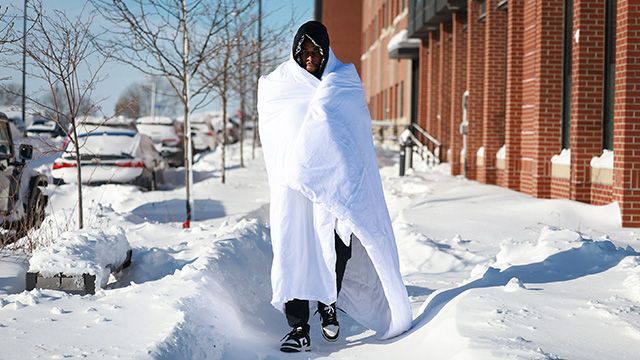
A polar cold wave has swept across the United States, causing a series of casualties related to the cold and widespread damage.
On the 14th (local time), the U.S. National Weather Service (NWS) reported that Arctic high pressure descending from the Canadian Prairies brought a cold wave from the Northwestern to the Mid-Eastern U.S., resulting in several days of severe cold. The NWS stated that a total of 95 million people nationwide were under cold wave warnings, advisories, or watches as of midnight that day. Cold wave warnings and advisories are issued when the wind chill temperature drops below minus 17 degrees Celsius (0 degrees Fahrenheit). Particularly, Montana, North Dakota, and South Dakota are expected to experience harsh cold with wind chill temperatures dropping to minus 56 degrees Celsius (minus 69 degrees Fahrenheit) due to strong winds.
The NWS said, "Unfortunately, the intensified cold air is pushing the cold front southward, and this dangerous cold is expected to continue for the next several days." CNN reported that more than 75% of the U.S. population is expected to experience below-freezing temperatures over the next seven days.
The Associated Press reported that three people died due to the cold in Oregon. In Portland, Oregon, a fire broke out when a tree fell on a vehicle while people were gathered inside a camper van warming themselves by a fire. Several people escaped outside the vehicle, but a woman in her early 30s was reported to have been trapped inside and died.
Additionally, in the Lake Oswego area of Oregon, a large tree fell due to strong winds and crushed a house, killing an elderly person who was on the second floor. Oregon typically experiences rain in winter, and severe cold and heavy snow are unusual, which contributed to the greater damage this time, according to the AP. Authorities in Buffalo, New York, warned residents not to drive on roads as 1 to 2 feet (30 to 60 cm) of snowfall was forecasted.
The surge in heating demand due to the severe cold is also threatening the power grid. According to PowerOutage.com, a site tracking power outages in the U.S., currently over 280,000 households (including commercial facilities) nationwide are without electricity. By region, approximately 16,000 households in Oregon, 47,000 in Pennsylvania, 42,000 in Michigan, 30,000 in Wisconsin, and 10,000 in New York are affected.
Meanwhile, South Korea is also experiencing severe cold. On the morning of the 15th, the lowest temperatures are expected to range from minus 13 degrees Celsius to 0 degrees, and daytime highs from 0 to 9 degrees Celsius. Strong winds are already blowing, which may lower the perceived temperature further. On Tuesday, the 16th, morning temperatures in Daegu and the Gyeongbuk region are forecasted to drop further to between minus 12 and minus 3 degrees Celsius. However, temperatures are expected to return to normal levels from the afternoon onward.
© The Asia Business Daily(www.asiae.co.kr). All rights reserved.

















