President Yoon Holds 'Semiconductor Livelihood Forum'
Pangyo as 'AI' Hub and Suwon as 'Compound Semiconductor' Base
16 Manufacturing Facilities to Be Built by 2047
Economic Impact Expected at 650 Trillion Won with 3.46 Million Jobs
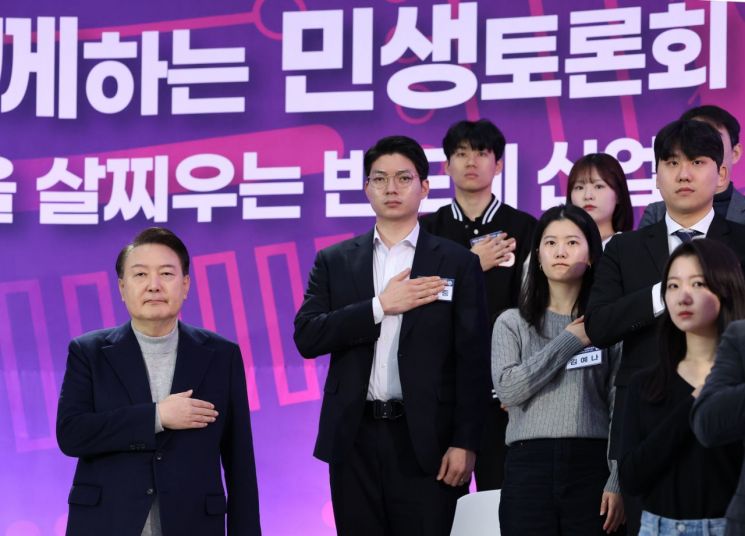 President Yoon Suk-yeol salutes the national flag at the 'Third Public Discussion on Livelihoods - Semiconductor Industry Enriching Livelihoods' held on the 15th at the Semiconductor Hall of the Natural Science Campus, Sungkyunkwan University, Jangan-gu, Suwon-si, Gyeonggi-do. January 15, 2024. Photo by Yonhap News.
The government and private sector will establish the world's largest and most advanced semiconductor cluster in the southern Gyeonggi region, including Pangyo, Suwon, Yongin, Icheon, Anseong, Pyeongtaek, and Hwaseong. To this end, Samsung Electronics and SK Hynix have agreed to invest a total of 622 trillion won by 2047 to build 16 new fabs (semiconductor manufacturing facilities).
On the 15th, President Yoon Suk-yeol stated at the third "Public Livelihood Forum" held at Sungkyunkwan University in Suwon, Gyeonggi Province, themed "Semiconductor Industry Enriching People's Livelihood," that "a total of 622 trillion won will be invested in the semiconductor mega cluster," and "3 million high-quality jobs will be newly created over the next 20 years." President Yoon emphasized, "The semiconductor industry enriches people's livelihoods and creates quality jobs more than any other industry." About 110 participants, including local residents, semiconductor industry representatives, students, and young researchers, gathered at the forum.
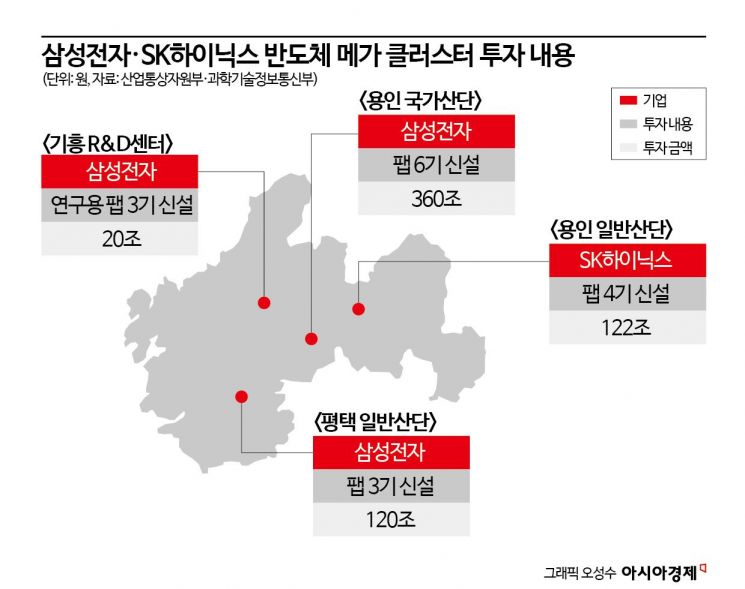
The semiconductor mega cluster refers to the area in southern Gyeonggi where semiconductor companies and related institutions are concentrated. Currently, there are 19 production fabs and 2 research fabs located there. The private sector plans to invest a total of 622 trillion won by 2047 to build 16 new fabs (13 production fabs and 3 research fabs).
Of this, Samsung Electronics alone will invest 500 trillion won. Samsung Electronics will build 6 fabs in the Yongin National Industrial Complex (300 trillion won), 3 fabs in the Pyeongtaek General Industrial Complex (120 trillion won), and 3 research fabs at the Giheung R&D Center (20 trillion won). SK Hynix plans to invest 122 trillion won to construct 4 new fabs in the Yongin General Industrial Complex.
The semiconductor mega cluster is expected to become the world's largest semiconductor complex, covering an area of 21.02 million square meters and producing 7.7 million wafers per month by 2030. It will produce world-class semiconductors such as High Bandwidth Memory (HBM) and system semiconductors under 2 nm.
The government expects a production inducement effect of 650 trillion won and the creation of 3.46 million direct and indirect jobs through this initiative. This year, the government anticipates semiconductor exports of 120 billion dollars and private investment exceeding 60 trillion won.
President Yoon said, "When semiconductor factories are established, an ecosystem including design, post-processing companies, and R&D facilities is formed, leading to infrastructure construction related to electricity and water, and joint investments by partner companies," adding, "Ultimately, millions of jobs are created, revitalizing local commercial districts and establishing a tightly connected supply chain."
"Achieving 10% System Semiconductor Market Share by 2030"
The government is pursuing the creation of the semiconductor mega cluster because major competing countries are mobilizing all possible means, such as large-scale subsidies and tax credits, to build clusters to secure semiconductor leadership. In the semiconductor industry, where competitiveness can only be demonstrated when manufacturing bases, partner companies, and talent are gathered together, cluster formation is essential.
Japan is developing Kumamoto Prefecture as a semiconductor industry reconstruction cluster. Taiwan has launched the "Greater Silicon Valley" project by linking the TSMC Hsinchu Science Park and its surroundings. The United States is promoting nationwide clustering through the CHIPS and Science Act (CSA), providing subsidies of 39 billion dollars.
The government plans to focus on four key tasks for the mega cluster: infrastructure and investment environment, ecosystem, super-gap technology, and talent.
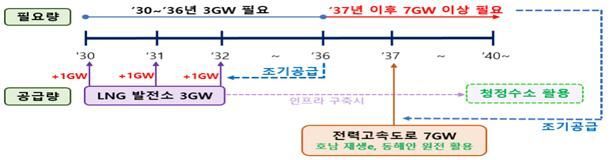
First, to supply electricity and water promptly to the newly developing Yongin National and General Industrial Complexes, the government will provide full support in cooperation with local governments. It will actively utilize the permit timeout system introduced in July last year and plans to shorten the construction period of transmission lines by more than 30% through the enactment of a special law for expanding the national power grid.
This year, the government plans to double the semiconductor budget from 2022 to 1.3 trillion won to foster an investment environment. It will also introduce an advanced industry regulation index and launch killer regulation reforms through the National Advanced Strategic Industry Committee chaired by the Prime Minister.
The government will also push forward with the construction of a testbed to support mass production verification, a long-awaited project for the materials, parts, and equipment industry, aiming for completion by 2027. After a preliminary feasibility study, the project will be built within the Yongin cluster with a total budget of 900 billion won. Additionally, it plans to attract R&D centers of global top 10 equipment companies by utilizing 200 billion won in foreign investment incentives (cash support) this year.
The government aims to expand the system semiconductor market share from the current 3% to 10% by 2030 and nurture 10 fabless (semiconductor design specialized) companies among the global top 50 in sales (currently 1). To this end, it will establish technology exchange meetings between demand companies and fabless companies to support networking activities for securing orders and build a new verification support center to validate chip performance developed by fabless companies.
Support for fabless prototype production costs will be doubled, a new national funding track for ultra-fine process support for advanced chip development will be introduced, and the number of prototype production openings by major foundry companies will be expanded. Policy finance offering preferential loans and guarantees will be increased from 6.6 trillion won last year to a total of 24 trillion won over the next three years (2024-2026).
Cooperation with global semiconductor alliances such as the United States, Japan, the European Union (EU), the United Kingdom, and the Netherlands will also be strengthened. Regarding the approximately 1 trillion won joint R&D center between Samsung Electronics and ASML announced during the state visit to the Netherlands last December, the government pledged active support to expedite site selection and related processes.
Pangyo as AI Hub, Suwon as Compound Semiconductor Base
Pangyo, Suwon, and Pyeongtaek will be developed as R&D and education hubs tailored to regional characteristics.
Centered on Pangyo, where fabless companies are concentrated, the government will promote the "K-Cloud Project" to develop and demonstrate world-class low-power, high-performance domestic AI semiconductors by 2030. The Ministry of Science and ICT plans to gradually advance domestic AI semiconductors by 2030 and apply them to data centers to verify AI semiconductor technology and performance. Furthermore, a preliminary feasibility study for the approximately 1 trillion won "K-Cloud" technology development project is underway to secure cloud data center technology specialized for advanced domestic AI semiconductors.
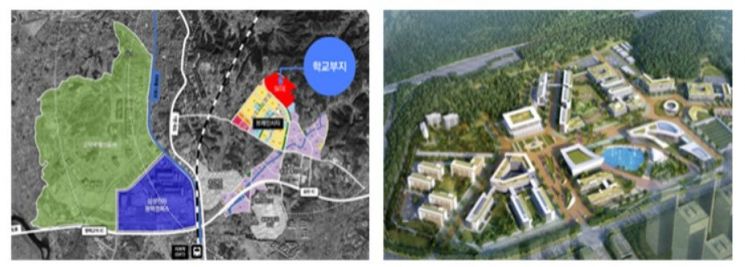
Suwon, home to semiconductor-related universities such as Sungkyunkwan University, Kyung Hee University, Ajou University, and the Korea Nano Technology Institute, will be developed as a compound semiconductor technology hub. Compound semiconductors, which have better power efficiency and durability than silicon semiconductors, are in growing demand in advanced technology fields requiring high temperature, high current, and ultra-high speed. The "R&D Science Park" to be established near Sungkyunkwan University is expected to serve as a focal point for semiconductor industry-academia-research cooperation as Gyeonggi Province's Silicon Valley.
In Pyeongtaek, a total of 500 billion won will be invested to establish the KAIST Pyeongtaek Campus by 2029, along with the KAIST Next-Generation Design Research Center and Device Research Center. The KAIST Pyeongtaek Campus will train about 1,000 core semiconductor talents annually and secure advanced technologies through international joint research with domestic companies such as Samsung Electronics and SK Hynix, as well as major overseas research institutions.
Training 30,000 Semiconductor Practical Personnel
The government plans to train about 30,000 bachelor's-level practical talents this year through semiconductor contract departments and quotas, specialized semiconductor universities, and semiconductor academies. It will also expand R&D-based talent development programs such as AI semiconductor graduate schools, specialized semiconductor graduate schools, and BK21 education and research groups to produce about 3,700 master's and doctoral-level advanced talents.
Additionally, the government will promote institutional improvements such as extending the Science Card visa period (currently 1 year → up to 10 years) and one-stop support for foreign residents to encourage the inflow of overseas researchers. It will also expand personnel exchanges by increasing the dispatch of domestic researchers to overseas research institutions to 2,060 by 2027.
Lee Jong-ho, Minister of Science and ICT, said, "Semiconductors are core technologies applied to AI, digital, communications, quantum, and bio fields and the backbone of our economy," adding, "We will establish a foundation to decisively lead in the global semiconductor competition by securing super-gap technologies and excellent professional talent."
Ahn Duk-geun, Minister of Trade, Industry and Energy, said, "With the recovery of the semiconductor industry, the top export sector, we will strive for 120 billion dollars in exports this year," and "We plan to expand the mega cluster success model nationwide and foster advanced industrial clusters, including semiconductors, into the world's top industrial hubs."
© The Asia Business Daily(www.asiae.co.kr). All rights reserved.



















