Jajangmyeon Bowl 7,000 Won, Up 35% in 3 Years
Kimbap, Naengmyeon, Kalguksu Up Around 20%
Delivery Fee Increase Also Raises Dining Out Costs
It is becoming increasingly difficult to have a meal for 10,000 won. With the rising costs of various ingredients as well as labor and rent expenses, dining out expenses last year increased at more than twice the rate of consumer price inflation.
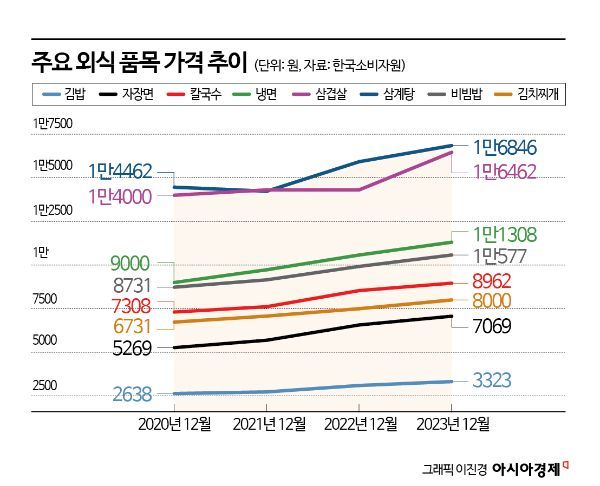
According to the Korea Consumer Agency's comprehensive price information portal, Chamgyeok, the average price of one serving of Jajangmyeon in Seoul in December last year was 7,069 won, up 7.6% (500 won) from 6,569 won a year earlier. This figure is more than double the consumer price inflation rate of 3.2% in December last year.
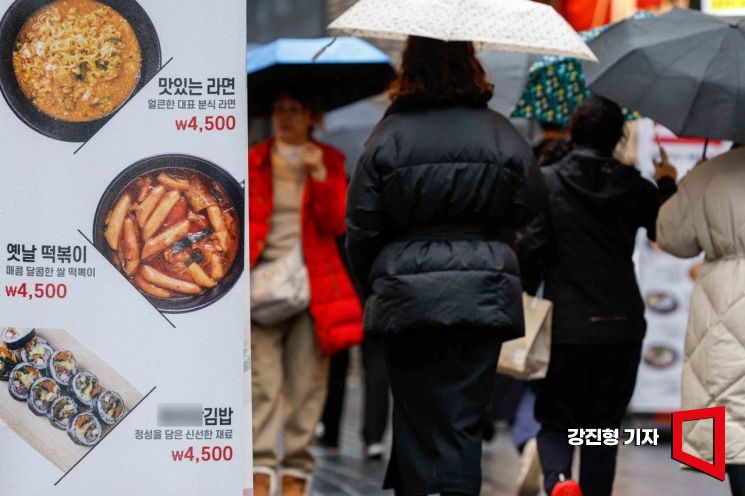
Other menu items also showed a uniform upward trend. Gimbap, which was 3,100 won in December 2022, rose 7.2% to 3,323 won in one year, and Naengmyeon, which was 10,577 won, increased 6.9% to 11,308 won. In addition, Kimchi Jjigae rose 6.7% from 7,500 won to 8,000 won, and Bibimbap, which was 9,923 won, increased 6.6% to 10,577 won, surpassing 10,000 won. All surveyed menu items showed an increase rate exceeding the consumer price inflation rate.
The steep rise in dining out expenses is even more pronounced compared to the end of 2020. A bowl of Jajangmyeon, which was 5,269 won in December 2020, rose 34.2% (1,800 won) in three years, and the price of one roll of Gimbap, which was 2,638 won, increased 26.0% (685 won) to 3,323 won. Other items such as Naengmyeon (25.6%), Kalguksu (22.6%), Bibimbap (21.1%), Kimchi Jjigae (18.9%), Samgyeopsal (17.6%), and Samgyetang (16.5%) showed increases around 20% over three years.
As dining out prices soared, the dining industry business condition index recorded a continuous decline throughout last year. According to Statistics Korea, the dining industry index fell from 86.91 in the first quarter to 83.26 in the second quarter and 79.42 in the third quarter last year. Among industries, the pub sector recorded the lowest index at 74.75 in the third quarter. This index indicates growth when exceeding the baseline of 100 and contraction when below 100.
Delivery fees for dining out also rose significantly. Statistics Korea recently released delivery fee survey results for the first time, showing that delivery fees increased 4.3% year-on-year as of last month, 0.4 percentage points higher than the 3.9% increase in November, reflecting the recent upward trend in delivery fees. By amount, 3,000 won was the most common delivery fee at 32.1%, and the 3,000 won range, including 3,000 won itself, accounted for 47.3%. The 2,000 won range accounted for 30.9%, followed by the 4,000 won range at 11.3%.
Meanwhile, as the burden of dining out increases, consumption is shifting to the Home Meal Replacement (HMR) market, where meals can be prepared relatively cheaply. In particular, the frozen soup, stew, and jjigae market, which applies rapid freezing technology that minimizes ingredient damage and offers better taste and flavor than conventional retort soup dishes, saw retail sales grow from 15.1 billion won in 2020 to 26.2 billion won in 2022. As of November last year, sales reached 28.5 billion won, a 25.2% increase compared to the same period the previous year, already surpassing the total sales volume of the previous year.
© The Asia Business Daily(www.asiae.co.kr). All rights reserved.
![Clutching a Stolen Dior Bag, Saying "I Hate Being Poor but Real"... The Grotesque Con of a "Human Knockoff" [Slate]](https://cwcontent.asiae.co.kr/asiaresize/183/2026021902243444107_1771435474.jpg)











