Basic Fare Increased by 150 Won from July
Survey of 1,000 Men and Women in Seoul and Metropolitan Area
Over 83% Feel Burdened by Transportation Costs
Introduction of Unlimited and Partial Refund Cards Called "Absurd"
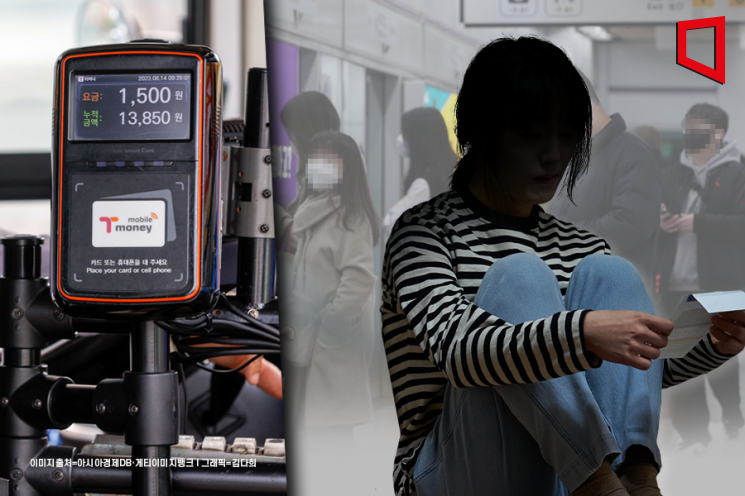
Following last year, an additional fare increase for the Seoul subway is scheduled for the second half of this year, causing growing sighs among the public. With high inflation thinning the wallets of university students and office workers, the burden of essential fixed costs is also increasing. While raising public transportation fares, there is criticism over policies introducing unlimited rides and partial refund cards.
Increased Living Expenses Burden... "Individual Efforts Alone Are Insufficient"
On the afternoon of the 14th in Gwangjin-gu, Seoul, university student Park (22) sighed over the subway fare hike news, saying, “It went up last year, and now it’s going up again?” and “No matter how much I try to save, there is a limit to transportation costs.” Office worker Jo (30) said, “I understand that the main cause of the subway deficit is free rides for the elderly. The age limit should be raised,” adding, “I wish someone would step up and solve the transportation fare issue.”
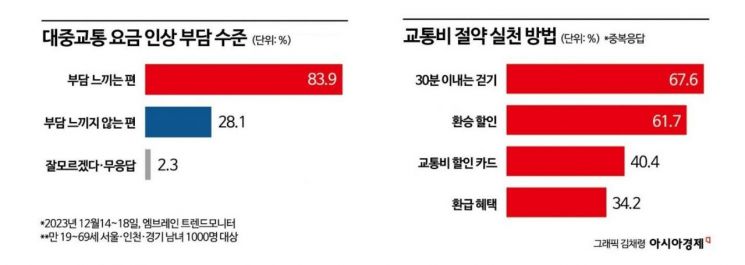
A significant portion of the public already feels the burden of transportation costs. According to a survey conducted by market research firm Embrain Trend Monitor from the 14th to 18th of last month targeting 1,000 men and women aged 19 to 69 living in Seoul, Incheon, and Gyeonggi, 83.9% of respondents said they “somewhat feel the burden of transportation costs.” In particular, people in their 20s (80.5%) and commuters or students traveling between Seoul and Incheon or Seoul and Gyeonggi (76.5%) were found to feel the burden more acutely. Although the cost per ride is only a few hundred won, the economic burden is significant when considered monthly.
Many efforts have been made to reduce transportation costs as much as possible, but limits remain clear. 86% of respondents expressed a desire to save on transportation costs as much as possible, and 64.4% said they are practicing ways to save on transportation expenses. Specifically, walking within 30 minutes (67.6%, multiple responses allowed), transfer discounts (61.7%), transportation discount cards (40.4%), and refund benefits (34.2%) were the most common methods. However, since they use public transportation daily, the overwhelming majority felt it is difficult to reduce costs through individual efforts alone.
Raising Fares While Offering Partial Refunds? "Hard to Understand"
Public transportation fares continue to rise. Seoul City raised the basic subway fare by 150 won last October and plans to raise it by another 150 won this July. Bus fares were increased in August last year. The increase was 300 won for main and branch buses, circular and differential buses, and village buses; 700 won for express buses; and 350 won for late-night buses.
The government is preparing to introduce the 'K-Pass,' a public transportation refund system, in May. The K-Pass will refund a portion of the fare proportionally based on the number of rides or amount spent to those who regularly use the subway or buses 15 times or more per month. The general public can receive 20% of their expenses back, youth 30%, and low-income groups 53% the following month. The budget for refunds will be jointly borne by the national and local governments. Seoul City will launch a pilot project for the ‘Climate Companion Card’ from the 27th, allowing unlimited use of public transportation for 30 days. There are 62,000 won cards for Seoul subway and buses and 65,000 won cards including the public bike system, Ddareungi.
Nine out of ten people expressed willingness to use transportation support policies, but six of them viewed these policies as unsustainable. Respondents prioritized fare reductions (66.9%) and fare freezes (58.2%). There are calls for effective measures rather than showy policies ahead of elections. Office worker Kim (32) said, “The government’s policy seems strange,” adding, “Wouldn’t it be better to provide financial support and avoid fare increases altogether?”
© The Asia Business Daily(www.asiae.co.kr). All rights reserved.



















