Official Launch of GPT Store on the 10th
Paid Users Paying $20 per Month
Anyone Can Distribute AI Chatbots
Domestic AI Startups on Edge
Era of Unlimited Competition with the Public
OpenAI has announced a seismic shift in the AI ecosystem by launching the ‘GPT Store,’ where anyone can buy and sell AI chatbots. While this move is seen as accelerating the era of AI popularization, domestic AI startups that have been offering various services using ChatGPT are feeling tense.
According to OpenAI on the 11th (local time), since the official launch of the GPT Store on the 10th, the number of registered customized chatbots has already exceeded 3 million. The GPT Store is a platform that distributes chatbot services based on OpenAI’s large language model (LLM), and any ChatGPT paid subscriber who pays $20 per month (about 26,000 KRW) can participate. The fact that customized GPTs are now possible shows that countless application apps can enter the market.
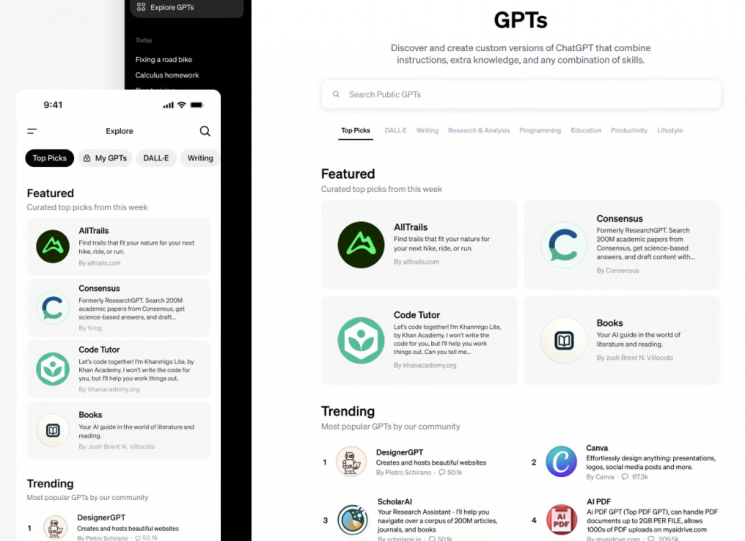
Last November, OpenAI released ‘GPTs,’ which allow users to create customized chatbots without separate coding. With the addition of a distribution platform following the development tools, not only developers but also the general public can now create, sell, and purchase AI chatbots.
The domestic AI industry has expressed concerns. Many domestic AI startups have launched AI services based on OpenAI’s LLM or ChatGPT. Last year, related services poured out like a flood, such as MyRealTrip, which offers an AI travel planner service using ChatGPT, and Chain Partners, which provides a workplace-specialized AI assistant service using the GPT-4 model. The era has come where these startups must compete endlessly not only with global companies but also with individuals. It is also analyzed that startups operating platforms similar to the GPT Store will be affected. Examples include Lytton Technology, which operates the ‘Lytton Store,’ and Allganize, which opened the ‘Alli LLM App Market.’ An industry insider said, "Since individuals can create most services with effort, startups providing GPT-based services will face a difficult path."
On the other hand, there are voices expecting the expansion of the AI ecosystem. With a global distribution network opened, there is a prospect of achieving great success with a ‘killer app.’ Just as unicorn companies (startups valued at over 1 trillion KRW) poured out after the Apple App Store and Google Play Store opened for mobile app distribution, success stories may emerge in the AI field as well. Domestic companies are moving quickly. Software company Polaris Office registered a ‘guide chatbot’ for its office users on the GPT Store. Shin Ki-bin, Chief AI Officer (CAIO) of Allganize, said, "If last year was the year of LLM, this year will be the year of apps based on it," adding, "At first, cases of fun usage will start, but a killer app could emerge within a few years."
However, cost remains a challenge to overcome. Although the barrier to developing AI chatbots has lowered, running them still requires significant expenses. An IT industry insider analyzed, "For the GPT Store itself to succeed, there must be many free apps, but GPT incurs a cost of at least several tens of won per query," adding, "Since free services are structurally impossible from the start, how to overcome this is the key."
© The Asia Business Daily(www.asiae.co.kr). All rights reserved.

















